


By Jon Chown
Before Baywatch turned California lifeguards into pop culture icons running in slow motion down the beach, Aptos resident Debbie Friedman was already on the job — pulling swimmers from dangerous surf, responding to car crashes and breaking barriers as one of California’s first female ocean lifeguards.
Now the 66-year-old Debbie Friedman is telling those stories in her new memoir, Guarded: Women, Water, and Saving Lives, which follows the first generation of women who entered the male-dominated world of California ocean lifeguarding in the late 1970s.
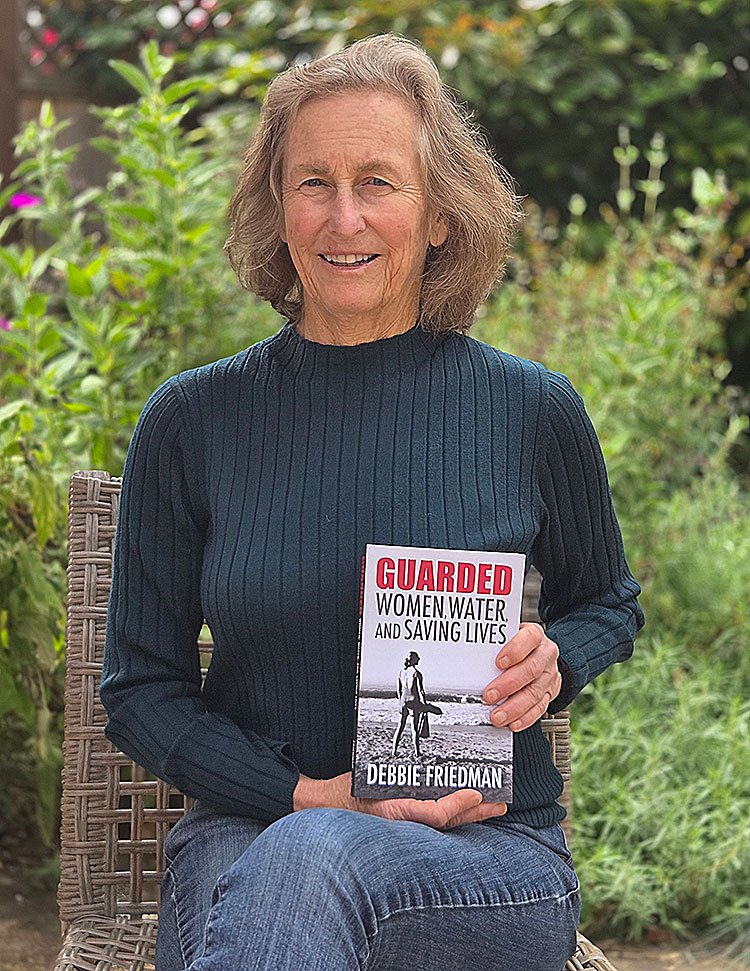
Debbie Friedman holds a copy of her book.
“Nothing had been written about that generation,” Friedman said. “And that’s a big part of why I wrote it.”
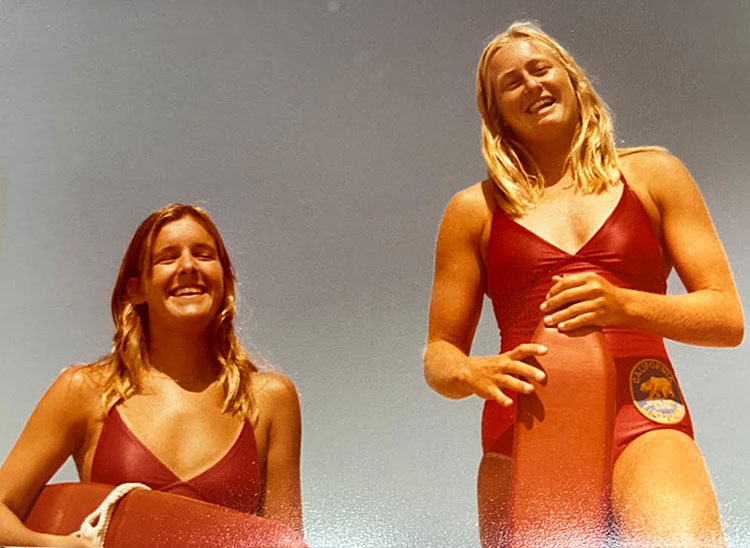
Friedman began lifeguarding in 1978 at Huntington and San Clemente state beaches. She said she was the only woman standing on the starting line during her first tryout.
“Baywatch is still relevant today. That’s the public touchstone, it’s what people think of when you mention lifeguarding,” she said. “People look for lifeguards now.”
But Friedman said the real experience was far different from the television version.
“Think about yourself in the late teens and 20s, and charged with life and death responsibilities, and your coming of age,” she said. “I write a lot about the fear that nobody loses their life.”
She said the work created lifelong friendships and shaped who she became.
“These people are your tribe,” Friedman said. “It just helped balance who I became, the woman I wanted to become.”
Friedman worked as an ocean lifeguard for 12 years before moving to Santa Cruz County in 1989. She now lives in Aptos and said she still walks the beaches below her home and watches the ocean.
In the book, Friedman mixes her own memories with stories from other early women lifeguards across California, including pioneering surfer and lifeguard Joyce Hoffman.
“Different women up and down the coast of California, we experienced different cultures, different beaches with different conditions,” she said. “It wasn’t all the same story.”
But in general, Friedman said conditions on the beach in the late 1970s and 1980s were rougher and more dangerous than they are today.
“There were no jet skis, the paddle boards were heavy,” she said. “Alcohol was allowed on the beach. We dealt with drunks a lot and spent a lot of time dealing with chaos and violence on the beach.”
She also remembered the poor working conditions women faced.
“I talk about how horrible our swimsuits were … and the bathroom,” Friedman said. “There was just great concern over where everyone was going to the bathroom.”
She said many beaches did not provide women with equal access to restrooms or changing facilities.
“The bathroom thing was really about otherizing women,” she said. “Women didn’t have access to the same facilities.”
Friedman said sexism also came from the public, especially while working at San Clemente’s military beach.
“A lot of Marines didn’t know how to swim and didn’t want to be rescued by a woman,” she said. “These big guys did not want to be rescued by a woman.”
Still, she said emergencies usually erased those attitudes, but at times she had to shout at them like drill sergeant.
“When a person is in real trouble, they are not going to care who you are,” she said.
Friedman said the job is centered on prevention more than dramatic rescues.
“The idea is always stressed upon to be as preventative as possible,” she said. “You get people out of the water before they even know they are in trouble.”
Over her career, she estimated she saves at least a couple hundred lives while making hundreds of rescues.
“The scariest ones are the ones that have already escalated,” she said.
She also recalled responding to serious traffic crashes along Pacific Coast Highway before paramedics arrived, discovering grisly scenes that she still can’t erase from memory.
“That was a big part of it, unfortunately,” Friedman said.
The book project began about three years ago after Friedman realized there were few written accounts from the first generation of women lifeguards.
“At first I thought I was writing a history,” she said. “Then I started writing about myself.”
She said looking through old photographs and interviewing former lifeguards brought back memories she thought were gone.
“I thought my memory was poor,” Friedman said. “But things came back the longer I worked on it.”
The book also explores the impact of Title IX, the federal law that expanded opportunities for women in sports and education.
“Fewer women remember what it was like not having sports programs,” Friedman said. “It was a time when women were being introduced into a lot of new professions.”
She said writing the memoir helped her reflect on those years with more perspective.
“You are able to see things with more humor and perspective, and look back without anger and malice,” Friedman said. “It was not all obstacles. It was just a time of great unknowns and fears.”
Friedman recently held a book event at the La Selva Community Center that drew about 100 people, including old friends and former coworkers.
“Santa Cruz County loves its lifeguards,” she said. “It’s been an incredible experience to feel that.”
•••
The book is also available locally through Two Birds Books and Bookshop Santa Cruz, and online at www.towerpress.com. Friedman is scheduled to speak about the book July 12 at the Live Oak Library Annex in Santa Cruz County. Register at: santacruzpl.libnet.info/event/
TOP IMAGE: Kim Raymont and Debbie Friedman at San Clemente Beach in 1978. • Photo courtesy Ed Vodrazka