


By Rebecca Gold Rubin, Public Outreach Coordinator, Soquel Creek Water District
The backpacks are packed, pencils are sharpened, and students are back in class. But kids aren’t the only ones getting a pop quiz this month!
No studying required. No grades will be recorded. And yes, you can peek at the answers.
Pencils ready? Let’s see how water-wise you are!
Question #1: True or False?
An aquifer is basically a giant underground lake.
Answer: False!
It’s easy to picture groundwater flowing around in huge underground lakes, but that’s not quite how it works.
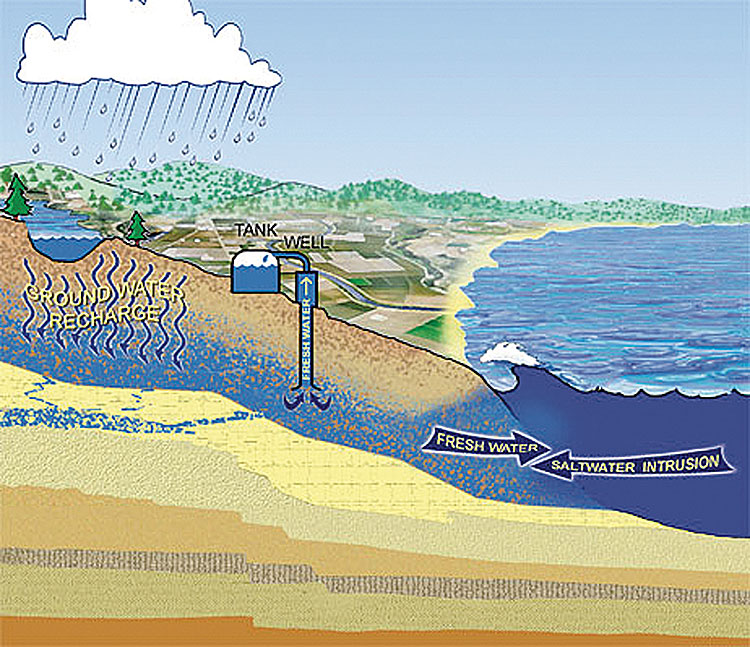
An aquifer is made up of layers of sand, gravel, rock and other geologic materials. Groundwater fills the tiny spaces between those materials—somewhat like water soaking into a sponge.
Why does that matter to us? Because those aquifers are where our drinking water comes from.
Question #2
Where does Soquel Creek Water District get its drinking water?
- The Sierra Nevada
- Loch Lomond Reservoir
- A river
- Groundwater beneath our community
Answer: 4 — Groundwater!
Unlike many California communities that depend on reservoirs or imported water, our community has historically only relied on groundwater.
That makes protecting our groundwater basin one of the District’s biggest responsibilities. We monitor groundwater levels and water quality and work to protect the basin from seawater intrusion. It’s also why the District invested in Pure Water Soquel, which provides a new source of purified water to replenish the groundwater basin.
Bonus point if you already knew that one!
Question #3: True or False?
Once groundwater is pumped out of a well, it goes straight to your faucet.
Answer: False!
Getting water out of the ground is only the beginning.
Depending on the source, water may go through treatment before entering the distribution system. The District also continuously monitors and tests drinking water to make sure it meets stringent state and federal standards.
Then there’s the journey to you. Pumps, pipelines, valves, storage tanks, meters and other equipment all work together to move water through the community and ultimately to your faucet.
Most of that infrastructure is underground or out of sight—which means you probably don’t think about it very often.
And that’s exactly how we like it.
Question #4
Why are water storage tanks often located on hills?
- The view is better
- Land is cheaper
- Gravity helps create water pressure
- They’re closer to the clouds
Answer: 3— Gravity!
Those tanks aren’t sitting up there for the scenery.
Elevation allows gravity to help provide pressure in the water distribution system. Storage tanks also help ensure water is available when demand is high and provide an important reserve for emergencies and firefighting.
Sometimes one of the simplest forces in nature is also one of our most useful water-system tools.
Question #5
Which of these might a Water District employee do during a typical workday?
- Test drinking water
- Repair a broken water main
- Map underground pipes
- Monitor groundwater conditions
- Help a customer understand their water bill
- Plan a pipeline that won’t be built for several years
- All of the above
Answer: 7 — All of the above!
It takes a surprisingly diverse group of people and professions to operate a water district.
Operators, field crews, water-quality professionals, engineers, GIS staff, customer service representatives, conservation specialists, finance staff, administrative staff and many others work behind the scenes every day.
Some of our work is easy to spot—especially when there’s a crew and an excavator in the middle of your street.
But much of the work that keeps your water system running happens quietly every day without customers ever seeing it.
Question #6: True or False?
One really rainy winter means our groundwater problems are solved.
Answer: False.
We certainly appreciate a good rainy winter, but groundwater doesn’t operate on a one-year report card.
Groundwater conditions reflect what happens over many years. How much water is pumped, how much recharge occurs, where groundwater levels are located and how seawater moves along our coastline all matter.
That’s why managing groundwater requires long-term thinking. The decisions we make today can affect our water supply years—and even decades—from now.
Question #7
Who owns Soquel Creek Water District?
- A private water company
- Santa Cruz County
- The State of California
- The community we serve
Answer: 4 — You do!
Soquel Creek Water District is a special district, a form of local government created to provide a specific public service.
The District is governed by a locally elected Board of Directors. Board members are District customers themselves and are elected by fellow customers who live within the District’s service area.
This means the people making important decisions about our water system are also members of the community they serve. Board meetings are open to the public, and decisions about budgets, policies, infrastructure investments, and other important District business are made through a transparent public process.
So when we call it your water district, we mean it.
FINAL EXAM
Okay, this is the big one!
Which of the following is part of the Water District’s job?
- Delivering safe, reliable drinking water today
- Maintaining and replacing water infrastructure
- Monitoring and protecting groundwater resources
- Planning for future water supplies
- Preparing for emergencies
- All of the above
You probably know where we’re going with this by now.
The answer is 6 — All of the above!
So, how did you do?
If you aced the quiz, congratulations—you may officially be smarter than a fifth grader when it comes to your local water system.
And if you missed a few, that’s okay too. Hopefully you earned a little extra Water Wisdom along the way.
Because if there’s one lesson we’d like everyone to remember, it’s this:
Delivering safe, reliable water today is only half our assignment. Making sure it’s here for generations to come is the other half.
Now you can put your pencil down.
Class dismissed!