


By Joe Ortiz
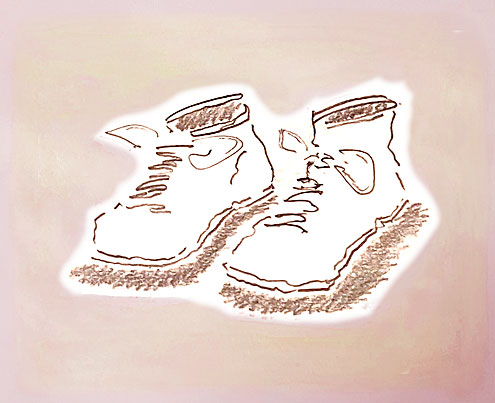
“For Sale, Baby Shoes, Never Worn.” — Ernest Hemingway
According to Ernest Hemingway, the above six words is the shortest example of a story imaginable. It exemplifies a barebones model of the three-act structure, defined by Aristotle more than two-thousand years ago.
Aristotle stated in his Poetics that a play should imitate a single whole action comprised of a beginning, middle, and end. And this iconic and archetypal story structure still holds true today.

Joe Ortiz
For some primal reason this simplification of structure appeals to our innate sense of dramatic development: The beginning sets up a problem, question or quest; the middle develops the action and often heightens the conflict by posing roadblocks, which must be overcome; and the end represents the climax and the obligatory resolution.
Whether it be in a movie, a short story or a novel, most writers would agree that the beginning and end are relatively short compared to the middle, which—as the crux of the story’s development—often commands a larger portion of the action.
By thinking in three-stages of development we not only work inside a form which innately resonates with audiences, but it also provides certain guardrails for composition.
Remember, three-act structure is simply an armature on which to build a narrative. The series of events that the writer attaches onto the structure is the fleshing out. If God and Aristotle reside in the mechanical structure, the Devil is in the details. And thus, the patina is where the creator of the work can express the art and emotion.
But what about Shakespeare’s five-act structure or the two-act structure of many plays and musicals? Smart writers know that placing an “inciting incident” somewhere near the beginning of their story helps to launch the audience into Act Two’s demand for developing the story’s ever-escalating conflict.
So, the concept of Beginning, Middle, and End can often appear right on top of any other story-act structure. Even on an important email or business letter.
What We Can Do
The next time you compose an important email, consider placing your “ask,” request, or significant information at the end of Act Two. And allow your final paragraph (act-three) to be the most well-crafted statement that will most effectively yield the response you’re looking for.
•••
Reader response: I’d love to hear your comments and questions. Email me at joe@gocapitola.com.