



By Jon Chown
The county’s timeline to draft an ordinance regulating Battery Energy Storage System facilities and the developer’s timeline for the proposed BESS site at 90 Minto Road are out of sync. As a result, the county might miss its chance to have a say on the controversial project.
New Leaf Energy is proposing to develop a 200-megawatt battery energy storage project just outside of Watsonville that would connect to the PG&E substation on Minto Road. The land, about 14 acres, is currently an apple orchard that struggles because of the hard clay soil underneath.
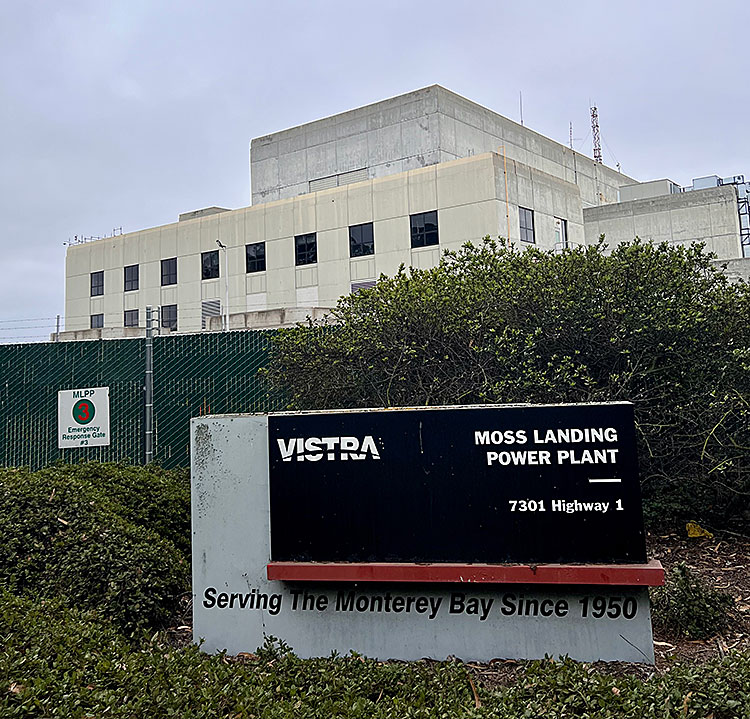
The Vistra BESS plant in Moss Landing.
The project is controversial, especially since a BESS plant in Moss Landing operated by Vistra Energy caught fire in January. It contained about 100,000 lithium-ion battery modules and the fire burned for parts of three days, with a flare-up a month later. More than 1,200 people had to evacuate as the fire spread heavy metals throughout the area.
Since that fire, AB 205 has passed. Sponsored by Sen. John Laird, the law adds regulations for BESS projects but also allows the California Energy Commission to override local rules with findings of public convenience and necessity. If local regulations are not in place, developers can apply directly to the state.
The Minto Road project is on the county’s Major Project Applications website page, which states “the need for proactive regulation is heightened by recently enacted state legislation, such as AB 205 … the Community Development and Infrastructure Department is currently developing an ordinance to allow and regulate BESS facilities on parcels greater than 10 acres that are adjacent to existing transmission substations. … Impacts under the proposed ordinance must be analyzed under CEQA prior to adoption. The draft ordinance would require written approval from the local fire agency before approval of the project.”
When asked by email about the board’s role, Supervisor Felipe Hernandez, who represents the county’s Fourth District, said, “At our last board meeting, the board directed staff to bring the ordinance back within a year.”
That might be too late, according to New Leaf Energy Project Lead Max Christian, who said his company is committed to getting local input and approval, but financial realities do create a limit.
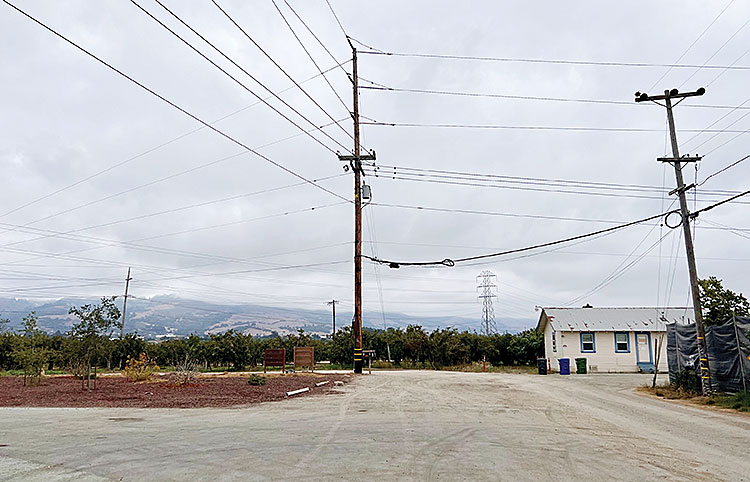
The property at 90 Minto Road where the proposed BESS plant would be built.
“The county delaying the ordinance, that puts us in a bind,” Christian said. He explained that the company has been guaranteed the capacity in the grid for the plant, but it either has to have a power contract in place, or put up multiple multimillion-dollar deposits to keep that capacity guarantee.
“Without a permit, we can’t get a power contract, and without a power contract, we have to put up these deposits to the project’s place in the grid,” he said. “If it would go all the way to August, we would have to look at all of our options.”
The county’s current timeline would extend to at least August.
Christian said the project should not be so controversial. It is nothing like the Vistra BESS facility in Moss Landing, he said. That plant had 100,000 batteries, which were basically the same batteries used in a Tesla automobile, sitting in the open in a warehouse with traditional fire suppression. Besides having no real way to put out the fire, the lithium-ion batteries were designed to charge quickly and are not very stable.
The Minto Road project, however, has a different kind of battery, lithium-iron phosphate. It’s far more stable, Christian said.
Instead of 100,000 batteries at risk of catching fire, here the risk is just 40 batteries. A 40-foot container, much like a shipping container, would store 40 batteries, with each battery having its own manifold and cooling system.
About 300 containers would be placed several feet apart, each with its own fire-suppression system. If a problem is detected, the power cells can be shut down remotely. An aerosolized spray would remove oxygen and coat the interior with a suppressive, cooling powder.
“In our tests, nothing has started on fire because there is no ignition source. It just melts away,” he said.
A rubber bladder would be placed over the clay soil underneath the entire site to prevent any liquids from leaking into College Lake.
“The site will be lined with an impermeable barrier so that any water will be trapped in a retention basin and be tested before it is released anywhere,” he said.
The project would not be built by New Leaf Energy, only developed. Once the permits are in place, the project would likely be sold to PG&E or another entity to build and operate.
“It’s a great opportunity for the county to get improved grid benefits,” Christian said. “Your county will be able to meet its climate goals, there’s revenue that would go to schools … a lot of benefits,” Christian said.
Many neighbors of the project are against it and have signs posted on their property calling for a halt. Those same signs are posted elsewhere in Watsonville as well. Many locals are wary.
“We’re watching it real closely,” said Dennis Webb, president of the Santa Cruz County Farm Bureau, located about two miles from the proposed site. “We don’t know a whole lot about the technology that’s proposed, so we are all looking to find the facts at this point. It’s an important issue.”
TOP PHOTO: Signs opposing the project are hung all along Minto Road.