



By Jon Chown
SANTA CRUZ — The Santa Cruz County Commission on the Environment held its final Battery Energy Storage System technical workshop on Aug. 20, and will next form an ad hoc committee that will summarize the information gathered, along with community comment.

The second site, on Houts Drive, has been ruled unsuitable by county staff due to the terrain. The third site, near Aptos High, is also unsuitable due to terrain and limited acreage. No developer has made a proposal for either of these sites.
The county lacks an ordinance on BESS. Under California Assembly Bill 205, developers could bypass local review by applying directly to the California Energy Commission or certification—unless the county has its own ordinance in place. The hearings are to inform county leaders on what that ordinance should look like. Other legislation is in the works.
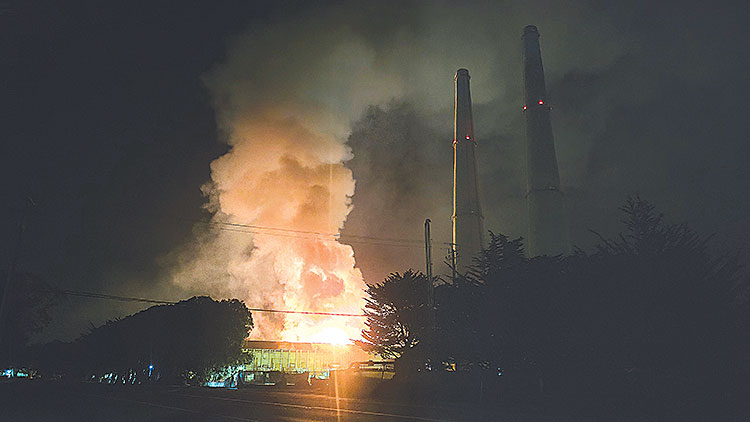
The Moss Landing fire remains part of the discussion as plans for lithium battery storage plants in Santa Cruz County move forward.
Looming over all is the Vistra BESS plant at Moss Landing where a fire on Jan. 16 prompted widespread evacuations amid a toxic plume of hazardous gases. Most businesses in Moss Landing are still shut down six months later. Investigations are ongoing, and cleanup of the damaged batteries, nearly 100,000 modules, is underway with EPA oversight.
Despite this, the county commission appeared to mostly favor BESS technology, as did the guest speakers brought to each of the meetings. Matt Paiss, a Soquel resident who has studied solar technology, trains firefighters on fighting battery fires and serves on multiple technical committees related to battery safety, had been scheduled to speak at the Aug. 20 meeting, but instead, Commission Chair Kris Damhorst read a letter from Paiss. The letter acknowledged some drawbacks, but Paiss wrote the public should not fear BESS. “While a BESS fire does produce toxic smoke, so does every fire I’ve been to in 23 years as a firefighter,” his letter said.
According to Paiss, batteries act like a shock absorber for the power grid, responding in milliseconds to demands on it. For renewable energy to be truly viable, it has to be stored for when the sun isn’t shining or wind isn’t blowing.
“Without the grid support energy storage provides, we might have a very fragile grid,” he wrote. “I often tell people storing energy is never risk-free—but neither is a grid without it. Our challenge is to make informed, measured choices that protect public safety, our climate and our energy future.”
Damhorst followed up with his summation of what he had learned during the previous workshops held on June 25 and July 20. “Battery storage is essential,” he said. “Without sufficient storage, renewable energy doesn’t work.”
He noted the long track record of lithium ion-technology and the many changes that had occurred in the aftermath of the Vistra fire. New facilities are built outdoors with battery modules spaced apart to prevent the fire spreading; the California Public Utilities Commission has now placed BESS facilities under the same regulatory structure as generating facilities; and BESS failure rates have fallen 97% in recent years. Furthermore, they replace “peaker plants.” These plants are used to quickly respond to energy demands, but are dirty and expensive to run, which raises the price of energy.
“So we should see economic benefits from getting rid of peaker plants,” he said.
However, with the Vistra fire fresh in the community’s mind, most of the members of the public at the meeting appeared to be against any plant construction.
“I think we are being scammed,” said Drew Lewis.
Several people expressed fear that there wasn’t enough regulation on BESS and what little there was wouldn’t be enforced.
“We cannot sit back and depend that our fire officials will watch over us. They are not going to,” said Becky Steinbrunner. “What is our county staff willing to accept? I’m very worried.”
Bob Lyons said he lives near the Minto Road site and the community is very worried. There are thousands of people who live nearby and it’s right next to College Lake, which provides water for agriculture.
“It’s a gigantic danger. There’s going to be protests all over the place in Watsonville because people are not happy about this,” he warned.
The meeting started with an update from Sen. John Laird’s office on Senate Bill 283 from analyst Khalifa Sarwari. Called the Clean Energy Safety Act of 2025, the bill requires BESS facilities to comply with fire-safety standards, mandates developers consult with local fire authorities at least 30 days before applying, and orders pre-operation inspections by fire departments or the State Fire Marshal. It would also ban BESS in combustible buildings. The bill has passed the Senate and has moved through Assembly committees. It seems likely to become law.