

By Edita McQuary
Our guide, American expatriate Brenda Hubbard, who has lived in El Salvador for 24 years, greeted us enthusiastically and led us to where our driver Kike (Kee-kay) was waiting by the jitney bus.
“Building Relationships for Better Lives” is the motto of Santa Cruz al Salvador, an organization of six Central Coast churches which has been sending medical missions and supporting children’s education in the Guillermo Ungo area for twenty years: St. Stephen’s Lutheran and Trinity Presbyterian of Santa Cruz, Lutheran Community Church of Watsonville, Advent Lutheran Church of Morgan Hill, Christ Lutheran Church of Aptos, Church of the Good Shepherd in Salinas and representing St. Andrew Presbyterian of Aptos on this trip was Pastor Karla Norton. The January trip was the education support trip.
To understand a country, one needs to know some of its history. On Friday morning, one of our leaders, Kent Madsen of Santa Cruz, took the first-time visitors, Jesse McMilan, Rachel Lapp, Sierra Dwyer-Voss, Jean Calvert, Beth Hoch, Ada Hochschneider, and me, to see various historical sites including the El Salvadorans’ “Memorial Wall”. This wall has 32,000 names etched on it of people who had been killed or had “disappeared” during the civil war of 1979–1992. Some had messages from loved ones taped to their names. “Oscar Arnulfo Romero” was highlighted in yellow. We saw much more. Our hearts were moved by what these people have had to endure.
Water is scarce in this land just above the equator. We gringos needing to drink bottled water, stocked up Saturday morning before we left the capitol for the interior so as not to burden our hosts with providing it for us. The grocery store had an armed guard standing in front of the door. One of the most pressing problems in this beautiful, vacation-resort land is crime and gangs. The campo (countryside) seemed safer than San Salvador – we saw no armed guards when we were in Guillermo Ungo, unfortunately, nowhere is immune from gang activity.
Trees, bushes, bougainvillea, and other beautiful flowers lined both sides of the road as we drove by. Sugar cane plants were showing off their “plumes” in the milpas (fields). Shortly before reaching Guillermo Ungo, we stopped at a bicycle store in San Martin to pick up a bicycle which Lee and Emily Duffus of Santa Cruz, sponsors of a prayer child, had asked Mike to buy and bring to a man who delivers bread for a living. Loaded with passengers, luggage, 5-gallon jugs of water, and now a bicycle blocking the aisle-way, our little bus journeyed on. Jean Calvert joked, “All we need are a couple of chickens to complete the picture.”
We arrived at the school grounds around 9:45 a.m. where the senior leader of the community, Don Fito and the school secretary, Blanca, warmly greeted us. All of the cement block school buildings, except one, had been built by a German delegation about ten years ago. On the outside wall of the school office building, the 22 graduating class members’ grades were posted. I was delighted that one of our sponsored prayer children, Milton Wilmer Palma Serrano, had the highest grades in all subjects: language and social studies as well as mathematics and science. He wants to be a doctor and wants us to help him achieve this goal.
The following day’s craft projects, sort of like “Vacation Summer School” were led by Joey Amrhein and were a huge success with the children: especially popular were the glitter tattoos, “stained glass” painting on various ornaments, and creating colorful rubber-band bracelets.
The next morning mothers and grandmothers arrived to help us arrange the tables for the scholarship ceremony. We were officially welcomed by Don Fito thanking us for coming and supporting their children’s education. As the child’s name was called, one of our delegation members escorted the child to pick up his/her schoolbooks, uniform, pair of shoes (all paid for by the government) and the gift packet that we, as sponsors, provided to them. The annual $75.00 that each sponsor pays is used to buy an extra pair of shoes, a second uniform, school supplies and a hot meal for each child.
Of the 120 gift packets that we brought with us, 80 of the children were there to receive them. The rest of the packets were held in the school administration office to be issued to the absent students when they come back to school after the Christmas holiday.
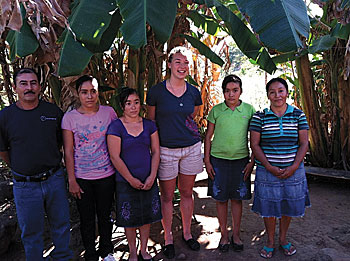
The families of these children are very concerned about educating their children. They live in the rural area in small cement houses surrounded by banana trees, and beautiful tropical plants and flowers. The bougainvillea was amazing! Each house had chickens and sometimes turkeys milling around. We were invited to eat lunch and dinner with the various families whose children we sponsored. We split our group of sixteen into two so as not to overburden any family. Tables were put together to accommodate eight of us and we were served chicken, rice, beans, tortillas, and something deliciously fruity to drink.
With the help of an interpreter, we were able to get better acquainted with the families. We left each hostess with a gift bag and a thank-you card with enough money to pay for our meals. “Brothers and sisters in Christ” took on a whole new meaning for us! For more information, please see santacruzalsalvador.org.