


By Jon Chown
Located in Davenport, Chris Johnson Glass is more than an artist’s studio — it’s a hands-on destination where visitors can step into the heat and experience the joy of creation for themselves.
Johnson is not just sharing his work, but he’s sharing his art through classes and experiences, which range from one-time sessions for curious newcomers to ongoing instruction for dedicated students. Whether you’re looking for just a fun afternoon for you or a group, or a deeper creative pursuit, the studio is designed for that.
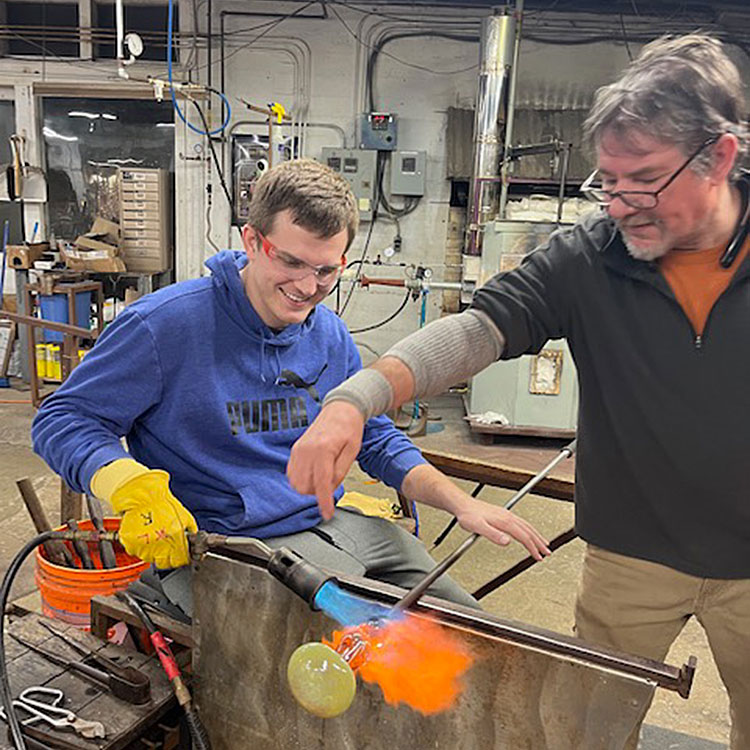
In those introductory sessions, participants choose a simple form — like a bird or a heart — and select from five color combinations before stepping up to the bench. After a safety overview and basic tool instruction, Johnson and staff guide them through shaping molten glass into a finished piece.
“You pick out your shape, and pick your colors. It’s lots of fun,” he said. “We run them through a safety talk, show them how to use the tools.”
Johnson said some people are more natural than others at it, but everyone can learn.
“You always have to make an assessment of the person you are with — how capable they are,” he said. “Most people have an average way of handling the glass, and you just guide people through the process.”
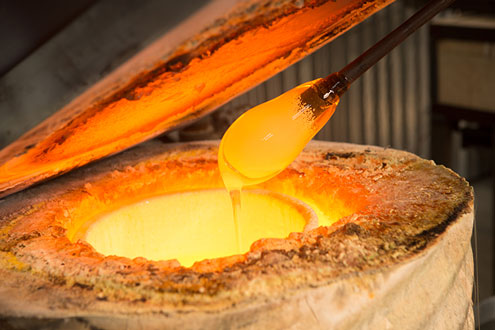
“So you have to finish the piece. You can’t put it down,” he said. “The glass is always moving when it’s hot. If it cools and stops moving, you can’t do anything with it — because now it’s a rock.”
Learning to control that movement is the first major hurdle for beginners — and part of what makes the experience so engaging. If a newcomer wants to improve, Johnson offers private lessons and multi-session instruction for people who want to develop real skill in the craft. Those lessons are not only about technique, but incorporate elements of glass history, chemistry and color theory.
Students begin with a foundational challenge: making a cup.
“It’s really hard,” Johnson said. “But once you’ve got the cup down, you can do a lot of different things.”
From there, the focus shifts to personal expression.
That emphasis on creativity is paired with an acceptance of trial and error.
“There’s no other way to learn than to fail,” Johnson said. “Failing and correcting — that teaches you where all the problems are and how to control the process.”
He recently saw that progression unfold with a student who first came in for a casual session, but instantly seemed to recognize what to do.
“She said, ‘Oh, you can feel the glass moving,’” Johnson recalled. “I told her, ‘you can feel it moving. Most people can’t at first.’”
She is now several lessons into her training.
“I’m so curious to see her progress,” he said. “For my students, I’m trying to give them the skills so they can go and do whatever they want to do.”
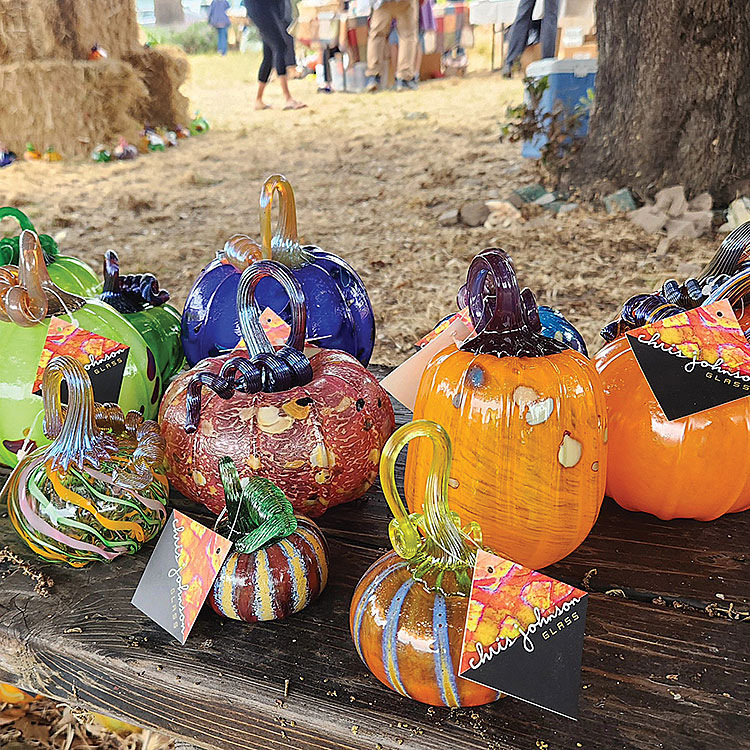
Beyond classes, Johnson’s studio also produces custom glasswork and original pieces, often driven by experimentation with color and process. That same spirit carries into his public events, particularly his annual glass pumpkin patch held each September at the Live Oak Grange.
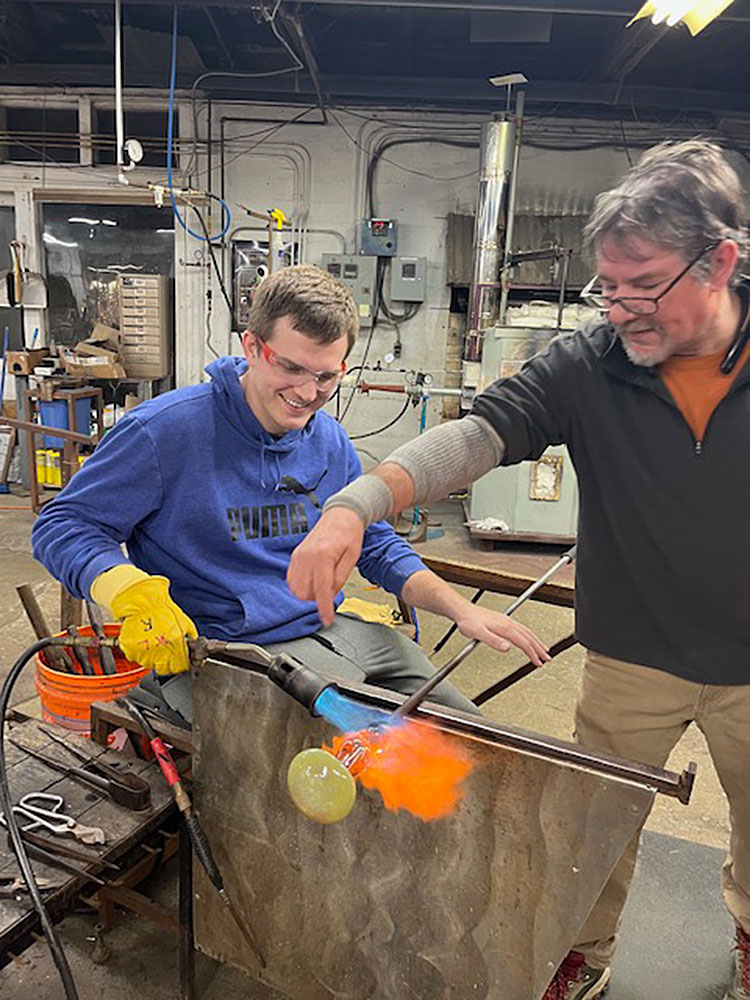
Chris Johnson, at right, works with a student at his studio in Davenport.
Rather than rows of identical pumpkins, the event showcases a new design theme each year.
“The pumpkins are all wildly different,” he said.
Johnson’s ability to guide others through the craft is rooted in his own unconventional path into glass. In the early 1990s, he visited a glassblowing studio during an open studios event and struck up a conversation that changed his life.
“I talked to Art Ramos, and he offered me an apprenticeship,” he said.
He later spent time as a technician at the Bay Area Glass Institute — a role that gave him a deep understanding of the mechanics behind the art.
“Most glass artists don’t come up through tech,” he said. “I came up being a glass studio technician.”
That technical background, along with early work as a machinist, continues to influence both his art and his teaching.
“I’ve always been trying to produce art with pretty much everything I do,” he said.
Johnson opened his own studio in 2006, a turning point that allowed him to fully immerse himself in the medium.
“I was doing glass once a week,” he said. “It wasn’t until I had my own studio and blowing five or six days a week that I really improved.”
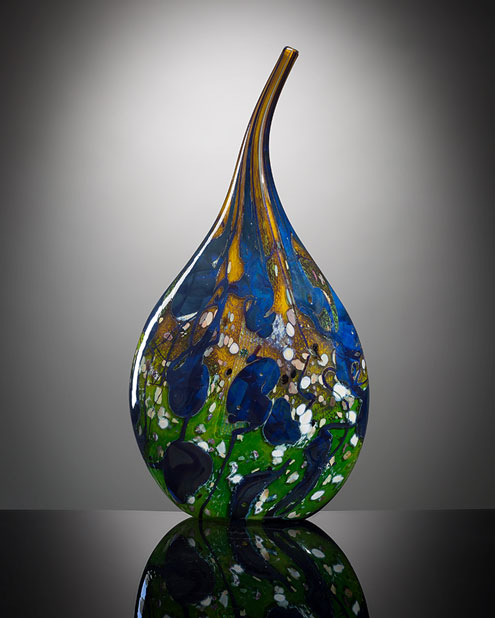
Now, nearly two decades later, he continues to experiment. Johnson said that in his art, he concentrates less on form and more on color.
“I’m always trying to push into new processes. I want to push into new territory. That’s what being an artist is about. And I’m not talking about being transgressive. I’m trying to make the prettiest thing I can make that hasn’t been made before,” he said.
•••
Learn more at chrisjohnsonglass.com.