


By Jon Chown
SANTA CRUZ — Santa Cruz County officials have released preliminary funding recommendations for the inaugural Measure Q Grant Program, revealing the initial thought process in determining how roughly $2.7 million will eventually be spent on different projects in the county.

The program has drawn strong interest in its first year. More than 50 applications were submitted requesting a combined $8.9 million, far exceeding the available funding and setting up difficult choices for county leaders. The preliminary recommendations, along with complete scoring results, have been made public on the county’s Measure Q Grants webpage, and officials are encouraging residents to provide feedback.
Final funding recommendations will be developed through two meetings of the Measure Q Citizens Oversight Advisory Board held May 6 and May 27, with final approval expected from the Santa Cruz County Board of Supervisors on June 9.
This first cycle of the grant program will being closely watched, not only for which projects are funded but also for how the process itself unfolds. County staff have emphasized that this is an “inaugural” cycle, and they plan to return later this year with a formal evaluation of how the program worked, including recommendations for improvement.
“With Measure Q funding, we as a County really need to show that we are doing urgent work to reduce risk for the community with the funds entrusted to us,” said District 1 County Supervisor Manu Koenig.
The Measure Q Grant Program was designed to focus on four major goals: improving water resources, reducing wildfire risk, protecting wildlife and habitat, and expanding access to parks and open space in an equitable way.
To carry out that vision, the county created a competitive grant process divided into two tiers. Tier 1, known as Community Catalyst grants, supports smaller projects ranging from $5,000 to $50,000. Tier 2, known as Community Impact grants, supports larger efforts with requests above $50,000.
The applications were scored between March 15 and April 14 by a team that included both county staff and external evaluators. Each project received one internal and one external score. Following the scoring process, staff spent about a week analyzing results and developing funding scenarios. Preliminary recommendations were published in late April and formally presented to the advisory board in early May.
High Demand and Competing Pressures
The demand for Measure Q funding was strong across both tiers. Tier 1 included 29 applications requesting about $1.13 million, while Tier 2 included 24 applications requesting about $7.75 million. Together, applicants sought nearly $8.9 million, more than three times the available funding.
Officials noted that Tier 1 requests were heavily clustered at the maximum grant amount of $50,000. Tier 2 requests varied more widely but tended to cluster between $300,000 and $500,000.
Nonprofit organizations made up 76 percent of Tier 1 applicants and 58 percent of Tier 2 applicants, though Tier 2 also included a larger share of cities and public agencies. County staff said public agencies often have an advantage in grant competitions because they have more experience with technical requirements and project planning.
The program also includes two required funding set-asides written into county code. At least $600,000 must go to projects in the San Vicente Redwoods, and at least $600,000 must be allocated to projects benefiting residents in the Pajaro Valley.
The scoring system used for the Measure Q grants was approved in advance by the advisory board and the Board of Supervisors. However, the first round revealed challenges in how different evaluators interpreted the criteria. Several factors contributed to differences in scoring. In some cases, the criteria left room for subjective interpretation.
Tier 1 projects showed more variation in scores, likely because they covered a wider range of project types. Tier 2 scores were more consistent, with differences often tied to how ready projects were for implementation. The county staff report emphasized that scores are only one tool in the decision-making process. Final funding decisions must also consider broader program goals.
Where the Money Might Go
From the full pool of applications, staff identified the top 10 projects in each tier based on average scores. These projects form the basis of all three funding scenarios.
In Tier 1, the highest-scoring project is River Stewards, proposed by the Coastal Watershed Council. The program would engage unhoused residents in weekly restoration work along the lower San Lorenzo River, combining environmental improvements with job training and increased access to public spaces. Erin Loury, spokesperson for the Coastal Watershed Council, said the group is waiting until final funding is awarded before making any comments on the ranking.
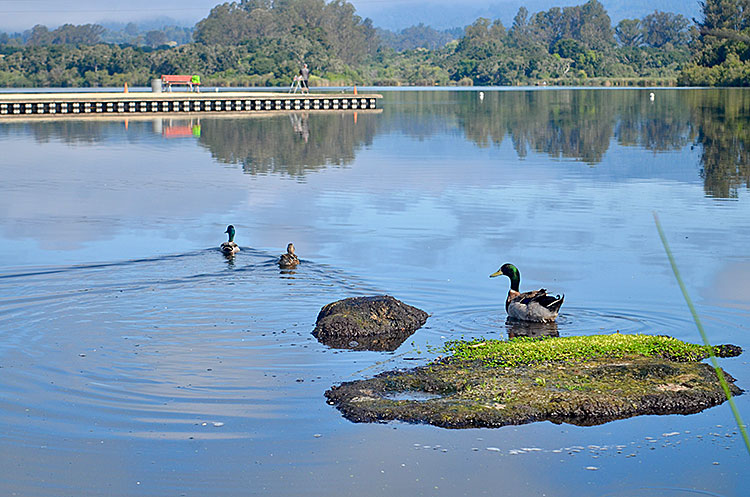
Another top project is Pinto Lake Water Quality Monitoring by Santa Cruz County Parks. This effort would study pollution sources in Pinto Lake in Watsonville, focusing on phosphorus levels that contribute to harmful algal blooms.
Several projects focus on wildfire preparedness. The Santa Cruz County Fire Department proposed three separate efforts: Truck Trail Emergency Response Navigation, which would install markers and signage along rural roads; Real-Time Digital Signage for Wildfire Preparedness, which would provide emergency alerts; and Strategic Water Supply Enhancements, which would improve water access in high-risk areas.
Other Tier 1 projects emphasize access and equity. Kids2Parks would fund transportation for students from low-income schools to visit state parks. The Vista Center for the Blind and Visually Impaired would provide guided park experiences and assess accessibility.
Black Surf Santa Cruz would expand surf instruction and ocean safety programs for underserved communities. The Boys & Girls Clubs would fund transportation for youth to visit parks, and the Las Cumbres Shaded Fuel Break Project would reduce wildfire risk in a mountain community.
In Tier 2, the highest-ranked project is Pajaro Valley Watershed Stewardship by Watsonville Wetlands Watch. This large-scale effort combines habitat restoration, school greening and trail improvements across multiple sites in Watsonville.
Other major proposals include the Rural Lands Assistance Program by the Resource Conservation District, which would help landowners manage wildfire risk, and the Watsonville City Plaza Revitalization Project, which would restore a historic downtown space with new amenities and infrastructure.
The Pajaro Valley Unified School District has proposed improvements to Rolling Hills Middle School that would allow broader community use of its track and field facilities. Mesa Village Park improvements would expand recreational space near Watsonville.
Two projects focus on water and flood management. The Pajaro River Bridge to Bay feasibility study would examine long-term flood protection strategies, while the San Lorenzo debris boom project would help protect water quality and marine habitat.
Other proposals include the Sol Y Tierra climate justice program, which combines education and workforce development, the Zone-0 workforce initiative focused on wildfire safety, and a prescribed burn program aimed at improving forest health.
Rather than presenting a single funding plan, county staff developed three scenarios to help guide discussion.
Scenario A follows the scoring results exactly. This approach is the most straightforward but results in a concentration of funding in the Pajaro Valley, where many high-scoring projects are located. About three-quarters of Tier 2 funding would go to south county under this option.
Scenario B adjusts the list to achieve a more balanced geographic distribution. It funds more projects overall and includes a broader mix of program types, including those that serve residents across the county rather than focusing on one region.
Scenario C prioritizes projects with the largest measurable impact, such as the number of people served or the size of the area affected. This approach shifts funding toward projects that can demonstrate clear, quantifiable outcomes.
According to the report, no single option is being recommended at this stage. The Measure Q Citizens Oversight Advisory Board will review the preliminary recommendations and gather public input before developing final recommendations. Those recommendations will then go to the Board of Supervisors for final approval on June 9.
According to the county staff report, the process will not end there. They plan to return in August with a full evaluation of the program’s first cycle, including lessons learned and possible improvements to the scoring system, application process and funding structure.
TOP PHOTO: A request for $48,000 from Measure Q funds to monitor the algae bloom in Pinto Lake was well received.