


By Jon Chown
New training and tactics by local emergency responders are focused on getting medical attention to victims much quicker in the event of a mass shooting.
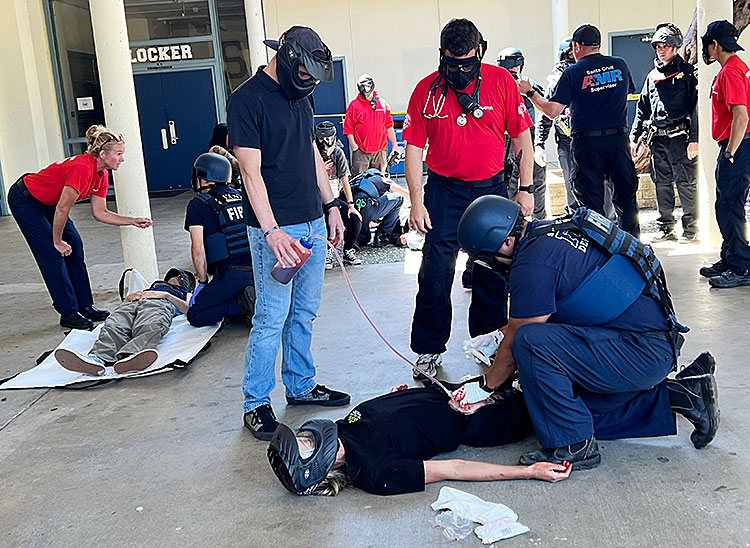
Dozens of law enforcement officers and firefighter/paramedics were at Soquel High on June 24 to practice and train for one of the worst-case scenarios imaginable, a mass shooting at a local school.
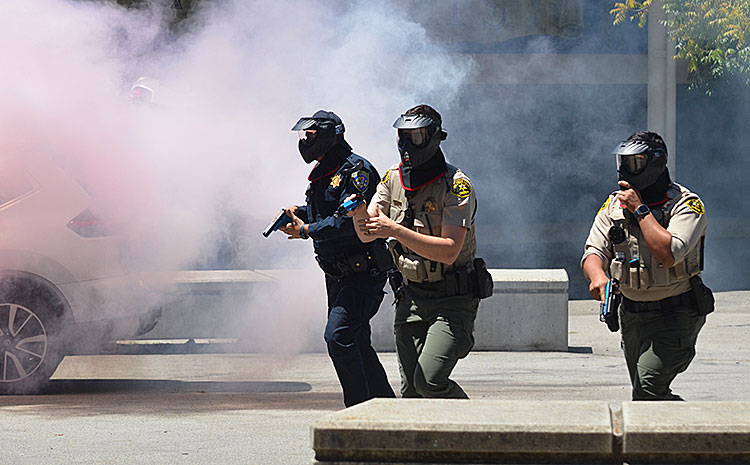
In this training scenario, a shooter has driven a car onto the campus, crashed it and started shooting. Emergency responders, who don’t know what they will find when they arrive, are called to the scene over the radio to simulate events as accurately as possible.
“Active shooter reported at Soquel High,” a call over the police scanner can be heard. “Multiple victims reported!”
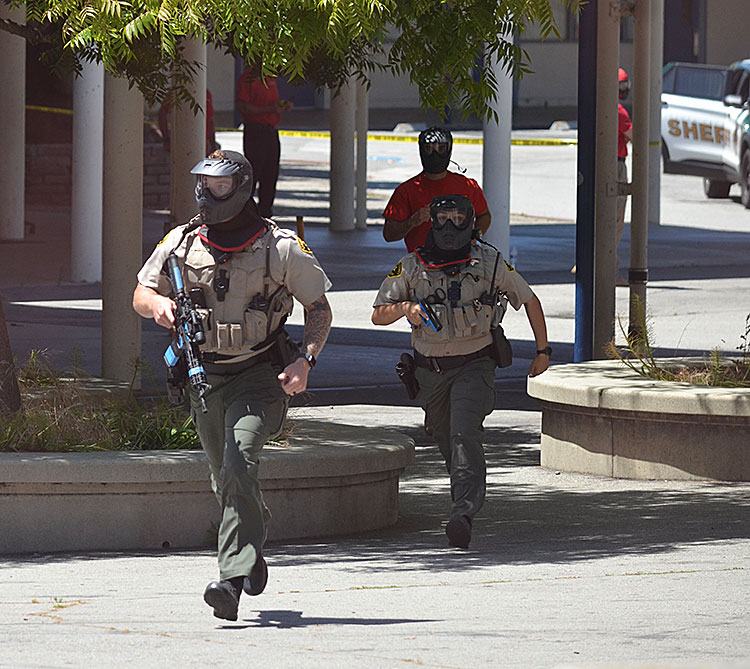
In total, there would be 22 simulated victims. A first wave of officers quickly arrived to see the empty car in the middle of the campus with red smoke simulating a fire. The officers fanned out, some deployed in a line to search the hallways and others secured the perimeter of the school. Just two and half minutes later a second wave of officers, along with a paramedic, arrived on the scene.
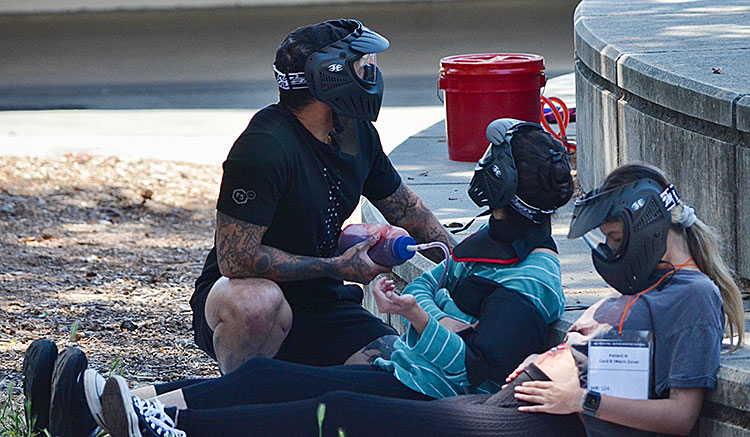
So far, two firefighters have been fully trained to respond in this way and more are in training. “They’re pushing those boundaries to get into places much, much sooner,” said Baldwin “We’ve seen just huge gains in how quick we can get things done because we can focus on stopping the killing that’s happening, and they can focus on preventing the dying that’s out there.”
More officers and more firefighters arrived in waves, all fanning out to search for victims and secure the scene. A group of police officers had found the person playing the shooter and arrested him. Paramedics evaluated the wounded, folding their arms across their chest if they were deemed deceased, or taking them out on a stretcher to an area of the school where more medical treatment took place.
“This is a tiny way of me giving back,” she said. “No parent thinks this is gonna happen, but still, this is a fear that a lot of parents live with because we see it so often.”
Volunteer Raffi Pehlivanian said that, while it’s a drill, it still feels very real. “These are real officers, these are real first responders, so it certainly does feel real.”
Members of every local emergency response agency in the county took part in the training, which went on for five days.
“We train for the darkest days,” said Baldwin. “Prioritizing life is the key thing, so that all comes with speed. And so the faster we can get in to help people, the higher the chances are.”