


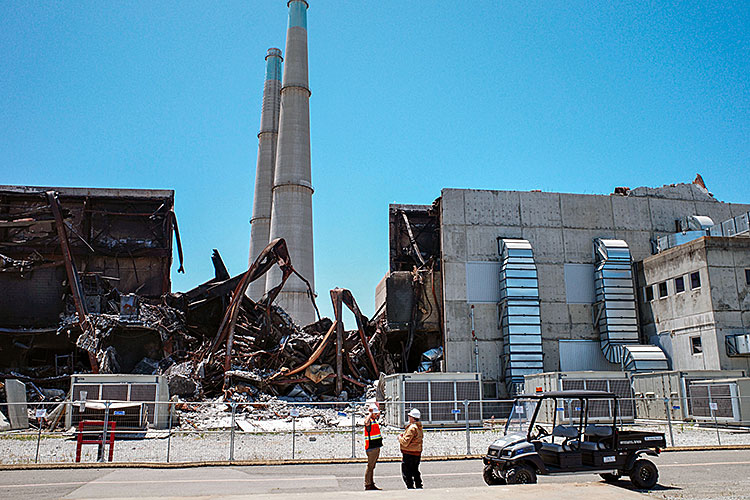
MOSS LANDING — Workers have begun removing lithium-ion batteries from the Moss Landing 300 building at Vistra Corp.’s power plant, starting an extensive cleanup months after a fire damaged more than half of the facility’s energy storage system.
The fire occurred Jan. 16, 2025, at the 300-megawatt energy storage system, which contained roughly 100,000 lithium-ion batteries. Officials estimate that about 55% of the batteries were damaged in the blaze. Local agencies immediately requested air monitoring, prompting the U.S. Environmental Protection Agency to deploy personnel to the site from Jan. 17-20. The State of California subsequently requested that the EPA oversee the battery removal process.

Prior to the July agreement, crews had already completed several preparatory steps. Batteries were disconnected from the building’s infrastructure, fire debris containing asbestos was removed and transported to the Forward Landfill in Manteca, about 135 miles northeast of Monterey, and roughly 586,300 gallons of water stored in tanks on the property — equivalent to an Olympic-sized swimming pool — were sampled, found to be non-hazardous, and safely disposed of.
Lithium-ion batteries, commonly used in energy storage systems, can pose fire risks if damaged or improperly handled. Damaged batteries may release heat or flammable materials, and uncontrolled fires can emit toxic fumes. Experts say careful de-energizing and monitoring are essential to reduce the risk of additional incidents during removal.
Safety remains a central focus throughout the cleanup. Measures at Moss Landing include continuous air monitoring, a 24-hour on-site private firefighting team, and a comprehensive emergency response plan. The EPA is coordinating with Vistra, Monterey County, and California state agencies to oversee work inside the property fence line, while local authorities monitor activities beyond the site.
Community engagement has also been part of the process. In September, the EPA released the Moss Landing Battery Fire Community Involvement Plan after conducting interviews with 17 community members, local officials, and organizations. The plan identifies information gaps and guides communication, outlining how updates will be shared as each phase of the battery removal progresses.
EPA and Vistra officials say the removal work is expected to continue through 2025, with regular updates provided to the community. Comments on the agency’s time-critical removal action are being accepted through Oct. 15.