


By Jon Chown • Photos Credit: Michael Oppenheimer
SANTA CRUZ — A neighborhood group has filed a lawsuit seeking to overturn Santa Cruz County’s approval of a 57-unit apartment project at 841 Capitola Road, arguing the county misapplied state housing law, bypassed required environmental review and approved a development far exceeding local limits.
The petition, filed March 17 in Santa Cruz County Superior Court, challenges the Board of Supervisors’ Feb. 10 decision to approve the five-story project in Live Oak. The case, No. 26CV00891, was brought by Supporters of Reasonable Development for Live Oak, a group of nearby residents and property owners. Santa Cruz County; the Board of Supervisors; and the developer, Workbench, are all named as defendants.
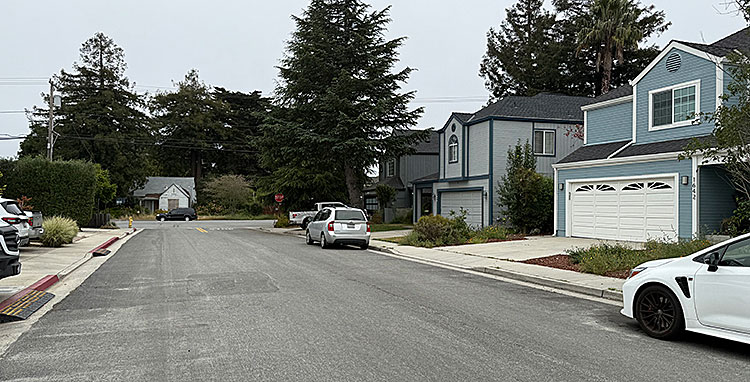
A look at the 841 Capitola Rd. plot from the Schooner Court cul-de-sac, giving a hint of how a 57-unit complex might feel out-of-place in the neighborhood.
At the heart of the dispute is the controversial “builder’s remedy” law and how it was applied to Santa Cruz County. The provision allows developers to sidestep local zoning rules when a jurisdiction lacks a state-certified Housing Element.
County officials determined the project could qualify for “Builder’s Remedy” because developer Workbench submitted an application on April 9, 2024, days before the state issued a formal certification letter for the county’s Housing Element. The lawsuit, however, argues the state had already completed its substantive review weeks earlier.
“The Project cannot invoke the Builder’s Remedy,” the petition states, asserting that the county’s Housing Element “was in substantial compliance as of March 15, 2024,” before the application was filed.
Whether or not the county was in compliance is critical. If the court agrees with the plaintiffs, the project would lose its ability to override local land-use rules.
Dispute Over Timing
The lawsuit runs alongside a situation now playing out between the county and the state over when compliance actually occurred.
On March 11, the Santa Cruz County Board of Supervisors voted to seek clarification from the California Dept. of Housing and Community Development (DHCC), asking the agency to confirm that the Housing Element was effectively compliant on March 15, 2024 — the date county officials say the state had finished its review.
Internal communications cited by both county officials and the lawsuit indicate DHCC staff had told the county the plan was complete and ready to be certified at that time, with no further substantive review afterward. However, due to clerical errors by DHCC, the formal certification letter was not issued until April 23 and later backdated to April 12.
At the March 11 board meeeting, Supervisor Manu Koenig said the delay could have significant consequences.
“There were no substantial changes after March 15, which means it was in compliance, and then HCD was just kind of sitting on it … which really is not in good faith,” Koenig said. “We should require the state to acknowledge that.”
The timing matters because several developers, including the applicant for 841 Capitola Road, filed projects during that gap, invoking builder’s remedy protections.
Claims of Legal Errors
In the lawsuit, the residents group alleges the county’s approval “rests on a series of fundamental legal errors,” including misinterpreting state housing law and improperly granting the project builder’s remedy status.
The filing also challenges the scale of the development, noting the site’s General Plan designation would typically allow about 14 units and its zoning about eight. Instead, the county approved a project with a base density of 40 units — 57 units with bonuses — “more than three times the General Plan maximum and over 500 percent of the zoning standard,” the petition states.
By doing so, the group argues, the county effectively approved a “de facto general plan amendment and rezoning” without following required legal procedures.
“A county may not amend its General Plan … through staff-level or quasi-judicial action,” the lawsuit states. “Any such change must be accomplished through” formal processes including hearings and public notice.
The lawsuit also alleges the county improperly exempted the project from environmental review under the California Environmental Quality Act, or CEQA. The exemption, according to the complaint, was tied to the false Builder’s Remedy claim. The county’s decision then “failed to proceed in the manner required by CEQA” and deprived residents of an analysis of the potential impacts.
“A project cannot bootstrap itself into a CEQA exemption … by asserting eligibility for a processing track that was never lawfully available to it,” the complaint states.
Beyond land-use and environmental claims, the lawsuit raises broader constitutional challenges to state housing law and targets a provision that allows projects to be “deemed consistent” with local zoning if officials fail to identify conflicts within a set timeframe.
The petition argues that mechanism improperly strips local governments of authority and denies neighbors a meaningful opportunity to be heard.
“By conclusively deeming a project consistent … solely based on the passage of time,” the law “purports to strip local agencies of their traditional authority,” the lawsuit states.
It further claims the provision “violates procedural due process” and “effectively transfers” land-use decision-making power to private developers.
What Was and What Is To Be
The Board of Supervisors approved the project in February on a 4-1 vote, with Supervisor Justin Cummings dissenting. Ironically, the approval was to avoid a lawsuit by the developer.
At the time, several supervisors said they believed state law left them little choice other than to approve the project and warned the county would likely lose if it denied it.
No county or city in California had yet prevailed in court against a ‘builder’s remedy’ suit, Supervisor Felipe Hernandez pointed out during the hearing.
The lawsuit asks the court to void the project’s approvals, require full environmental review and order the county to reconsider the development under standard planning rules.
It also seeks declarations that the project is not eligible for builder’s remedy protections and that portions of state housing law are unconstitutional.
If successful, the case could halt or significantly delay the project and potentially affect other developments filed during the same period, including proposals on Paul Sweet Road and Graham Hill Road.
County officials and the developer had not yet filed formal responses to the lawsuit.
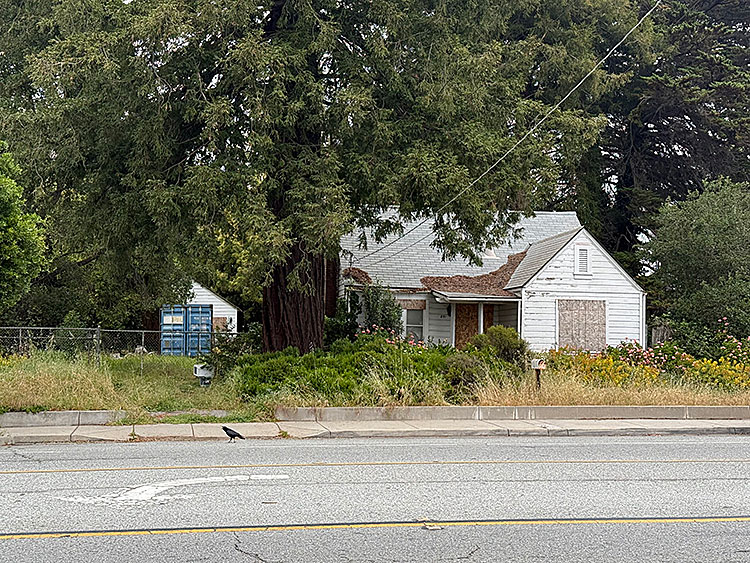
TOP PHOTO: A storage contaner can be seen at the back of the 841 Capitola Rd. property.