


By John Chown
The Capitola City Council delayed a final decision on proposed land-use and zoning amendments for the Capitola Mall at a special meeting on Feb. 23 and set a new date for a special meeting, March 16, to make the decision.
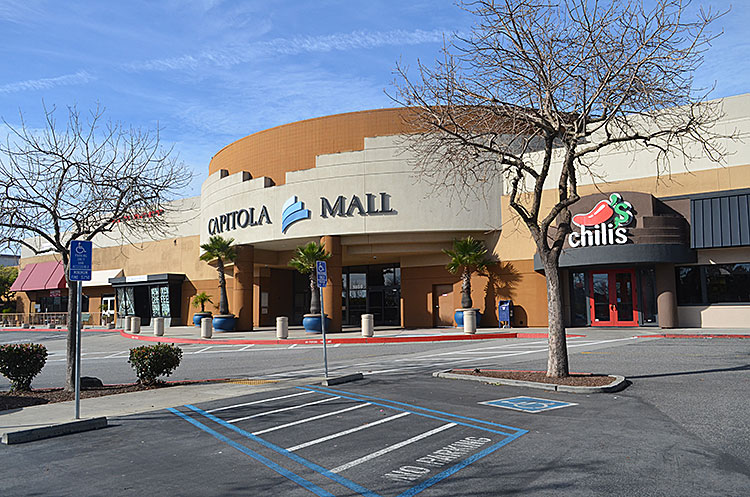
The City Council is considering changes that would pave the way for a large-scale redevelopment of the Capitola Mall property, potentially allowing more than 1,700 housing units, about 35,000 square feet of commercial space, apartment buildings up to 75 feet tall and a hotel up to 85 feet tall.
City leaders expected to make the decision at the Feb. 23 special meeting of the City Council, but a host of changes requested at the last moment by the property owner and eventual developer stalled the decision as city staff reviewed the requests further.
The City’s Mandate to Build
The zoning amendments are being proposed in order for Capitola to meet requirements of the city’s Housing Element for 2023-2031. Under California law, every city must update its Housing Element every eight years to assess housing needs, identify adequate sites for development and adopt programs to meet current and future demand. Capitola must plan for 1,336 housing units, including 497 units for low-income households, 169 for moderate-income households and 455 above moderate-income, or market-rate, units. Cities don’t have to build the housing but are required to properly zone and accommodate the construction of it.

“Several bills take all the control away from us and we can’t just say ‘no,’” said City Council Member Joe Clarke.
In its adopted 2023–2031 Housing Element, the city identified the Capitola Mall block as a key site for new housing because of its size and redevelopment potential and committed the city to revising its zoning so the mall property can accommodate at least 1,777 housing units. Approximately 1,100 of those units could be built on portions of the mall controlled by its primary property owner, Merlone Geier Partners, which operates the enclosed mall and former Sears building. However, MGP wanted 10 changes to the city’s proposed zoning amendments; otherwise, developing the property might not be financially feasible.
The City’s Proposal
Under the current proposal, just 15% of units must be for lower-income households and another 5% for moderate-income households. Under the new rules, buildings could reach 75 feet in the core portions of the property and 55 feet along surrounding streets. Certain commercial projects, such as a hotel, could go as high as 85 feet.
The city created three redevelopment tiers. The base level permits residential projects at up to 48 units per acre. Higher tiers allow additional density and development incentives if a project includes certain types and amounts of new commercial space or a hotel of at least 85 rooms.
The standards also require internal streets, pedestrian and bicycle connections, plazas and open spaces and prohibit large parking lots between buildings. Buildings must include varied façades, and there must be street-facing entrances to create a more walkable district.
The city did not want to turn the entire mall into housing, as modeling showed residential-only redevelopment would likely cost the city money, while mixed-use projects that include retail and hotel uses could generate income to balance the cost of services for the housing. Herlihy told the council that the city’s analysis showed a mixed-use project would reduce calls to the police department by 50%. The city wanted to require a developer to build at least 30,000 square feet of commercial space to reach Tier 2 of development incentives and 40,000 square feet to reach Tier 3.
Janine Roeth of Santa Cruz YIMBY applauded the project. “We’re really excited about the opportunity here at the mall,” she said. “It will not only bring new homes to address the housing crisis, we’ll build a destination for people, and we will also put people close to services and jobs.”
But she cautioned about some of the constraints in the project. “We want the housing on this site to be feasible,” she said.
Late Request Creates Uncertainty
A day before the special meeting, Merlone Geier Partners asked for 10 changes. Among them were less retail space — 25,000-35,000 square feet. The firm also wanted the perimeter zone in which taller buildings could be built reduced;that “sharrows,” in which bikes and cars share a lane, be allowed; that carve-outs for existing parking lots remain; and that the heights of the retail buildings’ first floors be reduced from 18 feet to 14 feet.
Council Member Joe Clarke said the late requests had “thrown a wrench into the process” and suggested sending the issue back to the Planning Commission.
Council Member Melinda Orbach said she feared that without the changes requested by MGP, the firm might not find the project financially feasible and the project would languish.
“What is the issue with changing it to 14 feet? I just don’t want this to not be a feasible project,” she asked city staff. Staff responded that some retailers will only consider space that is 18 feet high and they wanted quality retailers.
James Gwilliam, representing MGP, apologized for the tardiness but said all the changes he wanted were with feasibility in mind.
“An 18-foot minimum height? It might not sound like a big deal, but having that as a minimum can create extra costs. There are certain tenants and certain spaces where it just doesn’t make sense,” he explained. “I can’t just tell Target or Macy’s I’m going to build a bike lane through the parking lot. They won’t allow it. … There are constraints here that I don’t have with any other project up and down the state.”
Council Member Susan Westman noted that while feasibility was required, the city also wanted a good place for residents to live and shop.
“This is a big deal for Capitola,” she said. “We’ve gotten a lot of new information tonight. I think we’ll have to take a little time to digest that.”
After a little more discussion, the council voted unanimously to hold the special meeting on March 16 to give city staff time to evaluate the changes requested by MGP.