


By Jon Chown
MOSS LANDING — A former Center for Toxicology and Environmental Health scientist alleges the company hired by Vistra to monitor air after the 2025 battery fire didn’t test for all the toxic substances it should have and that when monitors did show toxins in the air, it was not always made public.
The allegations by Peggy Dixon, formerly of CTEH, were brought to the public’s attention Friday at a news conference near the Vistra power plant.
Dixon was not at the event, but activists from Never Again Moss Landing discussed her sworn affidavit and a new complaint filed on her behalf with the Environmental Protection Agency’s Office of Inspector General.
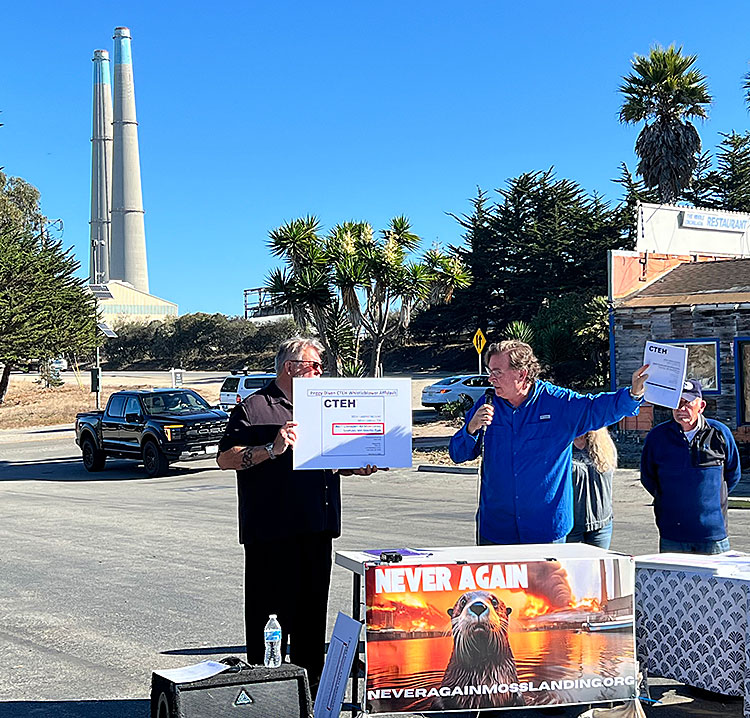
Brian Roeder holds a sign up while Scott Smith speaks during a press conference held Sept. 25 in Moss Landing.
The Government Accountability Project filed the complaint Wednesday. It asks the watchdog office to investigate CTEH’s work at Moss Landing, the Norfolk Southern train derailment in East Palestine, Ohio, and at other disaster sites.
CTEH now operates under the name Onterris. Dixon’s story was originally reported by the Wall Street Journal and Onterris denied Dixon’s allegations in a statement to WSJ.
Dixon, in a sworn statement, said that she worked for CTEH for five years as an environmental rapid responder. She has bachelor’s degrees in biology and chemistry. She said she was sent to Moss Landing and took part in air monitoring under CTEH’s Feb. 17, 2025, draft plan for Vistra.
Her main complaint centers on East Palestine, where she said managers pressed field workers to produce zero or “non-detect” readings. She also alleged that some higher readings were played down or left out, ash samples were not sent to a lab and evidence was kept from residents and reporters. Dixon said she later saw the same basic approach at other sites. “I signed up to help impacted communities,” she wrote in her affidavit. “I did not sign up to deceive people.”
Limited Testing at Moss Landing
At Moss Landing, CTEH’s 16-page draft plan, which Dixon made public, called for testing outside the plant fence. It listed cobalt, nickel and manganese, along with hydrogen fluoride and other acid gases, fine particles, volatile organic compounds and possible asbestos.
Dixon said that list was too limited because it left out dioxins, PFAS, PAHs and other chemicals that can be left by an industrial fire. She also said the plan focused on short-term exposure limits and did not fully address long-term exposure.
The plan also said readings above an “action level,” a point that can trigger more safety steps, would be sent to CTEH managers, site management and the response command. Any hydrogen fluoride detection would also trigger an internal notice. Left out of the draft was any effort to alert or inform the public.
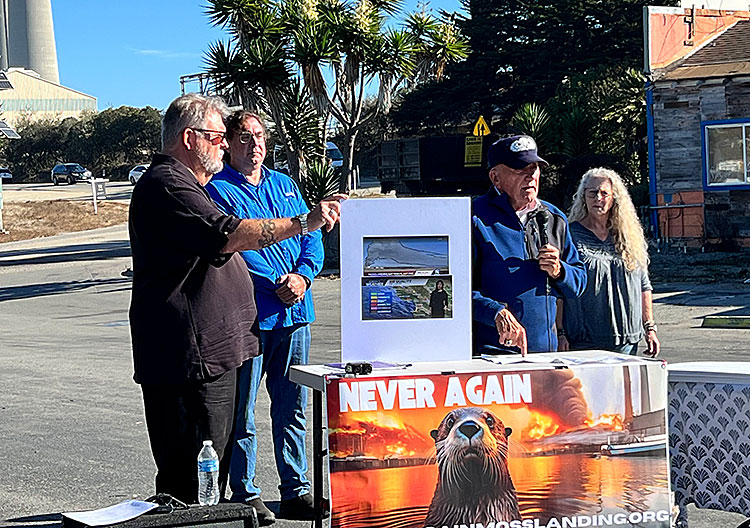
Scott Smith of the Blue Shirt Justice Group held up copies of the plan and Dixon’s affidavit at Friday’s news conference. “You can’t find what you don’t look for,” he said.
Smith also said records he reviewed showed hydrogen fluoride detections at the plant as late as September 2025.
The press conference was held a week after the latest fire at the Vistra battery building. The EPA said about 1,300 battery modules burned Sept. 18. The blaze was first detected around 6 a.m. and had largely died down by about 10 a.m. Monterey County kept a shelter order in place within one-third of a mile until about 4:15 p.m.
Tanya Rivera, the founder of Never Again Moss Landing, said she wasn’t notified of the shelter warning until 8:23 a.m., more than two hours after the fire started.
She questioned why the warning took so long and why Highway 1 remained open. According to Rivera, air monitors had not been running around the clock.
The EPA’s public cleanup page says air monitoring and sampling are required around the property during work hours. It separately says Vistra must keep a private firefighting company at the site 24 hours a day. Rivera asked where that crew was when the new fire began. “Profits should never supersede health and safety,” she said.
Ed Mitchell, chief investigator for Never Again Moss Landing, also questioned the type of monitoring used during the January fire. He said local officials relied too heavily on PM2.5 sensors. Those devices measure the amount of very small particles in the air, but they do not identify which metals or chemicals are in the particles.
The Monterey Bay Air Resources District said on Jan. 22, 2025 that its particle monitors and wildfire sensors showed the smoke did not affect ground-level residential areas.
Readings at nearby stations stayed in the good or moderate range, the district said. But the agency also said its equipment could not test for hydrogen fluoride.
Mitchell said responders should have sampled the smoke plume from the air and tested dark residue found after the fire.
Separate Studies, Different Results
The first fire began Jan. 16, 2025, inside Vistra’s 300-megawatt battery building. The EPA says the building held about 100,000 battery modules and roughly 55% were damaged. Federal workers set up nine monitoring stations around the property for particles and acid gases, including hydrogen fluoride, before turning the equipment over to Vistra on Jan. 20. According to the EPA, there was little pollution from the fire.
However, a peer-reviewed study led by Moss Landing Marine Laboratories found sharp increases in nickel, manganese and cobalt in surface soil at Elkhorn Slough. Some hot spots were 10 to 1,000 times higher than levels measured before the fire. The research team found evidence of pollution as far as 4 kilometers from the plant and estimated about 55,000 pounds of metal-rich particles fell across the slough.
A separate Phase II study prepared by Terraphase, hired by Vistra, reached a far different conclusion. It said the detected metals and other pollutants did not come from the fire and did not pose a threat to people or wildlife. That study often used samples about 3 inches deep, while the Marine Lab study focused on a much thinner surface layer.
Cleanup at the plant is in its final phase. The EPA oversees work inside the fence, while state and local agencies oversee areas outside it. Vistra is paying for and carrying out the cleanup under EPA oversight.
Smith said his group planned to run independent air tests over the weekend with a remote-sensing instrument and discuss the results at a town hall.
Brian Roeder of Never Again Moss Landing compared the response by local, state and federal authorities to the Three Stooges, assigning Curly to Monterey County, Larry to the state and Moe to the federal government.
“I characterize our authorities at the local, state and federal level as the Three Stooges,” Roeder said. “I call the county Curly, because Curly is kind of a friendly guy. Nyuk, nyuk, nyuk.”
The county was just overwhelmed, Roeder explained, and was trying.
“Let’s talk about Larry. Larry’s the state,” he said.
Larry could do better, but wasn’t trying hard enough, Roeder went on. He then cast the EPA as Moe.
“And finally, we have Moe, who’s slapping everybody around,” he said. “And that is the feds in the form of the EPA.”
Roeder accused the EPA of putting industry interests ahead of the public, a practice he called corporate capture.
“The EPA has been throwing elbows for industry for years, decades,” Roeder said. “It’s called corporate capture. We’ve seen it here.”
Roeder said the group worked with EPA public relations staff for information. He said the employees were pleasant, but complained that the agency’s website did not tell the community “what’s really happening.”
“You know who’s giving them their marching orders, folks? Vistra. CTEH. Terraphase,” Roeder said. “They’re setting the rules, and the EPA knows they’re not setting fair rules, and yet they’re following those rules.”
Roeder also returned to the public assurances given after the January fire. He said four days after the fire, an EPA representative told the community, in effect, “We have detected nothing to cause concern.” Roeder disputed that conclusion and accused the agency of failing to correct it.
“Every time Vistra speaks, they say the EPA said there was nothing to see here,” Roeder said. “In effect, go back to sleep. Today’s about telling you why we can’t go back to sleep.”
Roeder also complained that the fire had not resulted in fines or citations. He pointed out that a homeowner could get a fine for the slightest violation along the coastline, and yet a negligent fire that resulted in massive pollution along the coastline hasn’t resulted in any penalty.
“There have been no fines, no citations,” he said. “How is that possible?”
The inspector general has not said whether it will open a formal investigation on Dixon’s revelations. Her whistleblower complaint asks it to obtain the raw, unedited monitoring records and the history of any changes made to them.
This newspaper will seek answers from the public agencies and responses from the companies involved and report more as we discover more.