


By Jon Chown
New Leaf Energy has given notice to Santa Cruz County that it has chosen to bypass the county and apply to the state for its proposed Battery Energy Storage System facility to be permitted just east of Watsonville.
The letter, dated May 1, arrived as the county continues to work on an ordinance of its own, which has slowly been tightened since it’s its original form appeared before the Board of Supervisors and the community.

“In particular, the amendment requiring an additional discretionary approval by the Board of Supervisors for a transferof ownership of the project is unprecedented,” he wrote.
New Leaf Energy has never planned to operate the facility, but instead to develop it and sell it, most likely to Pacific Gas & Electric.
Battery energy storage systems allow solar and wind energy to be stored and used later — helping stabilize the electrical grid, lower energy costs and reduce greenhouse gas emissions. The county’s new ordinance will guide how and where these systems can be built in unincorporated Santa Cruz County. Named the Energy Storage Combining District Ordinance, it defines eligible sites, safety and environmental requirements, application procedures and oversight responsibilities. It includes environmental review to assess potential risks, public review and hearings for proposed projects and mandates regular updates on safety research and technology improvements.
Last year, Christian said New Leaf Energy would wait for the county to complete its ordinance and would not bypass county approval, but time was important. Christian has said that a lengthy delay would add burdensome costs to the project that could sink it. Huge sums of money are required to keep the project’s spot in line to get on the state’s electrical grid, which has to be guaranteed beforehand in order for the project to move forward.
“The county delaying the ordinance, that puts us in a bind,” Christian said in September. He said at that time that if an ordinance was not in place by August of 2026, his company might have to move forward without local input.
Local input has not been positive. “People are really upset about it here in South County,” said City Council Member Ari Parker, who led the council in voting last August to send a letter to the county registering the city’s disapproval.
In January, county supervisors reviewed the ordinance for approval and made more changes before sending it back for another review. Among the other requirements added to the ordinance:
- A sensor network around the perimeter of the facility to constantly monitor air quality, along with a meteorological station for the same purpose.
- A catchment system to collect and retain all runoff liquids used to suppress a fire, or that might be emitted in any way.
- A 20-foot buffer of landscaping to screen the development from public view, including large trees. The landscaping also has to be 50 percent native or drought-tolerant species.
- Thorough site plans that show battery locations.
- If placed on agricultural land, a study that confirms that the project minimizes the loss of high-quality farmland.
- A fire risk assessment and study to determine where smoke and pollution might drift, and the potential impact to local communities in a worst-case scenario.
- A dedicated water supply to fight any fire.
- An emergency response plan that addresses all phases of the project, from construction to operation and even its eventual decommissioning.
- Financial assurances, including liability insurance, to cover any costs associated with a hazardous incident or pollution or environmental damages caused by its operation. An agreement indemnifying the county is also included.
- Noise limitations were put in place.
- Utility lines are now required to be underground.
Those changes and others changed everything for New Leaf Energy.
“The Board of Supervisors delayed votes on the draft ordinance several times, including a delay from April 2025 to August 2025, then to November 2025, and the eventual vote in January 2026 that resulted in the amendments that made the County process non-viable,” Christian wrote.
Despite bypassing the county and applying through the California Energy Commission, Christian wrote that the BESS plant will still be safe.
“New Leaf is confident that the CEC Opt-in process will yield a safe and thoroughly vetted project that will deliver grid reliability, lower energy costs and climate action benefits. In addition to the Community Benefits Agreement, the CEC process requires a full environmental review, a thorough vetting by battery safety experts, an emergency response plan that is developed in coordination with local fire agencies, and a robust community input process that will include local public meetings and CEC-managed transparency,” he wrote.
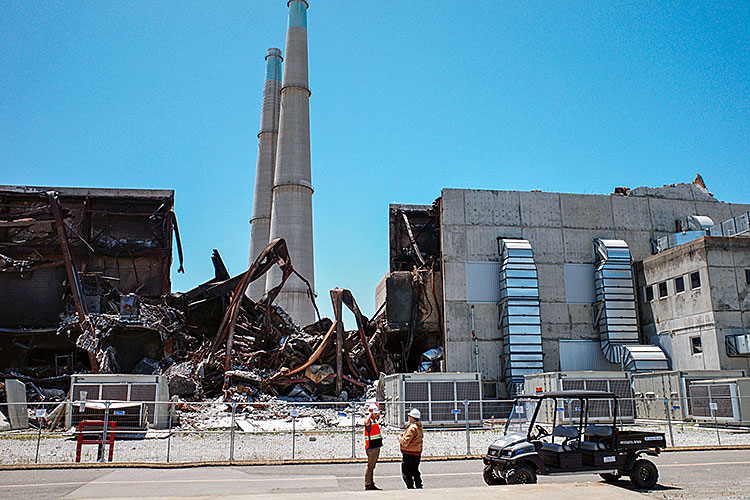
TOP PHOTO: Many of the items on the new ordinance that New Leaf Energy has issues with stem from the fire at Moss Landing’s BESS storage facility.