


By Dan Walters
Gov. Gavin Newsom dropped a brief and vaguely worded section into his State of the State address earlier this month, suggesting an overhaul of how California’s vast public education system is managed.
“It’s long overdue that we modernize the management of our educational system,” Newsom said, “and so in the budget I’ll be submitting tomorrow, I’m proposing that we unify the policymaking by the State Board of Education and the Department of Education, allowing the State Superintendent of Public Instruction to align our education policies from early childhood through college.”
The budget’s passage on this was longer, but still failed to explicitly say what Newsom had in mind.
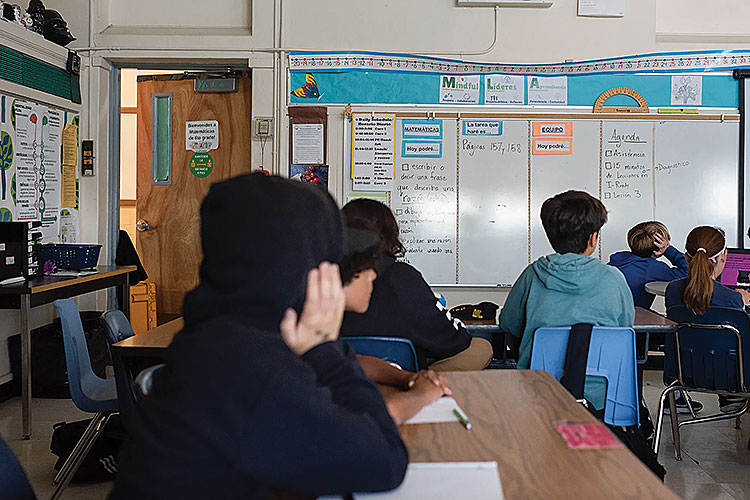
Students look forward during a lesson at the Melrose Leadership Academy in Oakland on Sept. 23, 2024. • Photo by Laure Andrillon for CalMatters.
The proposal cited two reports that criticized the multiple, often overlapping and sometimes competitive, state and local entities that govern schools. One was California’s Master Plan for Education, published in 2002. The other came from Policy Analysis for California Education, or PACE, a multi-university think tank, and was issued just weeks earlier.
The budget proposed moving oversight authority of the management of the state Department of Education and local districts under the California Board of Education.
Without saying so directly, Newsom would strip the elected state superintendent of schools of managerial authority over the state Department of Education, relegating the officeholder to an ombudsman or advisory role. Management would instead be vested in the Board of Education, whose members are appointed by the governor, along with an appointed executive director.
“These changes will strengthen governance of California’s education system to provide coherence and meaningful accountability to address the needs of students, parents, teachers, school staff, and administrators,” the budget proposal declared.
The current superintendent, former state legislator Tony Thurmond, complained that he was not consulted about what would be a major overhaul of responsibility for a system that serves nearly 6 million students and accounts for the largest single portion of the state budget.

It appears Newsom’s administration had been laying the groundwork for the power shift long before the State of the State address. The PACE report issued in December was part of that process and called for exactly what Newsom is proposing.
“California’s education governance system is a complex network of agencies and entities designed to serve the most diverse and expansive TK-12 population in the United States,” the PACE report said. “This system incorporates state, regional, and local levels of authority, each tasked with specific responsibilities and oversight.”
“However, its complexity often results in overlapping responsibilities, fragmented authority, and challenges in ensuring streamlined decision-making.”
PACE also issued a statement backing the change from Michael Kirst, a leading academic authority on education and architect of the Local Control Funding Formula enacted in 2012 under then-Gov. Jerry Brown.
Kirst called the proposal “a new vision and a dramatic overhaul” that would address what he described as a 19th-century governance structure.
“The lack of fundamental change since then has hindered education progress,” he said.
Politics aside, Newsom’s proposal would streamline a governance system that is currently opaque and fragmented, shielding many points of authority from accountability. At the same time, by vesting nearly total authority in the governor and appointed officials, it would make it harder for a governor to avoid accountability if educational achievement — which now lags — does not significantly improve.
•••
This article was originally published on ©CalMatters and was republished under the Creative Commons Attribution-NonCommercial-NoDerivatives license.