

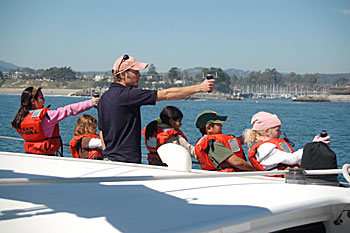
“O’Neill Sea Odyssey serves a vital role in getting students excited about science and about environmental stewardship, and this analysis bears that out,” says Dan Haifley, O’Neill Sea Odyssey’s executive director. The evaluation found that:
Before the program, a smaller percentage of students from lower income groups agreed with the survey questions overall (77%), compared to students from middle income groups (79%) and students from higher income groups (81%). After participating in the program, 96% of students from lower income groups agreed with the survey questions (19% difference), while 98% of students from middle-income groups (19% difference) and 97% of students from higher income groups (16% difference) agreed.
Of the three topics learned on the boat, 98% of teachers/group leaders thought students had “learned a lot” in the Ecology station, followed by 96% of in the Marine Science station, and 94% in the Sailing & Navigation station. Of the four topics learned in the classroom, most teachers/group leaders again said that students had “learned a lot” in the Follow-up and Discussion (98%), closely followed by the Marine Science station (97%), the Ecology station (94%), and the Sailing and Navigation station (91%). Almost all of the teachers/group leaders (99%) reported that their students had “learned a lot” from the overall learning experience.

The analysis also found that:
- Most groups came from Santa Cruz County (41%), Santa Clara County (32%) and Monterey County (22%).
- Approximately 96% of groups were of students between 4th and 6th grade, the programs target population. Six percent of students had attended the program previously.
- Based on population estimates, 54% of the students were Hispanic or Latino, 25% were White, 13% were Asian, Filipino, or Pacific Islander, 2% were African American, less than 1% were American Indian or Alaska Native, and 5% were of another race/ethnicity.
- It was estimated that 52% of the students attending the OSO program did not have English as their primary language, a slight increase since 2007‑08.
- More than half (58%) of students were receiving free or reduced price meals, more than ever before.
Besides this one-year snapshot, a study of the long-term impact of the program by San Jose State Master’s candidate Lauren Hanneman has also been completed.