


By Jon Chown
Seawalls, raised boardwalks, dune restoration and other measures will be needed to protect local beaches from sea-level rise caused by climate change, according to a new study. The findings were presented Thursday by California State Parks and Friends of Santa Cruz State Parks.
The California Department of Parks and Recreation evaluated a range of approaches for Santa Cruz County beaches, including fortifying existing facilities, relocating vulnerable infrastructure and hybrid strategies combining natural and engineered solutions.
The problems facing the beaches include cliff erosion, shoreline retreat, tidal inundation, wave overtopping, and temporary beach loss from storms. In order to mitigate this, solutions ranged from habitat restoration to the relocation and even removal of some infrastructure.

Storm debris at Seacliff State Beach
The recommended strategies vary. At each site, three approaches were considered: restore and relocate; fortify and protect; or a nature-based hybrid approach. Each was evaluated for its current, near-term, mid-term and long-term effects. For the most part, a hybrid approach was recommended.
“This project is about balancing recreation and conservation in the face of climate change,” said Friends of Santa Cruz State Parks Executive Director Bonny Hawley.
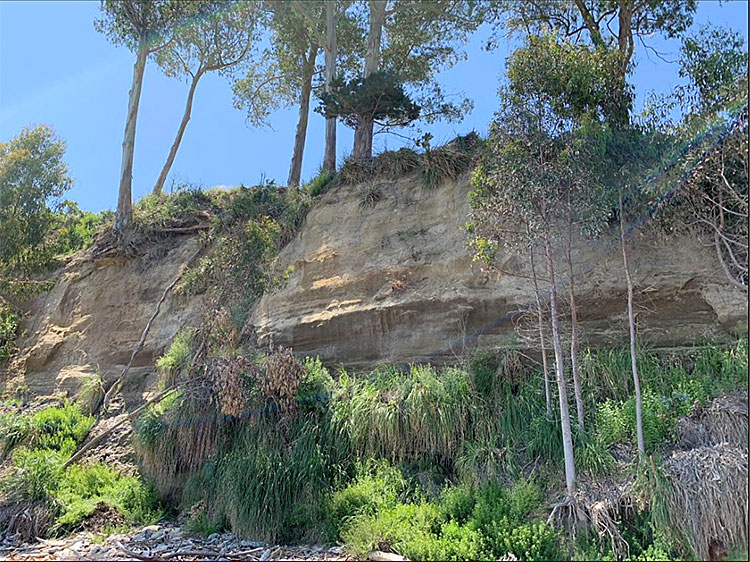
At New Brighton Beach, a hybrid approach calls for a “managed retreat,” with the existing elevated beach trail, and present-day facilities reduced to create about 1 acre for beach habitat and public recreation. Beach habitat would be restored, and native grasses planted on the lower cliff face to prevent erosion.
The other approaches were deemed inappropriate here. A “restore and relocate” approach would limit or possibly even eliminate ADA access to the beach, so it was rejected. A “fortify and protect” approach would take up a lot of habitat and might even accelerate the loss of the beach, so it was also rejected.
At Seacliff RV Campground, a hybrid strategy would relocate facilities, such as the comfort stations and shower facilities, and even the RV campground, to other locations in the park. Benefits to this alternative, says the study, include a wide enough beach for recreation, as well as space for habitat to enhance local biodiversity. The length of the beach would also remain open for public access.
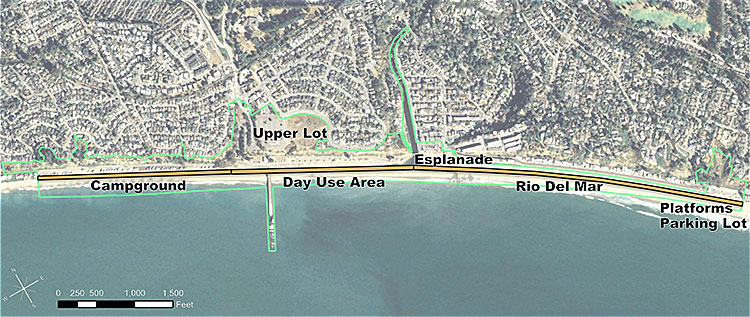
Subareas at Seacliff State Beach
The other approaches weren’t considered feasible. To fortify and protect the park would require so much fortification that it would be cost prohibitive. A restore and relocate approach would give up too much beach and habitat to the sea.
The Seacliff Day Use Area would also follow the hybrid approach, with facilities moved back as the beach erodes. Major portions of the existing seawall would also be moved back, consolidated at a higher elevation closer to the Visitor Center. This alternative was favored because it would create significant beach habitat and space for recreation and water activities over time.
“Vegetated dune formations would be created on the beach to enhance the scenic quality of the shore, increase opportunities for nature observation, improve resilience and enhance biodiversity,” the study said.
The fortify and protect strategy was deemed to require too many infrastructure improvements and would be inconsistent with coastal development policies. A restore and relocate approach at Seacliff Day Use Area would result in the loss of too much space for public recreation and habitat.
There are fewer options at the Rio Del Mar Esplanade, where a restore and relocate approach is favored. It would remove the restroom and seawall, create living shoreline elements and install cobble berms to protect planting areas. The recommended approach for the Rio Del Mar Platforms Parking Lot is to fortify and protect. Located about half a mile down Beach Drive from Aptos’ beachfront, the lot provides 60 parking spaces and two ADA-accessible spaces, as well as public beach access. The width of the beach can range from about 85 to 300 feet and provides some resilience to erosion and shoreline retreat, but it is mostly flat and does not prevent flooding. The fortify and protect alternative was primarily selected to preserve the current level of public access and parking. Other alternatives would have reduced the parking.
According to the study, the solutions were guided by public input, emphasizing visitor experience, recreation, scenic quality and environmental protection. Adaptation measures are phased to address projected sea-level rise of 1 foot by 2050, 2 feet by 2070, and 4 to 6 feet by 2100.
•••
Sea Level Rise Projections for Monterey Bay
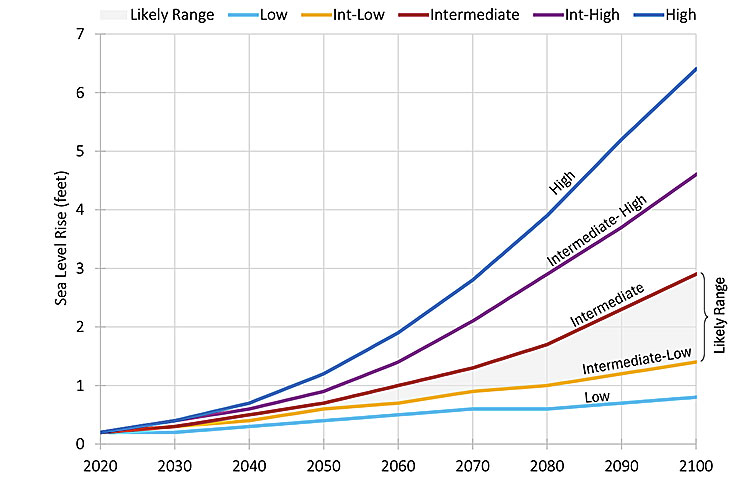
Intermediate-High (purple). This scenario reflects rapid ice sheet loss contributing to sea level rise and is representative of a plausible high-end projection.
Intermediate (red). This scenario is driven predominantly by high emissions scenarios and provides a reasonable upper bound for the most likely range of sea level rise through 2100.
Intermediate-Low (yellow). This scenario provides a reasonable estimate of the lower bound for the most likely sea level rise through 2100.
Low (light blue). Linear trend based on the current rate of sea level rise continuing into the future. This scenario is on the lower bounding edge of plausibility given current warming trajectories.
From the California Ocean Protection Council
•••
The study was presented at Samper Recital Hall at Cabrillo College. The study can be found at www.seacliffresilience.org.
TOP PHOTO: Establishing vegetative habitat on top of the Seacliff and New Brighton cliffs will contribute to bluff stabilization and erosion protection.