


By Jon Chown
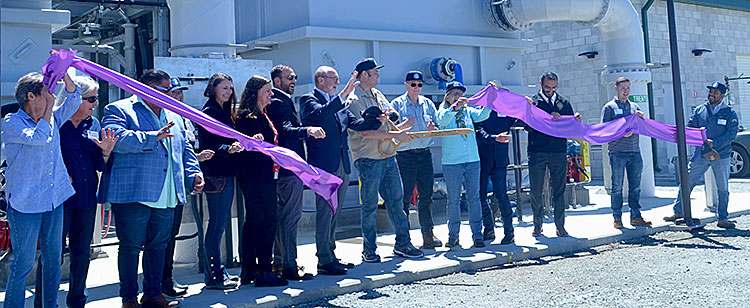
WATSONVILLE — A celebration was held Aug. 8 for the Pajaro Valley Management Agency’s latest project completion, and one it’s most significant in the agency’s history, the College Lake Water Supply Project.
Since June, the new project has been conveying hundreds of acre feet of treated water to thousands of acres of thirsty farmland in the Pajaro Valley, further reducing the need to drain the aquifer, which results in saltwater intruding farther into the valley’s wells. In addition to that, the project will help the local steelhead population.
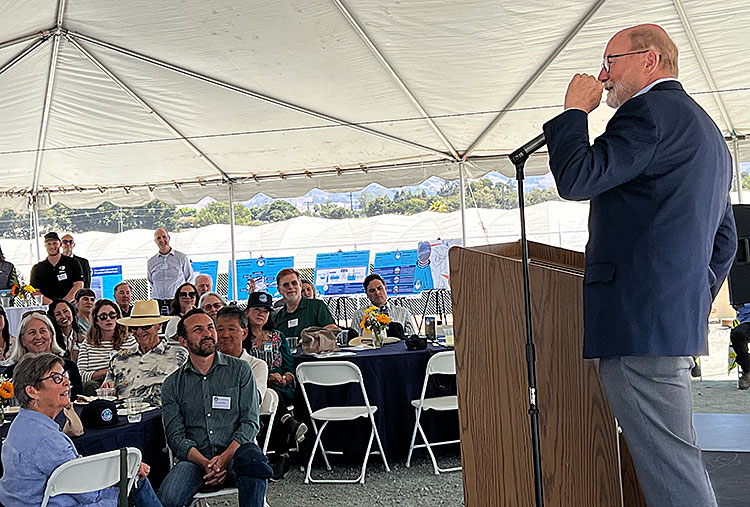
State Sen. John Lard (D-17) delivers remarks on the facility’s importance.
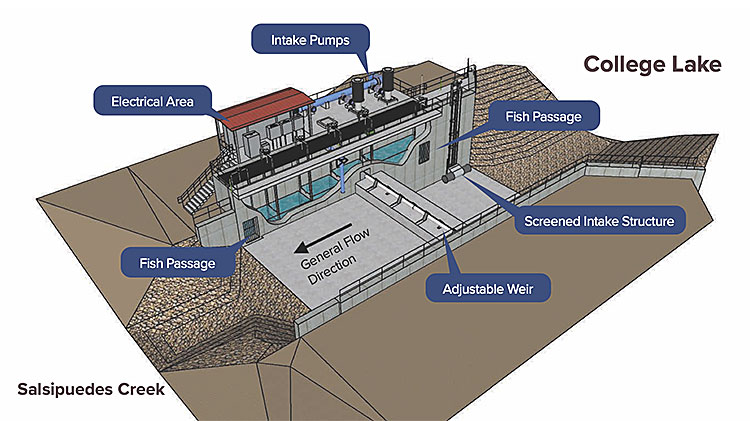
It’s a massive $80 million installation with three major components: a water intake facility with a fish passage; a water treatment plant on Holohan Road; and a six-mile pipeline to connect the project to 23 miles of existing pipeline. More than $10 million of the funding came from grants and the state. The celebration was held at the treatment plant.
“This is really the Pajaro Valley relying on itself. What a reason to celebrate; this is really something,” said State Sen. John Laird, who represents the 17th District, which includes Santa Cruz County.
Laird said he first heard of the idea for the water project from Dick Peixoto more than 20 years ago while a student of the local Agri-Culture educational program and “here we are 26 years later, fully living that dream.”
PVWMA General Manager Brian Lockwood joined the organization in 2005 as a hydrologist. “It feels like I’ve been working towards this day the entirety of my career,” he said.
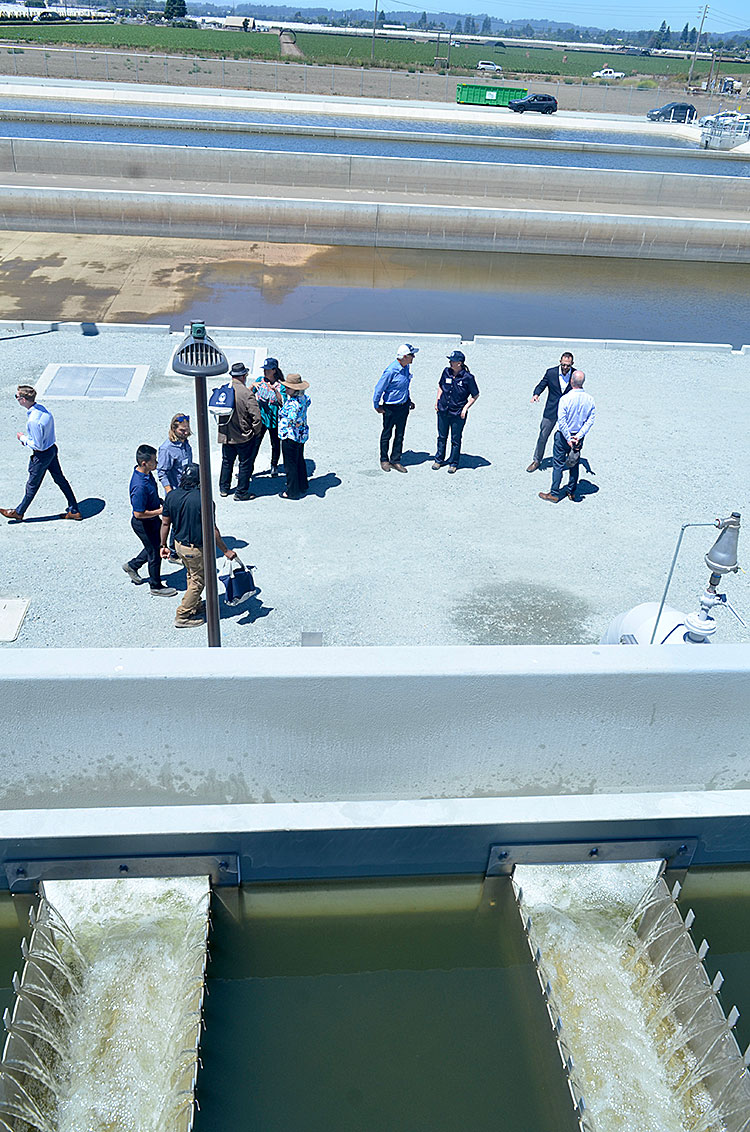
A view from atop the Holohan Road water treatment facility.
College Lake is a seasonal lake located about a mile from Watsonville. Several local creeks drain into it. One of those creeks, Casserly Creek, as well as two of its tributaries, Bates Creek and Gaffey Creek, support South-Central California Coast steelhead, an endangered species.
The intake facility has two pumps that pull water from the lake through a fish screen. An adjustable weir will also have a fish passage allowing fish to enter and exit College Lake during migration and outmigration periods. It will provide from 1,800 to 2,300 acre feet of water each year.
“It’s weird,” Tom Rider quipped when asked about the project. Rider was one of many past PVWMA board members who were at the celebration. The crowd was filled with elected officials, officials from the Department of Water Resources, the Department of Conservation, and members of the agricultural community connected to the PVWMA, even some who have been critical of some of its past ventures.
“This is what happens when you give the government a lot of money,” joked Dave Kegebein, also a past board member.
Mary Bannister, who retired as general manager from the PVMA in 2016 and then joined its board, ran through the agency’s long history and struggles — the myriad lawsuits it has faced and the hurdles overcome “through the perseverance of a dedicated board and a fearless staff.”
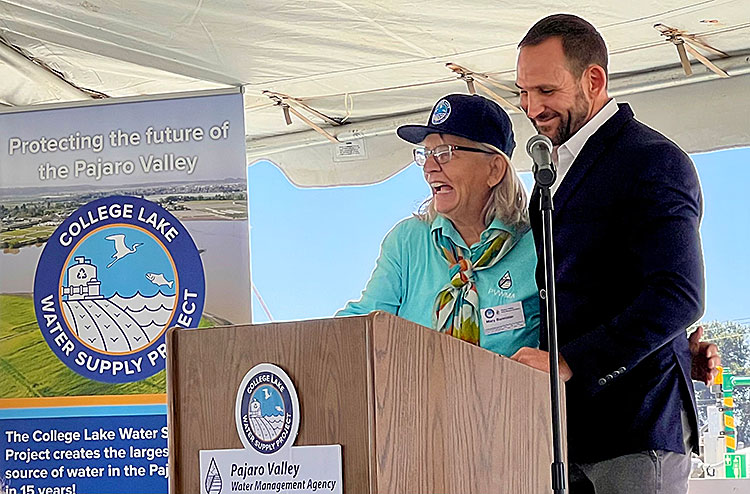
Past PVMWA General Manager Mary Bannister and current PVWMA General Manager Brian Lockwood talk about the project during the Aug. 8 celebration.
“I can’t think of a more complicated project,” she said, noting that only will the project deliver water, but protect wildlife habitat for future generations — our children and grandchildren.
“And I’ve got pictures of my grandchildren if you want to see them,” she laughed.
Ninety percent of Pajaro Valley’s water is pumped from the ground. As the water level in the aquifer has fallen over the decades, saltwater has spoiled wells along the coastline and slowly intruded into the valley. The only solution, according to the PVWMA and the hydrologists it has hired to study the problem, is to stop using more water in the coastal areas than is replenished.
•••
Cover Photo: Officials line up to cut the ribbon to officially open the College Lake Water Supply Project.