


By Jon Chown
A two-hour update with information from federal and state agencies involved in the Moss Landing Vistra fire cleanup is scheduled for March 17 during the Monterey Board of Supervisors meeting. The announcement was made Feb. 3 during a supervisors’ meeting that drew some ire from the public over its lack of information on the subject.
Kelsey Scanlon, director of the Monterey County Department of Emergency Management, gave a brief review of the progress being made on the fire’s cleanup. More than 19,000 of the 35,772 intact battery modules have been de-energized, and 16,000 have been removed to a facility in Nevada. There have been no flare-ups. Demolition activities are on pause until the team works through the remaining accessible intact battery modules. The second phase of demolition is still expected in mid-2026.
The county has been somewhat left on the sidelines as state agencies and the EPA direct the next steps in the process. That has caused frustration among residents and supervisors. Both are hoping some hard questions get answered.
“It’s a year later and not much is different other than Vistra is just going to do what Vistra is going to do,” said resident Michelle Cleary during public comment. “A quick six-minute update … isn’t really doing it. So I hope the March 17 one is a lot better.”

Glenn Church
Supervisor Glenn Church said the cause of the fire had still not been determined, and that is essential to know.
“I just can’t stress how important it is to know the cause of the fire because Vistra will start up, I’m assuming, sometime this year. It’s their decision under the CPUC (California Public Utilities Commission). We don’t have any say-so on that,” he said. “Maybe we’re not even going to get this truly answered because it just seems like the CPUC is not taking it seriously.”
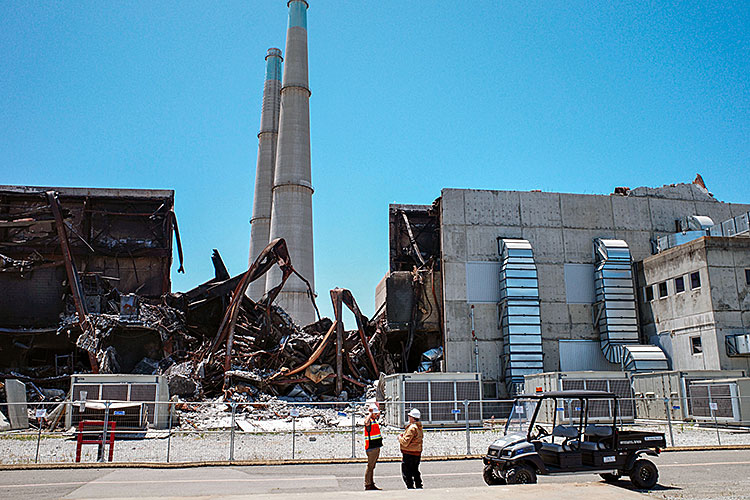
The Vistra BESS facility in Moss Landing is really three separate facilities sitting next to each other. Facility 1, Moss 300, burned. It used LG lithium-ion batteries stacked on racks densely indoors. It will not be restarted. Facility 2 is Moss 100; it is smaller and was already offline when the fire occurred. It is effectively in limbo. Moss 350 did not burn and has a different design. It has containerized battery units outdoors, with each container having its own fire suppression.
According to Vistra, restarting Moss 350 is a possibility and is under evaluation. It has no plans to restart the Moss 100 BESS facility at this time, and any restart of either facility would be done in consultation and coordination with appropriate regulatory bodies.
Church said that restarting the facility without knowing what caused the fire would be irresponsible. “If you repeatedly have accidents, the public is going to lose faith in this technology and we’re not going to move in the direction that we need to. In order to learn from a mistake, you have to know what the mistake was. Since we don’t know the cause, we haven’t learned from the mistake.”
Ed Mitchell, the lead investigator for the local group Never Again Moss Landing, said his group had photographic evidence of the cause: The batteries were stacked too close together. He displayed a photo during the meeting of the inside of the plant before it burned. Boxes of batteries could be seen strapped against each other in long rows stacked two high.
“Look at those,” Mitchell said. “That is zero separation for every box in the building. … No wonder it burned down.”
Board Chair Wendy Root-Askew said the county would do its best to make sure pertinent questions were answered at the March 17 meeting, which she said would take place as close to 1:30 p.m. as possible.
TOP PHOTO: Demolition of the BESS facility in Moss Landing continues.