


By Jon Chown
It took more than 50 years, but a song that local musician Mark Bradlyn wrote and recorded with his band in 1968 has finally been released.
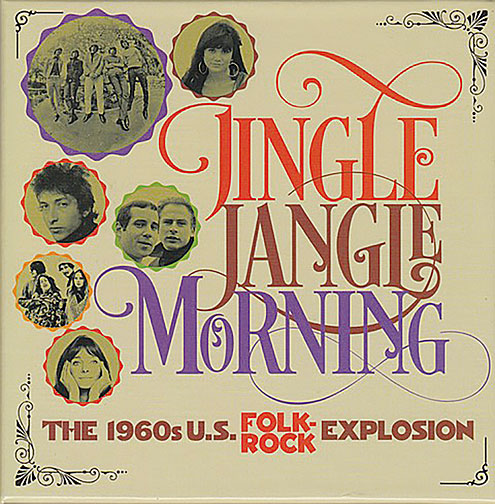
Bradlyn, who was 19 at the time, wrote and recorded “Watch You Walk Away” with his folk-rock band Stourbridge Lion. The song was recently included in a compilation released in Great Britain titled Jingle Jangle Morning: The 1960s Folk-Rock Explosion.

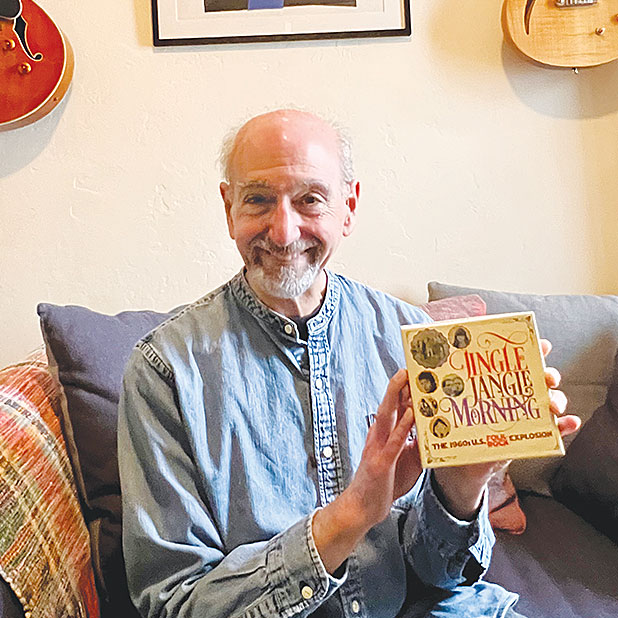
Mark Bradlyn holds the cover of his recently-released 58-year-old album.
The three-CD set includes songs from the Byrds, Bob Dylan, Simon & Garfunkel, Phil Ochs, Poco, Nico, Gordon Lightfoot, Judy Collins, the Grateful Dead and many more — even one from Stourbridge Lion.
Bradlyn wrote the song during the Summer of Love in 1967. He had just arrived from Florida and landed at Occidental College, where he was going to school. There, he met up with Stourbridge Lion, which was looking for a singer and had heard him playing his Martin guitar and singing in the quad.
He said the love song wasn’t based on any relationship he’d had. “It was a song about songs,” he said.
After they recorded a demo of it during a show in Glendale, the song was good enough to launch the band on a mini-tour of the Midwest. It would start with a three-week gig at Arnie’s Pizza King in Lafayette, Indiana, where the owner had given them $1,000 in advance and promised another $1,000 at the end.
The plan was for the band to play some gigs to hone their sound, then record a full album and announce a big tour. But they would need a new drummer — something that would become a recurring dream, or nightmare, during Bradlyn’s career.
Ron Wilson, the drummer at the time, was a star. He played the drum solo on the Safaris’ smash hit “Wipe Out,” which he insisted Stourbridge Lion perform at every show so he would be recognized. Unfortunately, according to Bradlyn, Wilson was also a thief. He was caught “blue-handed” when a club owner suspected someone in the band of stealing money from women’s purses inside the club. The owner had sprinkled blacklight powder inside a purse and set it out as a trap. At the end of the night, he brought the band into his office — which was decorated with blacklight posters.
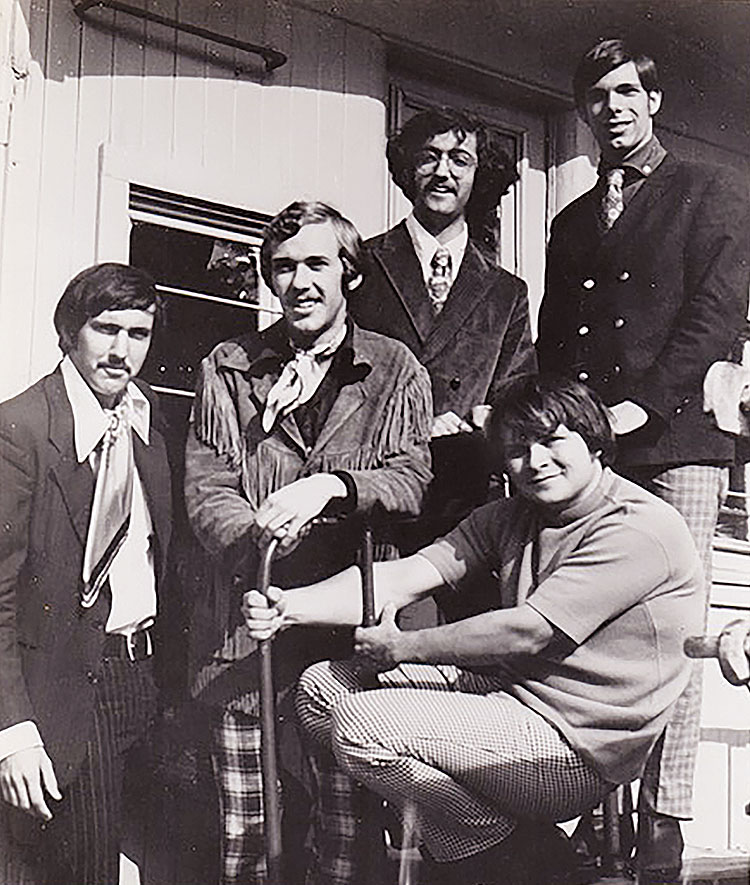
A photo of “Stourbridge Lion” in 1968. Mark Bradlyn is pictured in the middle, wearing glasses.
“Ron’s hands glowed bright blue. It was appalling. Really, it was a kick in the head,” Bradlyn said. “But our management team was really behind the band. They wanted us to succeed, so they set up this Midwest tour. The idea was to play those weeks at Arni’s, pick up some gigs on the way back and be a really tight band ready to record in the studio.”
The band found a new drummer, Terry Hand — another excellent guy on the sticks, Bradlyn said. The band sounded great and headed out to the Midwest. But after arriving in Indiana, Hand took a look around and said, “I’m not playing for these farmers!” and abruptly left. The rest of the band begged their parents or friends for money to pay back Arni the Pizza King the $1,000 advance — and left, too.
“It really was a bad decision, but we were idealistic, and we had a sound, and didn’t want to compromise,” Bradlyn said.
After returning to Los Angeles, the band soon broke up. Bradlyn got a copy of the demo tape and kept it, listening from time to time to reminisce. He eventually shared the band’s story with Bay Area rock historian Richie Unterberger, who then wrote a story about the band. That sparked enough interest in Stourbridge Lion for the song to be included in the compilation.
Bradlyn was delighted. “Who would have ever thought? It was more than 50 years ago,” he said.
Bradlyn continued his music career but said he never quite got the break he needed, despite having some connections.
“I could never find my way. I didn’t have a clear focus,” he said.
At one point, Bradlyn even got an audition with Leonard Cohen’s manager.
Bradlyn returned to Florida, recorded some demos and sent them off. After hearing nothing, he waited for months before mustering the courage to call the manager.
“I reminded him of my name and the tape I sent, and he said, ‘Oh yeah, didn’t knock me out. Thanks for sending it,’” Bradlyn recalled. “There are all these moments of disappointment.”
Bradlyn moved back to California in 1973 and joined a Palo Alto band named the Nightwings. They just needed a drummer.
“So I was in a music store talking about how we needed a drummer, and this guy walks up and says, ‘I just overheard you guys. You looking for a drummer? I’m a drummer,’ and he looks over at me — and it’s Terry Hand!”
Despite the history, Hand joined the band. “He’s a good drummer!” Bradlyn said.
After a few successful gigs, the band played a nightclub in Redwood City.
“There were two people in the audience. We were tuning up, and Terry Hand gets up from his drum kit and says, ‘I’m not playing for two people,’ and he walked out,” Bradlyn said.
The band continued to grow despite that gig and eventually went into a studio to record. The night before the session, their manager, Tom Adams, essentially forced them to sign new contracts.
Bradlyn said the next morning they had a great session and were offered a contract by Lou Adler, who produced the Grass Roots, the Mamas & the Papas, and Carole King.
“He said, ‘If you can get out of that contract, I can work with you.’”
The band went to court and eventually got out of the contract — but it took two years.
“By that time, interest had vaporized,” Bradlyn said.
So Bradlyn missed another shot. He moved to Santa Cruz in 1976 and got a job at Bookshop Santa Cruz. He’s lived in the area ever since and now lives in Aptos. He continued to perform in various bands and solo, recording some solo albums. He has also been active in local theater, performing in productions such as Cabrillo Stage’s The Music Man in 2004, and writing plays that have been performed locally. He also won a James B. Hall Award for short fiction. He and his wife opened Mockingbird Books in Aptos in 1995.
Bradlyn said seeing his 1967 song published gave him a special thrill.
“That my song, recorded not in a studio but solely as a demo on the stage of a Glendale music club, should be included among such stellar company is one of the most delightful happenings in my life,” he said.