


By Jon Chown
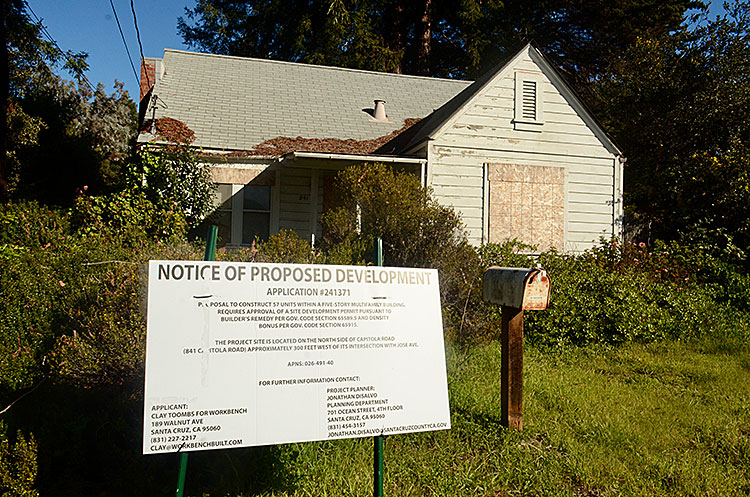
After hours of discussion and debate, the Santa Cruz County Board of Supervisors on Tuesday approved a 57-unit multifamily housing project at 841 Capitola Road, bowing to California’s housing laws and drawing the anger from many neighbors over the project.
The 4–1 decision, with Supervisor Justin Cummings the lone vote against, followed a rare “de novo” public hearing, meaning the Board reconsidered the project after taking jurisdiction over an appeal of the Planning Commission’s earlier approval. The appeal was filed by Michael Reis on behalf of Supporters of Reasonable Development for Live Oak, a residents’ group that argued the county failed to adequately evaluate safety, access and parking impacts.

The developer, Workbench, had gotten approval from the Santa Cruz County Planning Commission on Oct. 22. The project had been pushed forward using “Builder’s Remedy,” which allows housing projects to move ahead, bypassing local restrictions, if a local Housing Element is not in place. On Dec. 9, the Board of Supervisors voted to take jurisdiction of the approval process.
Back in 2024, Santa Cruz County was late submitting its required plan to add more housing, called a Housing Element, to the California Department of Housing and Community Development. As a result, the county’s Housing Element was not certified until April 12, 2024. Workbench submitted its application on April 9, 2024. Other projects were also submitted during that period. However, according to county staff, the problems were not entirely due to the county, as the state admitted that some clerical errors of its own delayed the process.
Neighbors who are against the plan contend that the state had given the county verbal approval of the Housing Element before April 9 and had threatened to sue if the county approved the project without a second hearing. Besides the inappropriateness of such a large development being squeezed into such a tight spot in the neighborhood, they also raised concerns about traffic flowing through Grey Seal Road, a residential street that will serve as the project’s primary access point.
At the Feb. 10 hearing, residents asked the county to take the state to court, but county counsel advised the supervisors that the county would likely lose a lawsuit. Supervisor Felipe Hernandez read from a news article, noting that no county or city in California had yet prevailed in court against a “Builder’s Remedy” suit. “Not Los Gatos, Beverly Hills, Cupertino and on and on,” he said.
The residents in attendance shouted out, demanding a court battle.
“If it didn’t require gambling $3 million of General Fund money, I would agree,” said Supervisor Manu Koenig, who wished them luck in fighting the state themselves. “You have a much better chance of winning than the county.”
According to a traffic analysis prepared for the development, nearby intersections are expected to operate well enough even with the added trips from the new units. Traffic engineers also reaffirmed that access via Grey Seal Road, not Capitola Road, is the better route. Capitola Road is a major artery with bike lanes, a staff report said, and the closely spaced driveways make a new curb cut both unsafe and inconsistent with the General Plan.
“The law does not allow us to redesign this project based on subjective concerns,” the report said, citing court decisions that bar local agencies from reconfiguring density-bonus projects over community opposition.
Supervisors also upheld a reduced parking plan for the project, approving between 27 and 31 on-site spaces, far fewer than typically required under county code. Staff explained that state density bonus law allows such reductions and prevents the county from requiring new parking studies unless it has completed a qualifying jurisdiction-wide analysis — which it has not.
Supervisors also modified a condition of approval related to affordable housing. Under the final decision, the developer must either pay the county’s Affordable Housing Impact Fee for all market-rate units or, if the fee is not paid, provide 15% of the units as deed-restricted affordable housing.
Unless litigation is filed by the neighbors, Tuesday’s vote apparently clears the way for construction of the 57-unit building. Supervisor Monica Martinez said she understood the frustration of the neighbors, as it was frustrating for the supervisors as well.
“It’s incredibly difficult to represent a community and have decisions taken out of our hands by the state,” she said.