


By Joe Ortiz
If you’re like me and you take a lot of notes, you must find scraps of paper, bar napkins, lists of ideas everywhere. How do we keep track of it all? And ultimately, how would we shape those notes into a cohesive article, essay, report, or paper?
In The Hand of A Poet, author Rodney Phillips describe Walt Whitman’s process for writing a poem: he would write the initial idea on a scrap of paper and place it in an envelope. On ensuing days, he would “lie in wait” for other ideas and phrases to enhance the poem’s theme and imagery. After writing these new inspirations on separate bits of paper and placing them in the same envelope, he would then fashion them into a finished piece.

Tullius says that writing a book is “like wrestling a grizzly,” because the task is so overwhelming in volume and scope. Although Tullius’s method is demanding, it can make a large quantity of information easier to handle and organize. And it can make the writing process nearly foolproof for constructing a first draft.
What We Can Do: Try the method yourself. You’ll see how it offers an elaboration of Whitman’s technique for writing a poem yet can be tailored to the demands non-fiction:
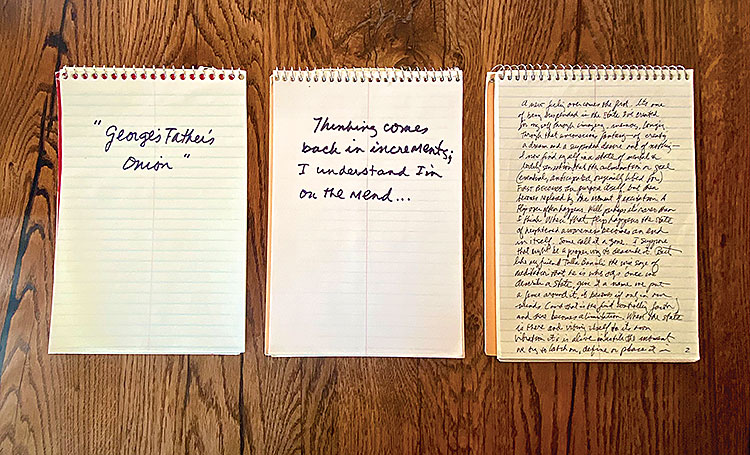
- a) Use a steno pad to take your notes, one idea per sheet, whether it’s one word, one sentence, or a full paragraph,
- b) It’s fine to write your ideas in no particular order because, as many authors would point out, our ideas don’t often reveal themselves to us in chronological order,
- c) After you’ve gathered enough pages to adequately cover your topic, lay the pages out one at a time on a table,
- d) Once you see how they flow, re-arrange the notes in an order that makes sense; when you find a good beginning, place it first; do the same with a section that appears to be a good ending. Those notes that support your argument belong in the middle, and of course, in true, “story-building” structure, order them in logical nuggets of information that support your theme,
- e) If after reading the material, you discover that you’re lacking in supporting insights, details, transitions (or more research), write new entries on separate pages and insert them in the proper place,
- f) When you feel like you’ve exhausted your topic, copy the material into a computer, file, taking care to make whatever transitions and qualifying phrases the narrative might demand,
- g) If you’re writing a book, the process is the same. But place the notes in individual chapters first. Then arrange the chapters in a logical order.
You might ask yourself, “If you use a very mechanical technique to build a framework, can it really be writing?”
But trust the process. I’ve discovered that through one’s effort in pouring over quotes, facts, and anecdotes and placing them in order, you’ll start to recognize a logical flow of narrative, bolstered by the various natural transitions you’ve added along the way. Furthermore, new ideas will arise during the input stage that will help color the narrative with your personal style.
As Tullius once told me — only halfheartedly in jest — “The book or essay practically writes itself.”
•••
Reader response: I’d love to hear your comments and questions. Email me at joe@gocapitola.com