


By Jon Chown
A trial over who owns part of an Aptos parking lot is on hold as both sides wrangle over evidence, asking the judge to intervene. Santa Cruz County Superior Court Judge Syda Kosofsky Cogliati is scheduled to consider several motions Sept. 24.
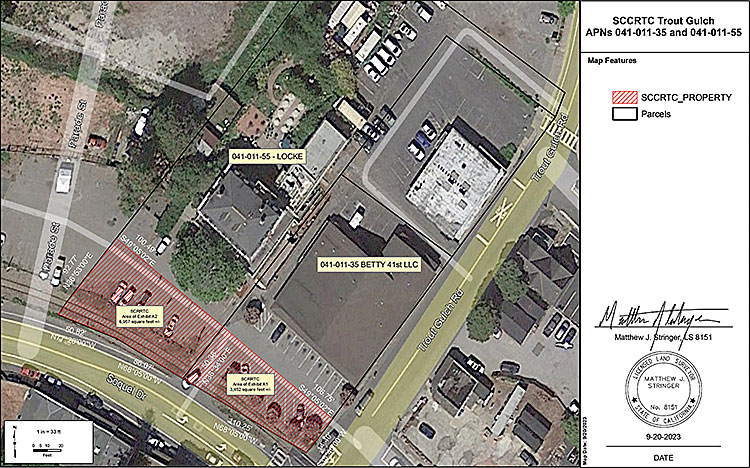
The Santa Cruz County Regional Transportation Commission filed the lawsuit Oct. 2, 2023. It asks the court to settle competing ownership claims to about 3,452 square feet of a parking lot at 403 Trout Gulch Road.
The RTC says the disputed land is part of the Santa Cruz Branch Rail Line, which stretches from Watsonville to Davenport. The agency bought the 32-mile rail corridor from Union Pacific Railroad in 2012.
The RTC claims it owns the disputed land outright. Betty 41st and other defendants argue that the railroad received only the right to use the land for railroad purposes.
The trial had been expected to begin this summer. At a June 18 hearing, the court struggled to find an open courtroom and said a trial could not begin before July 13. But now, months later, a trial date has still not been set.
The dispute centers on a deed signed by Jose Arano on Dec. 30, 1876, and recorded in January 1877. The deed gave the Santa Cruz Railroad Company land for a railroad right of way, its main track, a side track and a depot. Both sides trace their claimed property rights to that deed. However, they disagree over what Arano gave to the railroad.
The RTC argues that the deed gave the railroad full ownership of the property. That type of ownership is known as “fee simple.” Betty 41st argues that the deed created only an easement, which would give the railroad the right to use the property without owning the land beneath it.
Two Sides Make Their Claim
The RTC filed an amended trial brief Sept. 10 laying out its case.
The agency points to language in the deed granting the railroad “all that certain tract of land.” It argues that the words describe a transfer of the land itself, not simply permission to use it. The RTC also points to language stating that the deed’s terms would apply to the “heirs, assigns and successors” of Arano and the railroad company. The agency argues that those words support its claim that Arano transferred full ownership.
Betty 41st offers a different reading of the same document.
The company argues that the words “for a right of way” show that Arano allowed the railroad to use the property for a limited purpose.
It also points to several limits placed on the railroad. The deed required the railroad to keep access open to Arano’s property.
It restricted where tracks and switches could be built and barred most structures other than tracks and a platform. It also limited the storage of lumber, stone, dirt and other freight on the land.
Betty 41st argues that those limits, along with the lack of a cash payment to Arano, show that the railroad received an easement instead of full ownership.
Betty 41st said the disputed area has been used for customer and tenant parking since at least the 1940s.
The RTC says the property remained with the railroad through several company mergers. According to the agency’s trial brief, the Santa Cruz Railroad Company later became part of the Pajaro and Santa Cruz Railroad Company and then Southern Pacific Railroad. Southern Pacific later merged with Union Pacific, which transferred the branch line to the RTC through a quitclaim deed in 2012.
In addition to the dispute over the 1876 deed, the two sides are fighting over what documents and testimony the judge should allow at trial.
Betty 41st filed a motion asking the judge to block the RTC from using an owner’s title insurance policy and preliminary title reports as proof that it owns the land.
A First American Title Insurance Co. policy issued when the RTC bought the rail line described the agency’s interest as fee simple. The RTC cited that policy in its trial brief.
Betty 41st argues that a title insurance policy is a contract that protects a buyer against certain financial losses. It does not decide or prove who owns the property, the company said. Betty 41st also said the RTC’s policy contained broad exceptions involving deeds that used the term “right of way” or transferred property for railroad purposes.
The company said other title insurance records reached a different conclusion. According to its court filing, an Old Republic policy described the disputed area as an easement. Betty 41st said First American also described the land as an easement in a 2006 lender’s policy.
Betty 41st is not asking the judge to ban the title records for every purpose. Its attorneys said the documents could still be used to show what the parties knew or to challenge a witness’s testimony. The company wants to prevent the RTC from presenting the policies as direct proof of ownership.
The RTC also filed three motions of its own.
In the first, the agency asks the judge to block many documents and statements created after the 1876 deed. The RTC argues that the deed must be read based on its own words and that later records cannot be used to change its meaning.
The agency’s second motion asks the judge to exclude county parcel maps, property numbers and related statements by county surveyors and assessor-recorder employees.
The RTC argues that recording a parcel map does not transfer ownership. It also says assessor parcel numbers are used to collect taxes and are not proof of a property’s legal boundaries or ownership.
In its third motion, the RTC asks the court to exclude a 2020 settlement involving the closure of the Bayview railroad crossing and the opening of another crossing at Parade Street.
The agreement involved the RTC, Negro, Valledor, the VN Living Trust, a developer, Swenson Builders and the Santa Cruz County Department of Public Works.
Betty 41st argues that the agreement supports its claim because the RTC signed a document describing the land as property belonging to Negro and Valledor. The document allowed workers to enter the property and close the Bayview crossing.
The RTC argues that the agreement dealt only with closing the crossing and did not decide who owned the land. The agency also said the county Department of Public Works did not sign the agreement, even though it was listed as one of the parties. It also claimed that the agreement contains no words transferring property from the agency to Negro or Valledor, and argues that the agreement states that none of its terms should be treated as an admission that earlier claims were true or false.
According to the RTC, the agreement required Negro, Valledor and the trust to release claims connected to the crossing project. The RTC said it did not release any claim to ownership of the disputed land.
The case has also included a long fight over the RTC’s release of records to Betty 41st.
On Aug. 27, Cogliati granted part of a Betty 41st request to enforce an earlier discovery order but denied other parts. Discovery is the court process that requires each side to share records and other evidence before trial.
Betty 41st argued that the RTC had not clearly said whether it had produced all the requested documents. The company asked the judge to impose financial penalties and decide certain issues in its favor.
The judge ordered the RTC to file a statement explaining whether it had produced the records, could not find them or was refusing to release them because of a legal objection. The judge declined to impose any penalties.
The RTC filed its statement Sept. 1 and said it had already released records related to the branch line and the 2020 settlement. It said other documents were protected by attorney-client privilege or rules covering an attorney’s work. The RTC said it gave Betty 41st a list identifying the records it withheld.
The agency also said it could not find communications between the RTC and earlier railroad owners about the disputed property. It identified Union Pacific, based in Omaha, Nebraska, as a company that might have some of those records. n
•••
The court had not yet ruled on the Sept. 10 evidence motions as of Sept. 14, when this publication was sent to print. The case is Santa Cruz County Regional Transportation Commission v. Trout Gulch Crossing, case No. 23CV02345.
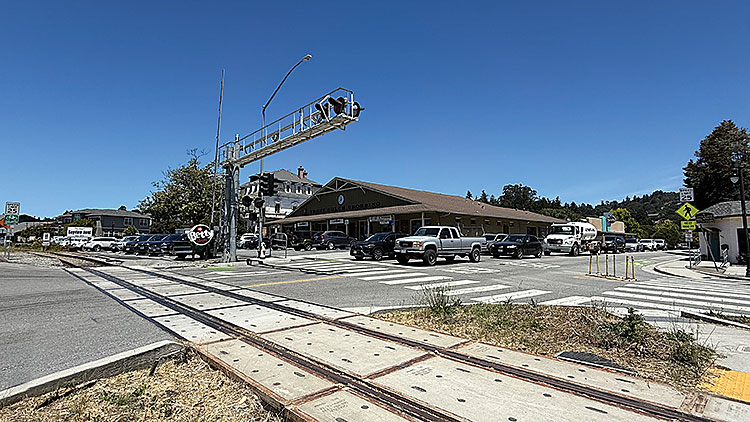
TOP PHOTO: A look at the Parking Lot in question at the corner of Soquel Drive and Trout Gulch Road.