


By Jon Chown
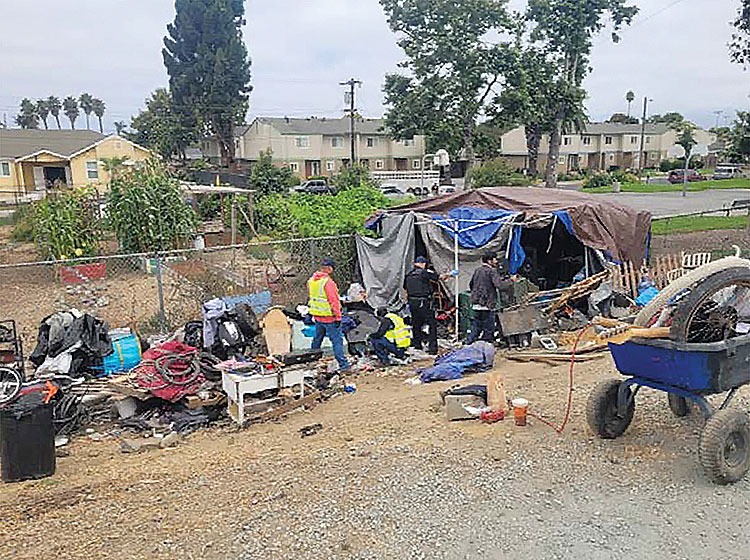
WATSONVILLE — The Watsonville City Council approved major changes to the city’s camping ordinance, creating clearer rules on camping in public spaces and creating a map of specific no-camping areas.
The changes, approved July 7 on the Consent Agenda, rewrite Chapter 36 of the Watsonville Municipal Code.
According to a staff report, the revised ordinance is meant to simplify older regulations, reflect recent court decisions and strengthen enforcement while outlining procedures for handling people’s property during encampment cleanups.
The council also adopted an official map showing “No Encampment Zones,” areas where camping is prohibited and where city crews can take immediate enforcement action.
The ordinance follows a 2024 U.S. Supreme Court ruling in Johnson v. City of Grants Pass, which found that cities may enforce camping restrictions on public property without violating the Eighth Amendment’s ban on cruel and unusual punishment. It also follows Gov. Gavin Newsom’s executive order encouraging California cities to remove encampments that threaten public health and safety.

The new law keeps the city’s general ban on camping anywhere in Watsonville unless specifically allowed, but it changes how camping is defined.
Instead of focusing mainly on sleeping outdoors during overnight hours, the revised ordinance expands the definition to cover several activities at any time. It now prohibits constructing semi-permanent shelters, digging or altering the ground to create a campsite, leaving personal belongings unattended on public property, using tents or sleeping equipment for shelter, and making fires or using portable stoves for cooking on public property outside designated park barbecue areas. Sleeping in parked vehicles is also specifically listed as prohibited camping.
The staff report said the broader definitions make the ordinance easier to enforce because they no longer depend on proving someone intended to spend the night at a location.
The ordinance also reorganizes exceptions to the camping ban. Camping remains allowed in designated public camping areas, city-sponsored events, nonprofit events approved by the City Council and, under limited conditions, on private property with the owner’s written permission. Camping on private property is still limited to 14 consecutive days and may occur only once every 90 days.
One of the biggest changes creates detailed enforcement procedures that were not included in the previous ordinance. Except in emergencies or designated No Encampment Zones, the city must provide at least 72 hours’ notice before removing an encampment or unattended property. Notices must include information about local shelters and housing resources and explain that stored property can be reclaimed without charge for up to 60 days.
When city workers return after the notice period, they must allow anyone present 30 minutes to remove personal belongings before collecting and storing remaining property.
The ordinance also requires post-enforcement notices explaining where property has been taken, how to retrieve it and when it will be discarded if left unclaimed. The new rules define personal property that must be stored, including items worth more than $50 as well as items with personal value such as identification, photographs, medical equipment, backpacks, bicycles, wheelchairs and habitable tents.
The council also approved an official map identifying No Encampment Zones throughout Watsonville.
Camping is prohibited in those areas because they include critical infrastructure, environmentally or historically sensitive locations, and areas around homeless shelters or navigation centers. Signs will mark each zone and notify people that camping is subject to immediate enforcement.
Unlike other locations, people camping inside a No Encampment Zone are considered to have already received notice. City crews may immediately remove camps and impound property without waiting the standard 72-hour notice period.
Even in those cases, stored property must be kept for 60 days and can be reclaimed without paying storage fees.
The ordinance keeps the same penalties already in city law. A first violation is treated as an infraction. Anyone cited who commits the same violation again within 48 hours may be charged with a misdemeanor. The ordinance will take effect in August.