

By Jon Chown
Close encounters with sharks, like the one that closed Rio Del Mar Beach for the first two day of July, will likely be more common as a result of climate change, says Chris Lowe, professor of marine biology and director of the Shark Lab at California State University, Long Beach.
On July 1, a little before 11 a.m.., a junior lifeguard youth aide at Rio Del Mar State Beach was brushed by what was reported to be a white shark estimated to be 6 to 8 feet long. It happened about 100 yards offshore near Lifeguard Tower 7 as the aide was setting up a buoy.
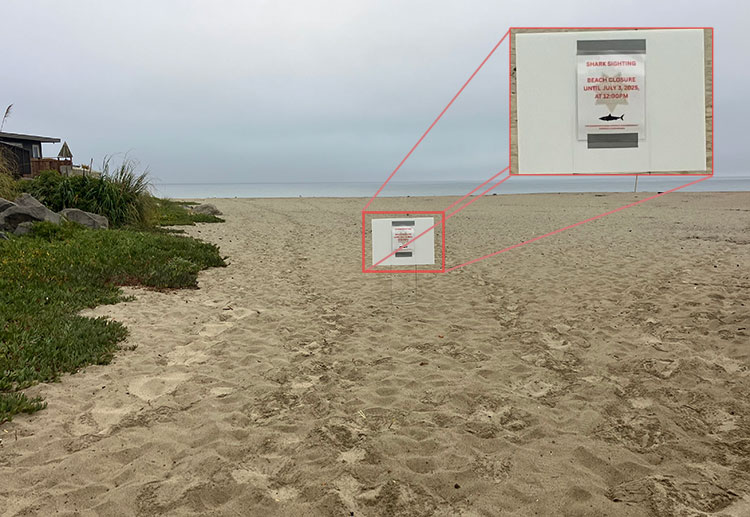
Closed Beach Sign at Rio Del Mar Beach
The shark first bumped the buoy and then brushed against the aide, who was not injured. Lifeguards quickly came to the aide’s rescue. It was first reported as a “shark attack,” but was later reclassified as a “shark encounter.” Following the incident, a two-mile zone of Rio Del Mar State Beach was closed for 48 hours as a precaution, in accordance with the California State Parks Shark Incident Response Plan.
Lowe said he hadn’t received the full report from the lifeguards yet, so he wasn’t 100 percent certain it was a great white or what occurred, but from what has been reported, it’s not that surprising. It’s the sort of behavior that occasionally occurs in southern California — and now it’s happening in central California.
Gabe McKenna, public safety superintendent for California State Parks, said that beach closures might not be increasing, but “documented juvenile white shark activity in the New Brighton to Seacliff area has increased in the past decade.”
According to Lowe, it’s because there are more great white sharks in the water. The population has been in recovery since the ’90s when, in 1994, California became the first state to ban their take and Federal protections followed in 1997. Now, due to a warming ocean, there is a shark nursery in the Monterey Bay, where it had once never been observed before.
“It’s a climate change phenomenon that these nurseries are moving north,” Lowe said. “They hadn’t been north of Santa Barbara before.”
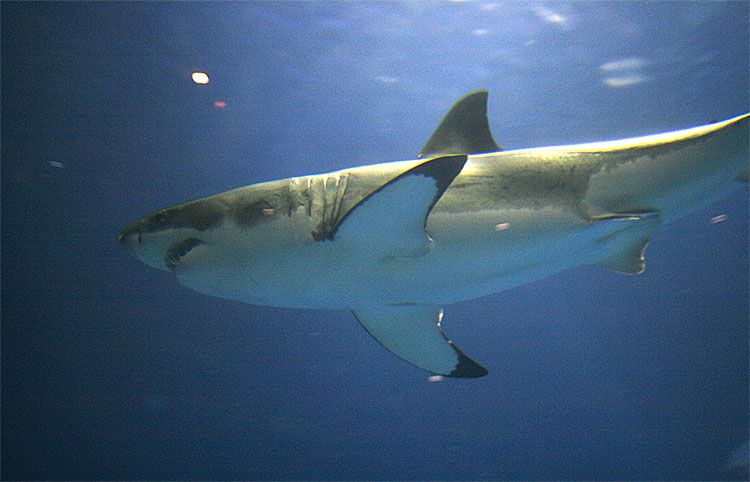
White Shark in Monterey Bay Aquarium
Now that they’re here, they’ll not be going away, according to the science. Our white sharks are part of a population that is isolated to the west coast of North America and Hawaii. White sharks will venture out into the ocean, but they never cross it. Sal Jorgensen, a marine biologist at CSU Monterey Bay, has been studying the shark population in the Monterey Bay for more than a decade. He has helped pen studies such as “Predicted habitat shifts of Pacific top predators in a changing climate,” and many similar.
“They’ve been isolated, we estimate, for some 200,000 years,” Jorgensen said in a seminar he gave in September of 2024 to the Friends of San Pedro Valley Park, “So, despite the fact that, in one season a white shark can swim all the way to Hawaii, and from Hawaii it’s almost equidistant to Japan, the sharks always return to the place of their birth, year after year, generation after generation.”
The sharks had a fairly regular migration, with young sharks staying mostly south and mainly adults venturing north. However, Jorgensen said, in 2014 things began to change. A marine heat wave resulted in more juvenile sharks traveling north into Monterey Bay near Rio Del Mar. In 2014, one juvenile shark was spotted off our local beaches, in 2021 there were more than 20.
“We are seeing juveniles. We are seeing newborns that we never saw prior to 2014,” Jorgensen said.
The ocean near Rio Del Mar, Jorgensen said, is a little warm pocket within the Monterey Bay, and sharks are preferring it. “That’s our working theory right now,” he said.
Lowe, like the scientist he is, said he wasn’t positive what occurred on July 1 at Rio Del Mar Beach because he hadn’t yet received a full report on the incident. “But I can tell you that that sort of behavior occasionally happens in southern California, where a juvenile white shark makes contact without injury,” he said.
Lowe has spent the last six years studying shark behavior in the waters near Long Beach. He said sharks, swimmers and surfers interact every day, but people just don’t realize it. Sharks don’t see people as food or foe, so mainly just ignore them.
“There’s so much human water activity and shark activity that both have learned to ignore the other,” Lowe said. “But up north, that’s a new nursery and people are getting used to it. And in Santa Cruz, the water is kind of murky and sharks don’t have good eyesight. Kind of the way they check things out is they bump into it.”
The shark that brushed the youth at Rio Del Mar may have just been investigating the swimmer, the buoy — or both. As a result, the beach was closed for 48 hours. Lowe said he was part of the committee that helped develop that policy, which was based on the best science available, but also a bit arbitrary.
“When we started, we said ‘look, based on behavior that we know, the animal could be 120 miles away or it could still be there. So the problem is, it’s kind of arbitrary, but it’s based on some science. In my opinion, the 48 hours is more based on people. Everybody needs a timeout and it allows the lifeguards to post warnings to the public so they are aware,” Lowe said. “In the future, using DNA technology, we may get to the point where we can say there’s no shark DNA in the water, but we’re not there yet. So most of it is just changing people’s behavior — just being aware.” n
IF YOU SEE A SHARK
- Don’t panic or splash
- Keep the shark in sight, maintain eye contact
- Move slowly towards the shore or your boat
- Keep your movements slow and controlled
- Do not touch or chase the shark