
By Jon Chown
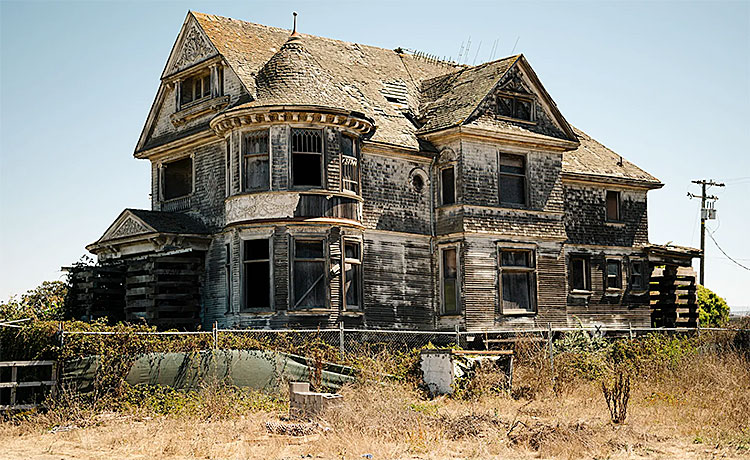
It will be remembered by many in the community as a lost treasure, nearly reclaimed and momentarily grasped until it slipped away. The Redman-Hirahara House’s historic designation is being removed, the home likely razed — an opportunity of historic proportions vanished.
What remains of the home on Lee Road off Highway 1 has been on cribbing for more than a decade, at one point waiting for the next step toward restoration, but eventually it looked like it was just waiting to fall over. On Aug. 5, the Santa Cruz County Board of Supervisors approved removing the Redman-Hirahara House from the county’s Historic Resource Inventory.
The decision, according to a press release, considered the house’s significant deterioration, failed restoration attempts, and the changing neighborhood due to nearby commercial development. The next steps will be to coordinate with a professional historian to document the site for archival preservation, funded by the property owner; offer the structure to the public for salvage or relocation; and begin the process of removing the home from state and national historic registries.
“It felt pretty inevitable, but it’s still sad. It’s a shame,” said Stephen Pederson, a former board member of the Redman-Hirahara Foundation, the local group that almost saved the house.
A Special History
The farm home, built in 1897 for James Redman by famous architect William Weeks, was owned by the Hirahara family when Pearl Harbor was bombed. President Roosevelt’s Executive Order 9066 forcibly removed Japanese-Americans from their homes and imprisoned them in camps, which included the Hirahara family.
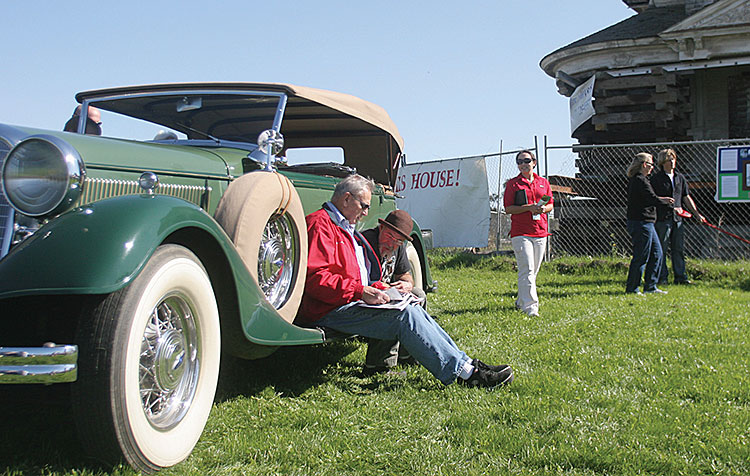
Author and car collector Jack Passey of Watsonville, now deceased, shares one of his books with Michael Leeds of Santa Cruz during a fundraiser held at the Redman-Hirahara home in 2007. Leeds is famous for turning old vehicles and other found “junk” into works of art that can be taken on the road. They are sitting on Passey’s 1933 Lincoln.
Fortunately, the Watsonville community continued to pay the taxes on the home and take care of it so the family was able to move back in when the war was over. It was also discovered by the Redman-Hirahara Foundation that the barn, which has since completely collapsed, had once been a dormitory to house other Japanese-Americans who had no place to live after the war.
The future generations of the Hirahara family would continue to live at the home until the Loma Prieta Earthquake in 1989. It was red tagged due to structural damage caused from the quake and has been empty ever since.
After years of effort, the foundation was able to buy the home in 2004 for $1.9 million, but still owed the money to various entities — $1.5 million of it to GreenFarm LP. The plan was to turn the home into an educational and cultural center where the home’s story would be told.
The plan for the cultural center was to not only feature the home’s history, but the entire Pajaro Valley. For a time, there seemed to be momentum, but in late 2008 the housing collapse hit the economy hard. The property was also not included in Measure U, which expanded Watsonville’s boundaries. Had that happened, the project would have been eligible for redevelopment funding. In the end, the foundation was unable to raise the funds to keep paying the mortgage and GreenFarm foreclosed in 2009.
The debt created by that purchase, according to Barbara Powell, the secretary-treasurer for the foundation, was too much of a weight, she said back in 2009. The foundation tried to get state funds earmarked for restoration of historic buildings, but was turned down for a grant twice and the debt was listed as the reason, she said.
The $1.9 million purchase price was based on the property being used commercially, which it still is not zoned for. Had it been appraised as agricultural property, the sale price might have been half as much. In 2018, it was purchased by Elite Developments, owned by Sonny and Amarjit Tut, for $1.2 million.
After the foreclosure in 2009, Owen Lawlor, representing GreenFarm, indicated he had hoped the land could soon be cleared and used commercially.
“Given the economics the city and county are facing, we just want political players to look at the site with fresh eyes,” he told a Register-Pajaronian reporter in 2009. That has never happened.
Could Enough Still Remain?
Former board member Dean Coley, who owns Architectural Millwork and Design in Watsonville, believes the home could still be restored.
“The bare bones are there. It’s not in much worse shape than it was when we bought it, to tell the truth,” Coley said. “It’s still standing strong, as far as I’m concerned.”
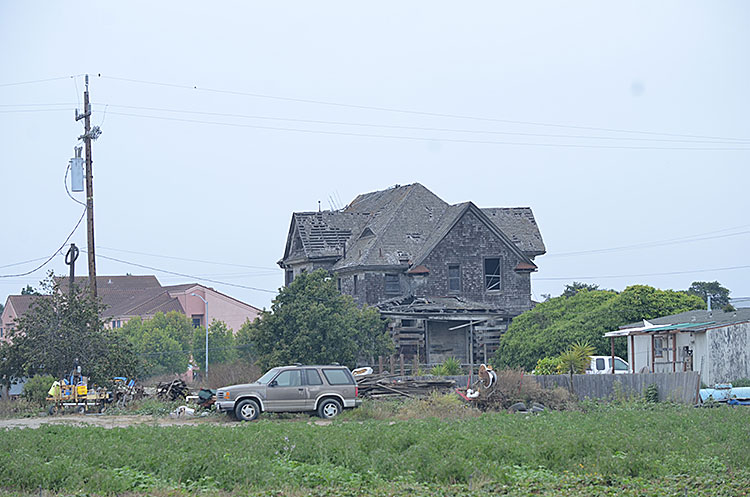
Redman-Hirahara House Today
Many of the doors, banisters and interior woodwork had been removed or pilfered over time. But Coley said enough remains to recreate the interior, and he still has some of the doors and enough of the pieces in his shop to do it. Former Redman-Hirahara Foundation President Geoff Scurfield, a retired contractor, also believes it could be saved and desperately hopes it will be.
“It could still be salvaged because it’s old growth redwood, hard as a rock. I still feel its a doable project,” he said. “It’s still very much possible to restore. And it would bring a lot of money to Watsonville. … We came so close. It still pisses me off.”
TOP PHOTO: Redman-Hirahara House in 2007