
By Marisa Kendall and Ben Christopher
Gov. Gavin Newsom has threatened many times to withhold state homelessness funds from cities and counties that aren’t doing enough to get people off the streets.
This year, those threats seem more real than ever. In fact, Santa Cruz County has already seen a reduction in funding.
 Newsom’s administration and the Legislature are adding new strings to that money, which they hope will help address one of the state’s most obvious policy failures: Despite California’s large recent investments in homelessness, encampments are still rampant on city streets. But cities and counties already are chafing under the tightening requirements, which they worry will make it harder to access crucial state funds without directly improving conditions on the street.
To access state Homeless Housing, Assistance and Prevention money, cities and counties are being pressured to enact a policy regulating homeless encampments that passes state muster — a potential challenge in a state where local jurisdictions’ rules on encampments vary greatly, and many localities have no policy at all. The state also wants localities to get a “prohousing designation,” a special status awarded to places that go above and beyond to build housing. Only 60 of California’s 541 cities and counties — home to about 15% of the state population — have achieved that designation so far. The city of Santa Cruz is among them; Santa Cruz County is not, but is working on it, as are other local municipalities.
Newsom, the Legislature, local officials and other stakeholders will spend the next several months fighting over those terms and hashing out the conditions for the $500 million in homelessness funding proposed in this year’s budget.
Until those details are resolved, exactly what standard cities and counties will be held to — and what will happen to those that don’t comply — is unclear. But one thing is clear: The state is done freely handing out cash.
Some counties are already feeling the heat. They report increased scrutiny as they apply for homelessness funds already approved in the 2024–25 budget, which have only recently been made available due to bureaucratic delays.
According to Accountability California, the Santa Cruz County region received about $24.5 million in Homeless Housing, Assistance and Prevention funding in 2025, with nearly $21 million going directly to the county. The funds are distributed in five rounds. The final round of funding for the county, $5.08 million, was reduced by about $840,000 from the previous year due to the county’s failure to reduce homelessness enough.
Supporters of the new accountability measures say cities and counties have long collected state funds without proving they were using them effectively. Assemblymember Sharon Quirk-Silva, a Democrat from La Palma in Orange County, said the message from the state is clear: If local governments want the money, they must show results.
But others warn the new requirements could slow progress.
“I worry that we may leave more cities out,” said Carolyn Coleman, executive director and CEO of the League of California Cities, “and that we may cause delays in the ability to get more people housed sooner.”
A Tougher Application Process
Applying for state homelessness funds feels very different this year, said Robert Ratner, director of Santa Cruz County’s Housing for Health program. Although the county approved an encampment policy in September and has begun pursuing a prohousing designation, the state still returned its application with extensive comments.
“It has felt, at times, like the goal post keeps moving a little bit,” Ratner said.
In Mendocino County, the state appears to be withholding funds until the county can explain how it plans to pass anencampment ordinance.
“They’re holding the counties’ feet to the fire,” said Megan Van Sant, senior program manager with the Mendocino County Department of Social Services.
Van Sant said the requirement puts housing administrators in a difficult position, since they have no authority over enforcement policies.
“We’re housing providers,” she said. “We try to figure out how to provide people housing. We don’t want to weigh in on enforcement. At all.”
Local leaders worry that future funding rounds may require cities and counties not just to plan for compliance, but to already meet all benchmarks before receiving funds.
It’s All About Accountability
The debate centers on the state’s Homeless Housing, Assistance and Prevention program, the primary source of state homelessness funding for local governments.
Although originally introduced as one-time funding in 2019, the program became a recurring part of the state’s homelessness strategy. For four consecutive years, California distributed roughly $1 billion annually through the program.
Last year, however, the Legislature committed to $500 million — about half of previous funding levels — contingent on new accountability requirements.
Those requirements include having a state-approved housing plan, obtaining a prohousing designation, adopting a local encampment policy consistent with state guidance, providing local matching funds and demonstrating measurable progress on homelessness outcomes.
Lawmakers expect further debate over the final requirements in the coming months. Critics argue that tying funding to factors like prohousing designations could penalize service providers for issues beyond their control.
San Jose Mayor Matt Mahan said the state should focus on more direct measures of success.
“We’re making this way too complicated,” he said.
•••
This article was originally published on ©CalMatters and republished under the Creative Commons Attribution-NonCommercial-NoDerivatives license.
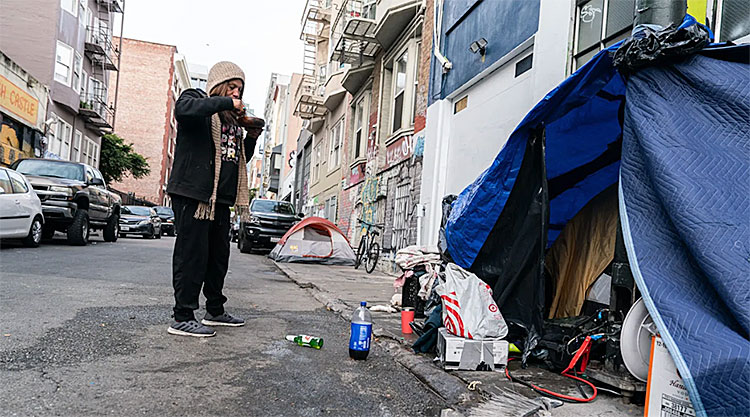
TOP PHOTO: Linda Vazquez, 52, eats noodle soup outside of her tent on Cedar Street in San Francisco on Nov. 19, 2024. City workers regularly tell unhoused people to move during homeless sweeps and cleaning operations. • Photo Credit: Jungho Kim | CalMatters.