
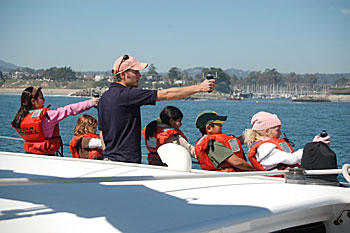
 Applied Survey Research (ASR) has completed its evaluation of student survey results for O’Neill Sea Odyssey’s (OSO) program for the 2012-13 school year and found that the free, ocean-going science and ecology program had a high impact on participating youth. The ASR study measured the results of surveys of students administered before and after the program as well as the results of surveys completed by teachers whose classes participated in the program, and cross-analyzed them against demographic data about the participating schools.
“O’Neill Sea Odyssey serves a vital role in getting students excited about science and about environmental stewardship, and this analysis bears that out,” says Dan Haifley, O’Neill Sea Odyssey’s executive director. The evaluation found that:
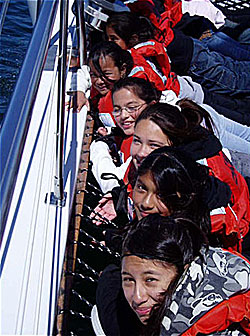 The student survey showed that the OSO program was effective in promoting substantial increases in students’ environmental awareness. Before participating, an average of 79% of students agreed with the survey questions and after, this percentage increased to 97%.
Before the program, a smaller percentage of students from lower income groups agreed with the survey questions overall (77%), compared to students from middle income groups (79%) and students from higher income groups (81%). After participating in the program, 96% of students from lower income groups agreed with the survey questions (19% difference), while 98% of students from middle-income groups (19% difference) and 97% of students from higher income groups (16% difference) agreed.
Of the three topics learned on the boat, 98% of teachers/group leaders thought students had “learned a lot” in the Ecology station, followed by 96% of in the Marine Science station, and 94% in the Sailing & Navigation station. Of the four topics learned in the classroom, most teachers/group leaders again said that students had “learned a lot” in the Follow-up and Discussion (98%), closely followed by the Marine Science station (97%), the Ecology station (94%), and the Sailing and Navigation station (91%). Almost all of the teachers/group leaders (99%) reported that their students had “learned a lot” from the overall learning experience.
 Seventy percent of all teachers/group leaders reported that they had used the online teaching materials provided on the website before their field trip, and most teachers (93%) intended to use the online teaching materials in the classroom after the trip.
The analysis also found that:
- Most groups came from Santa Cruz County (41%), Santa Clara County (32%) and Monterey County (22%).
- Approximately 96% of groups were of students between 4th and 6th grade, the programs target population. Six percent of students had attended the program previously.
- Based on population estimates, 54% of the students were Hispanic or Latino, 25% were White, 13% were Asian, Filipino, or Pacific Islander, 2% were African American, less than 1% were American Indian or Alaska Native, and 5% were of another race/ethnicity.
- It was estimated that 52% of the students attending the OSO program did not have English as their primary language, a slight increase since 2007‑08.
- More than half (58%) of students were receiving free or reduced price meals, more than ever before.
Besides this one-year snapshot, a study of the long-term impact of the program by San Jose State Master’s candidate Lauren Hanneman has also been completed.