
By Jon Chown
The Santa Cruz County Regional Transportation Commission has released the final Project Concept Report for its Zero Emission Passenger Rail and Trail project, answering some key questions and leaving others unanswered.
The report, published Oct. 24, follows months of public outreach and feedback from advisory committees, agencies, stakeholders and community members. It builds on earlier studies, including the 2015 Rail Transit Feasibility Study, the 2019 Unified Corridor Investment Study and the 2021 Transit Corridor Alternatives Analysis. It does not commit the RTC or local governments to building a rail project. It just provides analysis.
 “This report represents an important step forward in understanding what zero-emission passenger rail could mean for Santa Cruz County,” said RTC Executive Director Sarah Christensen. “It gives our community and decision-makers the facts needed to thoughtfully consider how this system might enhance mobility, sustainability and access for all.”
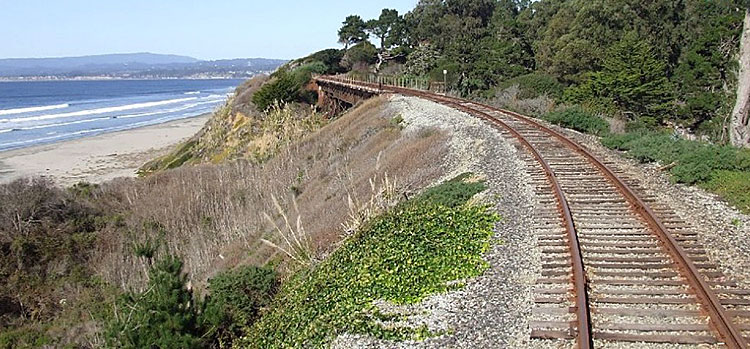
The projects proposes new passenger rail service and stations on about 22 miles of the Santa Cruz Branch Rail Line corridor. The southern most station would be in Pajaro and the north end would be located near the Santa Cruz Wharf. It would take from 40 to 55 minutes to travel from end to end.
The project also includes the development of 12 miles of the Coastal Rail Trail — Segments 13-20 from Rio Del Mar Boulevard through the community of La Selva Beach and the city of Watsonville — and the Capitola Trestle reach (Segment 11).
The rail line passes with one mile of nearly half of the county’s population, more than 90 parks, 40 schools and hundreds of businesses. The goal is to connect this artery to the California State Rail Network at Pajaro, as envisioned in the 2024 California State Rail Plan.
The proposed route has created concerns up and down its length. The final report addresses some of this, but leaves the most controversial questions unanswered. In Watsonville, the rail is shifted from the center of the roadway to the north side of Walker Street, which is supposed to allow for two lanes of traffic to keep operating, while maintaining access to businesses in the industrial heart of Watsonville. That has been a concern for both residents and businesses.
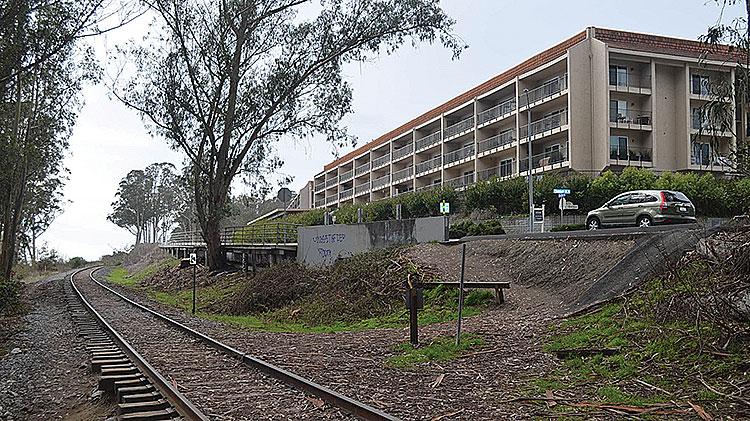
A bigger controversy remains along the Capitola trail segment, where the right-of-way overlaps the Blue & Gold Mobile Home Park in Live Oak, and Castle Mobile Estates in Capitola. “Alternatives to address these constraints will be evaluated as the project continues to advance through the environmental process,” the final report reads.
The projected capital costs ($4.28 billion) and annual operating expenses ($34 to $41 million) remain the same in the final report as they were in the draft. Unfortunately, how it would exactly be funded still does not seem to be fully determined in the final report. “A local funding source, similar to a tax measure like Measure D, would be needed to supplement federal and state funding,” it reads.
There were not many changes in the final report. It estimates that typical ridership will be 4,200 to 5,400 passengers per weekday for the year 2045, with weekend ridership lower. Annual revenues from fares were estimated at $5.1 million to $6.4 million. Additional strategies for generating revenue were also identified, including advertising at stations and on trains, transit-oriented development, electronic fare collection, and more.
Christensen said the report had not been shared publicly before Oct. 24 and emphasized the agency’s commitment to transparency. The commission will receive a presentation on the findings at its December 2025 meeting and vote on whether to move forward with the project.