
By Jon Chown
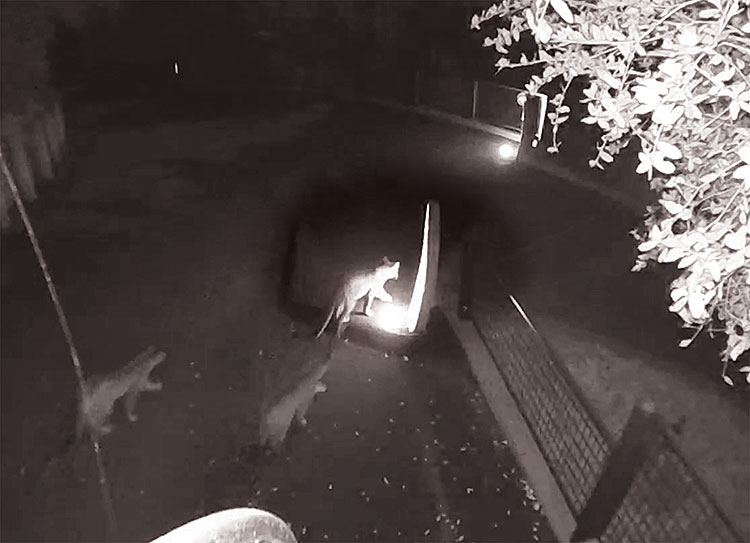
A family of mountain lions has taken up residence in the mountains above Aptos. Near the end of Newell Drive, two adults and two cubs have been spotted several times roaming past Ring cameras.
Resident Jerry Ball said it started a few weeks ago when he noticed a female lion strolling right down his driveway. Three night later, she was back. Then, on Feb. 3, she was back again, but with two cubs behind her. Ball said the mountain lions are a bit scary, but beautiful at the same time.
“I moved into their neighborhood, so I don’t have much to say about it,” he said. “It makes me a little nervous when I have to take the dogs out at nigh. I’m a little reluctant, but we live in the forest because we love the animals and the peace and quiet and we recognize we are intruding on their home. … You have to respect mother nature.”
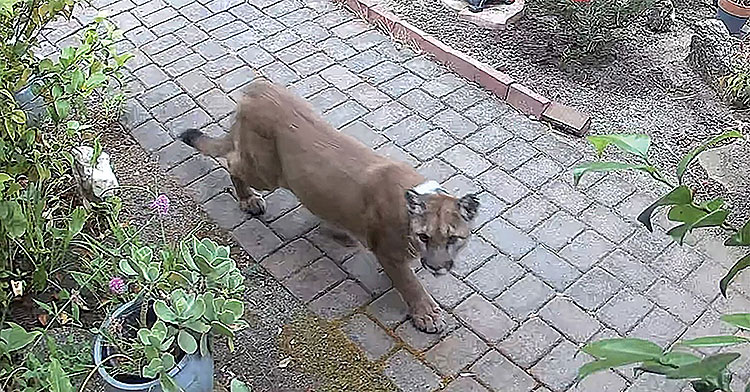
This mountain lion was spotted the morning of May 27 in an Aptos neighborhood.
Ball said a lot of wildlife can be found in the neighborhood: skunks, squirrels, coyotes, and more. He said he’s seen hundreds of turkeys at one time, and there are deer everywhere. It’s not entirely new. Ball said a mountain lion attacked a neighbor’s goats a couple of years ago, but the sightings seem to be on the rise. He recently saw a lion perched on a tree branch above Redwood Drive while he was driving by, and saw another while looking for a neighbor’s dog that had gotten loose.
Ball said he believes the local deer population draws them. “We have a lot of deer and mountain lions control that population,” he said.
Norman Trengrove, 83, was the first person to live on Jingle Lane, off Day Valley Road in the mountains southeast of Nisene Marks State Park. In the 63 years he has lived there, he has not seen a lion, but he said neighbors have spotted them. One lion recently killed a deer near his neighbor’s fence.
“My wife (Carol Trengrove) and I were looking up at the power poles because they were covered with buzzards. I asked a neighbor about it and he said there was a deer carcass on the other side of his fence. He saw a mountain lion run down the deer and kill it.”
Trengrove said he is concerned about the mountain lions and feels a little unsafe when he and his wife go out walking. “I worry we could be targets,” he said. “It looks like we’re getting a hell of a lot of lions around here. It’s potentially dangerous.”
Krypton Kellum, information officer with the California Department of Fish and Wildlife, said there is no definitive number of mountain lions in the region. One CDFW study estimated about 200 cats live between San Mateo and Big Sur, but they roam. Female mountain lions have territories up to 300 square miles and males up to 500 square miles.
“Mountain lions are active dusk through dawn. If you are aware of mountain lion sightings reported near your neighborhood, you should avoid taking walks or hiking or biking between dusk and dawn,” she said.
If they are in the neighborhood, hopefully, they will leave on their own. They often do.
“Mountain lions are very wary of people and will avoid populated areas. On rare occasions they will make their way into populated areas, but usually return to the open space natural habitat they came from,” said Kellum.
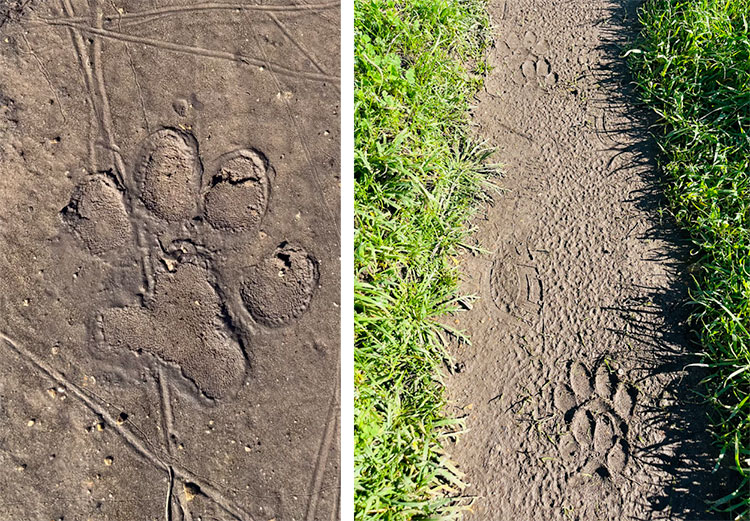
These mountain lion prints were discovered May 7 in north Santa Cruz County by CalFire.
Even though Mountain Lion sightings are becoming more common, the big cats are being considered for protection under the California Endangered Species Act — and it likely already happened as you are reading this.
The issue was on the agenda of a Fish and Game Commission meeting held Feb. 11-12 in Sacramento, just as this publication was being sent to print. Commissioners were to “consider and potentially act” on the petition to list the lion as endangered.
The state’s evaluation of whether to list the Southern California and Central Coast population of mountain lions under the California Endangered Species Act has slowly evolved into a recommendation for protection.
When conservation groups originally petitioned the California Fish and Game Commission in 2019 to list the population, the California Department of Fish and Wildlife decided in early 2020 that the petition contained sufficient scientific information to merit further review. Based on that finding, mountain lions were designated as a candidate species, granting them temporary protections while a full scientific assessment was conducted.
That assessment was completed in late 2025 when the department found that the mountain lions roaming Southern California and the Central Coast are genetically distinct. The report found the population to be increasingly isolated and vulnerable due to habitat fragmentation, vehicle strikes, rodenticide exposure, and low genetic diversity. Unlike the earlier petition evaluation, which only determined that listing “may be warranted,” the 2025 review made a full recommendation that the population be listed as threatened under state law. The department concluded that, without additional protections and management measures, long-term viability of the these lions is at risk.
Ball said he supports that, despite being wary of the predators.
“I think it’s important that they live naturally and are not hunted down, unless they become a pest,” he said. “They figure there’s 200 mountain lions from San Mateo to Big Sur, I don’t think that’s a whole bunch.You just have to keep your eyes open and know what to do when you come upon a mountain lion.”
Kellum said that if you see a mountain lion, stay calm. Don’t run and don’t turn your back. Running may trigger its instinct to chase, so stand your ground, face the animal, maintain eye contact and back away slowly. Make yourself look bigger by raising your arms or spreading your jacket open. Wave slowly and make loud noises. If you have children with you, pick them up. But do not crouch or bend over. Crouching can make you appear more like prey. n
•••
CDFW asks that people submit mountain lion sightings to the Wildlife Incident Reporting System at https://apps.wildlife.ca.gov/wir. This helps track and monitor the species and respond to conflicts as necessary.
TOP PHOTO: A recent image from a RING camera outside an Aptos home.