
No Surge at Hospitals Yet; Peak May Be in May
By Jondi Gumz
The number of new coronavirus COVID-19 cases is growing more slowly than expected, Santa Cruz County health officials said at a press conference Thursday, and they want to keep it that way.

Dr. Gail Newel, Santa Cruz County Health Officer, and Mimi Hall, director of the county’s Health Services Agency, wore face coverings at the COVID-19 press conference Thursday. • Photo credit Jondi Gumz
Mimi Hall, director of the county’s Health Services Agency, had asked California Healthcorps workers to start Monday after Easter but she’s postponed her request “for a couple weeks” because “hospitals are not seeing a surge” of patients.
Of the 13 patients in the county hospitalized for COVID-19, four are confirmed and nine are suspected, according to the state database, which reports seven people in intensive care, three confirmed and four suspected.
“We are among the very best counties in flattening the curve,” said Dr. Gail Newel, the county’s Health Officer, thanking the community for observing “shelter in place” restrictions imposed March 16 and extended through May 3.
Her latest order, issued April 8, closed the county’s parks and beaches for Easter week and Passover, specifically prohibiting surfing, a popular attraction for people living inland, until April 16.
$1,000 Tickets
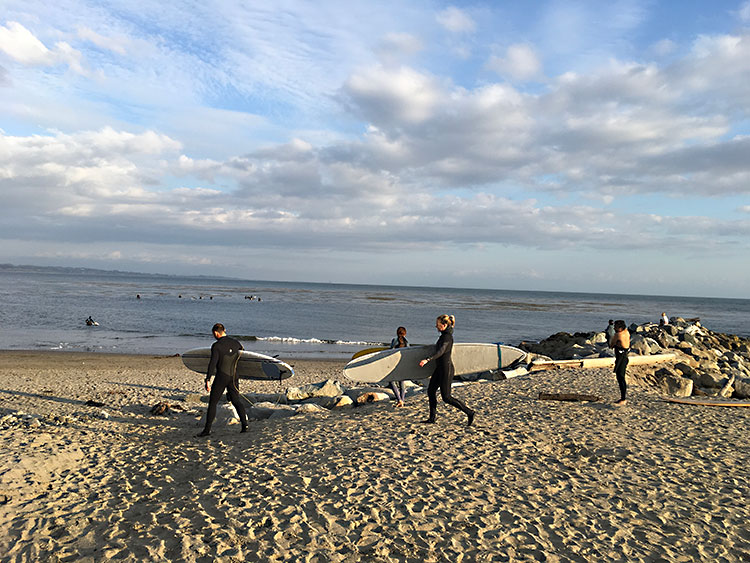
The beaches and surfing in Santa Cruz is closed from April 10 thru at least April 19. There will be a $1000 fine for violations.
Deputies warned beach-goers Wednesday of the impending closure, and have issued 111 “shelter in place” tickets so far. Beach-goers can get tickets with a $1,000 fine.
“We do not want vacationers in Santa Cruz County,” Newel said, noting a case where a family from Sacramento traveled to their ski condo, got sick and brought COVID-19 into a small hospital in Sierra.
The order applies to all outdoor religious gatherings, including those for Holy Week and Easter, Passover, Orthodox Easter and Ramadan. Newel said gatherings would set back efforts to reduce community spread of COVID-19.
1,673 Negative Tests
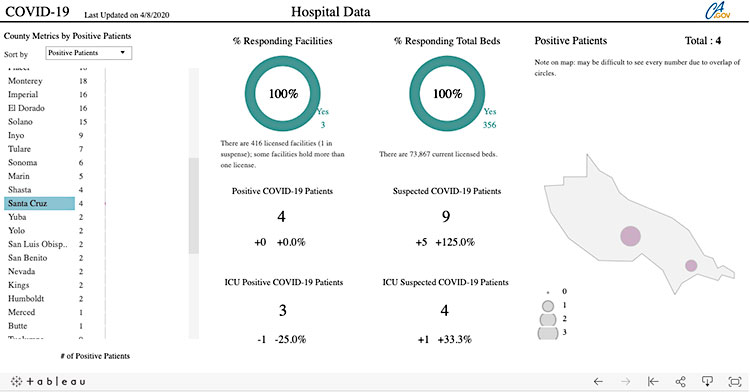
Santa Cruz County Numbers
As of April 9, Santa Cruz County reports 80 confirmed COVID-19 cases, 13 in the hospital, one death, and 1,673 negative test results.
All parts of Santa Cruz County are touched, with 27 cases confirmed in North County, 30 in Mid-County, 14 in South County and nine under investigation.
In a telephone town hall Wednesday night with county Supervisor John Leopold and his constituents, Newel was asked about when cases might peak locally.
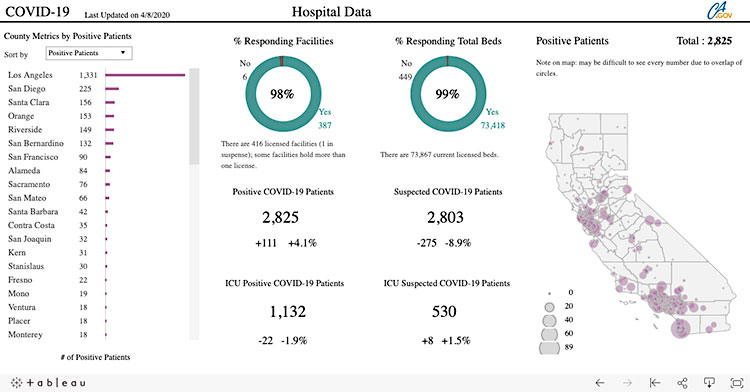
State of California Nubmers
The peak for the state is predicted to be April 14 but “it could be quite a bit later, the first week of May,” she said, “because of our success” in slowing the spread.
“We really don’t have enough cases to make great predictions,” she said. “We’re going to be OK with capacity, hospital beds and ventilators.”
Dr. David Ghilarducci, the county’s EMS medical director, is overseeing alternate care sites should they be needed. The sites are 1440 Multiversity, a nonprofit retreat center in Scotts Valley, 45 up to 80 beds, and the county’s Simpkins Family Swim Center, 20 up to 40 beds.
Newel said she would release details on best- and worst-case scenarios, which have been provided in closed session to the Board of Supervisors, “very shortly.”
Ghilarducci added, “The numbers fed into the model are so small, these models could change week to week.”
On March 25, nine new cases were confirmed; on March 26, zero cases. Since then, each day has brought one to six new cases, but there is no obvious pattern.
Testing Bottleneck

Sample Early CDC Test Kit
There is a testing bottleneck: Not enough testing capacity, not enough swabs to go into the nose or throat, not enough of the compounds needed to detect the virus.
Not having a state lab, Santa Cruz County has been sending its specimens to a state lab in neighboring Santa Clara County, which is home to Silicon Valley and much larger in population, with many more COVID-19 cases: 156 patients confirmed, 34 suspected, with 76 in ICU, 70 confirmed and six suspected.
The state lab typically produces test results in 24 hours but capacity is limited.
Newel said the state lab in Santa Clara County can do a maximum of 60 tests. She’s sent 120 specimens there, with the rest going to commercial labs, where the turnaround time can be two weeks.
This should change next week after Dominican Hospital starting testing its patients with newly arrived equipment. Testing equipment also is due to arrive at the county’s Emeline lab next week.
“Testing will be that thing that helps us understand what’s happening,” said Hall, the health services director.
Due to capacity issues, Newel said the county has prioritized testing for health care workers and hospital patients.
Health Care Workers Impacted
She said there are confirmed COVID-19 cases among local health care workers and first responders, but did not provide the number.
Though Newel praised the community response overall, she said she may have to close skate parks and dog parks because of people gathering without following social distance rules to be six feet apart from non-family members.
In a telephone town hall Wednesday night with county Supervisor John Leopold and his constituents, Newel said there are no confirmed cases at nursing homes, assisted living facilities, migrant housing, the jail and Juvenile Hall, and people who are homeless.
Motels for Homeless
“We’re focusing on congregate housing,” she said, noting federal funds are paying for a motel in the Beach Flats area of Santa Cruz to house elderly homeless and those who are medically fragile.
“We’re going to fill up one motel at a time,” she said. “We have contracts with several.”
In addition,VFW halls in Live Oak and Watsonville have opened as shelters for people who are homeless.
“Most people recover on their own,” said Dr. Larry deGhetaldi, president of Sutter Health Santa Cruz, while others, like Britain Prime Minister Boris Johnson, was hospitalized and getting oxygen in intensive care. “Some require a ventilator — they have a long and difficult course of care.”
During a telephone town hall Tuesday night with county Supervisor Zach Friend and his constituents, deGhetaldi said this particular virus has “an unusually strong ability” to attack not only the upper respiratory system but in some people, it attacks the lower respiratory system.
“It’s amazing what we don’t know for a pathogen that moved around the globe,” de Ghetaldi added, but he sees potential to learn from other parts of the world. “Knowing the risk factors is the most important thing.”
Those risk factors, based on a government study of fatalities in Italy, are: Age, male gender and having a chronic condition such as heart disease, high blood pressure, diabetes and lung diseases such as asthma or COPD.
“If you’re 80-year-old old man with multiple conditions, you really need to protect yourself,” deGhetaldi said.
Intravenous Vitamin C
Times Publishing Group asked deGhetaldi if intravenous Vitamin C, which has been used to successfully treat hospitalized patients in Shanghai and Long Island, New York, would be employed locally.
DeGhetaldi noted Vitamin C is “almost completely nontoxic” and “a modest dose of Vitamin C is not ill-advised but there is no medical evidence. We have to focus our efforts on drugs that have efficacy.”
Answers on intravenous Vitamin C may come from a randomized clinical trial begun at Zhongnan Hospital in China in mid-February and posted on Clinicaltrials.gov. Results are expected Sept. 30, according to the U.S. National Institutes of Health.