
“Creativity has become a more important leadership quality than attributes like management disciplines, rigor or operational acumen.”
— Frank Kern, Senior Vice President, IBM
Last month I got the opportunity to listen to a professor by the name of Xhang Zhau. Dr. Zhau is world-renowned for his comments on educational systems worldwide, especially the Chinese educational system where he was educated as a young child. In his presentation, he drives the point that creativity is a crucial part of the new economy and that though many educational systems around the world may score better in Mathematics or the Sciences than the United States, the United States produces students that are more creative. This creativity, he concludes, is the reason for American economic prosperity.
In his words, the American Talent Show is a great tradition because it encourages students to get in front of their classmates, try something new and get applause for it. In his mind, this represents the greatness of the American system. We reward individuals for being creative and trying something new. Despite China’s improving scores in Math and Science less than 10% of Chinese college graduates work for foreign firms due to their difficulty in “thinking outside of the box.” The arts encourage the type of independent thought and creativity that students need by encouraging students to not only find new ways of looking at things in themselves but to find new ways to express it. That is, in my opinion, what makes the Arts so important in the classroom.
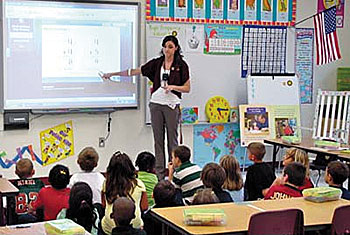 The importance of Art in education has been well documented and studied. For example, according to a recent Federal study, students involved in the Arts, regardless of what form, are four times more likely to be highlighted for achievement in academics. Low-income students who are involved in the Arts are twice as likely to graduate from college than those who are not. Students participating in the Arts have higher attendance numbers, lower drop out rates and less disciplinary problems. What the Arts do is give students a broader view of the world while at the same time encouraging creativity and problem solving. When a student watches a play or listens to a piece of music that is not of their culture, they are learning; learning from a play written from a different perspective or listening to music that elicits different emotions. They think about how they can also create such words or music. While they are learning, they are developing their creative skills. There is almost universal agreement that the Arts are crucial to education – over 92 percent of parents in a recent study thought so – and it is the business community that is speaking most loudly about the importance of the arts in education.
With the change in our economy, an increase in service sector jobs and the loss of manufacturing in our country, creativity, multiple perspectives and problem solving have become crucial skills. These can all be found in Art education. For example, a student learning about painting can see that different individuals bring different perspectives to their work and there is more than one solution to a problem, but many.
Changing the educational system to better deal with the 21st Century workplace, California is changing to what is called the “Common Core” relying less on testing and finding the right answer and focuses instead on a more collaborative approach to education.
The Arts can play a big part in this new system and helping our children. An example would be playing in a band where collaboration produces the right music or in a dance recital where one learns that practice does make perfect. That to be truly successful at anything one must have perseverance. These characteristics are those that the Arts can teach in new and creative ways.
The good news is despite a lack of funding for the arts, local parent groups in the Aptos schools stepped up and helped fund Arts in the classroom. At Rio Del Mar school, for instance, the Parent Alliance raises money in a variety of ways such as the Spring Auction and other fundraisers to support education and the arts at their school. This enables the school to provide piano and guitar lessons and even have a school band in which kids play at various venues around the county.
Mar Vista and Valencia school also benefit from this kind of parental dedication. Mar Vista is able to provide each teacher up to $620 annually to introduce the Arts in the classroom. This school has an annual showing at Bay Federal of their student’s artwork. Think of how exciting it is for those students when their band plays at a local restaurant or they walk into a local financial institution and see their artwork displayed. This encourages student involvement and a commitment to their education. I applaud these efforts. Arts are a crucial piece of the educational process and with the changes our student’s will be asked to undertake, become even more important than in the past.
A recent study noted that 72% of hiring managers say that creativity is the #1 thing that they are looking for in a job candidate. Artistic development is the key to creativity, problem solving and will help to make our students more competitive in the 21st Century. That is why I am advocating for a more balance approach to Arts education at PVUSD and am looking forward to working on the District’s Art plan. This plan not been revisited since 2008 due to funding concerns. Now that funding is starting to be restored, I am committed to make sure that our children benefit through a well-rounded artistic education. The arts will help to foster the required skills needed to compete in the global market place while at the same time building a school and local community that values all that the Arts bring to our quality of life.