

By Jon Chown
WATSONVILLE — A new study that compares college readiness between the Pajaro Valley Unified School District’s three high schools shows Aptos High School students have about a 50% higher rate than Pajaro Valley High and Watsonville High students.
The report, created by Aspiring Higher, was presented to the Pajaro Valley Unified School District Board of Trustees on March 18. Overall, the report shows increasingly better outcomes for PVUSD students over the past six years. Nearly half the Class of 2019, 46.8%, were found not to be prepared for college or a career. That has fallen in the past three years in a row to 40.7% for the Class of 2025.
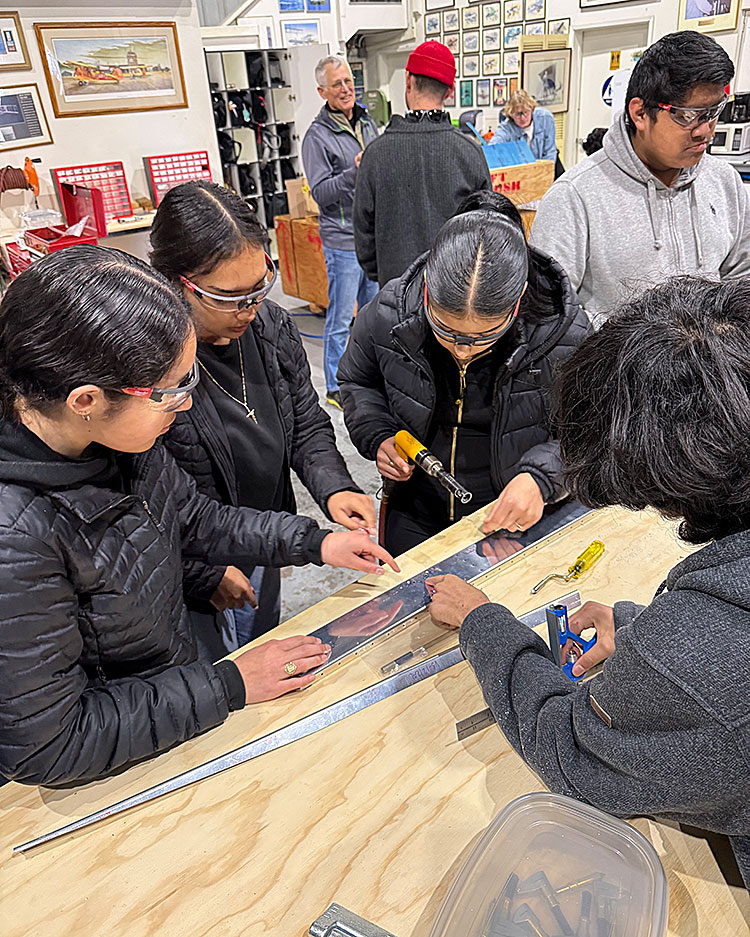
Watsonville High students building an airplane.
While more students are being deemed “prepared,” the report shows actual eligibility for California’s colleges and universities varied significantly by school and has remained relatively flat over recent years. While Aptos has high has risen slightly from 60.1% to 61.9%, Watsonville High and Pajaro Valley High have both fallen. Just 44.3% of graduates from PV High were eligible in 2025, down from 51% the year before. Watsonville was even worse at 40.5%, down from 42.4%. The state average is 53.9%.
The report also shows that fewer students want to go to college, or more just feel it isn’t affordable. The report cites research showing that while 71% of California parents want their children to earn at least a bachelor’s degree, 69% are concerned about affording it.
PVUSD’s own survey of seniors in March 2025 found that cost was the top barrier to attending a four-year university: 83% of Aptos High, 72% of Pajaro Valley High, and 54% of Watsonville High seniors named affordability as their primary concern. Cost was a top issue. According to the study, a lot of eligible students are applying for some kind of financial aid for college. At Aptos High, 84.5%, at Pajaro Valley High, 88.8%, and at Watsonville High: 81.4% of students are either filling out at an application for Federal Student Aid or a California Dream Act Application for eligible undocumented students.
Despite this, cost remains a significant perceived barrier to a college education. The report recommends early education on financial aid and college costs, including hands-on workshops and personalized support starting in ninth grade.
The inequities between students and schools were plainly evident in the report. Trustee Misty Navarro pointed out that students are tracked from junior high and those spots in advanced courses are only made available to a limited number of students. It can be hard for a student to climb out of a General class environment where fellow students can be disruptive, the class size larger and the teacher less able to be engaged with students.
“We track students way too early and we leave many out of a lot opportunities,” she said.
The inequities between the schools ranged, and what a student might need and miss out on could be determined by which school they attend. The report found that the three high schools function in many ways as their own “small districts,” with significant differences in what they offer. Aptos High leads in Advanced Placement courses and enrollment. Pajaro Valley High is strongest in Visual and Performing Arts, and Watsonville High offers the most Career Technical Education opportunities. According to the study, these differences have led to perceptions of inequity among students and staff, with stakeholders often unable to explain the rationale behind site-specific programming.
Among the report’s recommendations are expanding early college and career exposure with field trips and career speakers, and improving access to advanced coursework.
Aptos High’s 7th Period Pilloried
Among the findings specifically for Aptos High were that the 7-period day is underused, with 83% of seniors taking just five classes and just 16.7% of juniors and seniors enrolled in 7th period. Among the school’s strengths was its strong AP access, with 35 AP sections, 850 enrollments and average class size of 24.3 students.
That 7th period was also seen as troublesome by the trustees. Navarro questioned the different opportunities available at the schools and what she witnessed as her child attended Aptos High, while she also represented PV High. “There is a lot of inequity among the district,” she said.
Part of the problem, Navarro said, was the 7th period at Aptos High and how it prevented the district’s three schools from aligning their bell schedules so that students might be offered more of the same opportunities. Instead, she suggested the district look at “aligning our resources and trying to consolidate our programs and making sure that we’re allowing all of our kids those various opportunities.”
Trustee Olivia Flores concurred. “It’s (7th period) getting to the point that it has to be addressed,” she said, and suggested that students could be bused from another high school to take advantage of some of these opportunities if not for the 7th period, which is difficult for kids anyway. “Seven periods is a lot,” she said. “It’s a big load for these students.”
Other trustees also commented on the 7th period, with none having anything positive to say about it.
“I also worry about where students are if they don’t have an assigned class,” Trustee Carol Turley noted.
TOP PHOTO: The Ribbon Cutting ceremony for the remodeled “quad” in September, 2019.