
By Joe Ortiz
In their experimental watercolor renderings, oil painting masters, J.M.W. Turner, Winslow Homer, and John Singer Sargent utilized the technique of wetting their paper before starting to lay in their colors. In this process, repeated rapid washes diffuse into abstract shapes to help create depth, contour, and shadow; the key to the technique is its lack of control. Moreover, the amorphous blending of colors creates a fluidity, vibrance, and spontaneity.
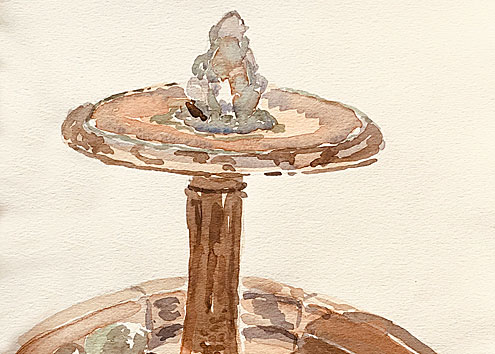
My watercolor sketch below of Sargent’s “wet-in-wet” technique—combined with his habit of using architectural details to replicate form — shows how a quick, 20-minute rendering can create a serviceable, yet impressive likeness.
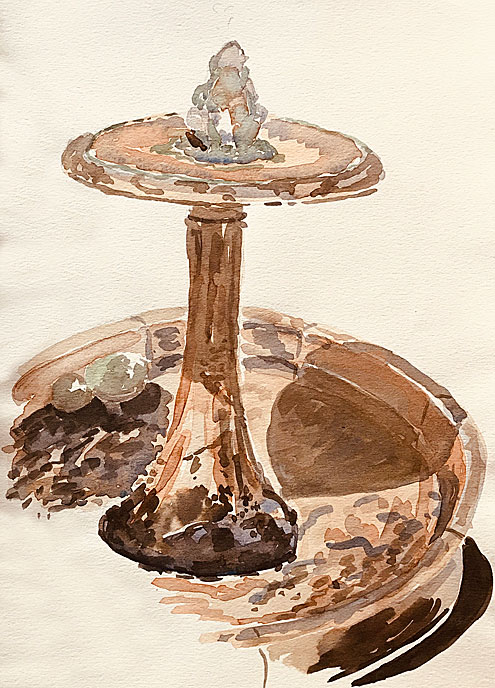 Many watercolorists use this technique to achieve what some would call alla prima or au premier coup, translated respectively, as “Get it right on the first try,” or “In the first strike of the brush.” These “quick-draw” painting techniques help artists to record a fast impression in a spontaneous sketch, which can serve as a practice of what one would hope to achieve in a studio work—where overworking might push a painting toward rigidity. Trusting in a spontaneous gesture is the goal.
As always, we can learn similar lessons from other disciplines: golfers use a very mechanical training mode to evaluate shots and body moves analytically. But when playing, the golfer is taught to simply accept what happens spontaneously. According to Bob Rotella in Golf is Not About Perfect, while the training mentality is overly thoughtful, the trusting mentality feels almost reckless.
In jazz, players practice in the analytical mode but strive to “play in the moment.” As Jerry Coker tells us in Improvising Jazz, improvisation demands that there’s no regret, no crossing out, fixing, or retouching.
Alla prima, and le premier coupe are each done in the “trusting” mode. While corrections are discouraged—if they are made—they must be made in the moment.
Many artist live by the rule that Monet once confessed, “I never retouch a sketch.” Perhaps this is a holdover from the Impressionist movement, which encouraged painting in plein air, where an impulsive, uncritical mentality can help produce a painting in one spontaneous session.
Working in the discipline of creating a painting quickly and on the first take, the artist places herself in a situation which demands less thinking—and less overworking of the finished piece. Ultimately, impulse must win out.
What Can We Do Now? Find a nice, sturdy piece of watercolor paper, pick an object to paint, set yourself a time limit and begin. Instead of thinking of this as an exercise, consider it a work in itself. But keep the experimental mentality alive. There are no mistakes. Do your best to get the image down in the first pass, the first several strokes—in the true spirit of au premiere coup: the first strike of the brush!
Start with a light pencil sketch of your subject. Wet the paper with clear water. Allow it to dry a few moments until the surface becomes glistening. Then start by laying in one wash of a basic color, starting with the rough outline and major shapes of your subject. Once that color is laid down, and while still wet, use another color, darker in intensity, which will represent the contours.
Then add another even darker layer, much smaller this time to describe the deepest shadows. Let the colors blend as they may without trying to fix them. Let the sketch dry a bit. Then add a few dark and dense shadows, details, and contour lines to finish the piece.
•••
Reader response: I’d love to hear your comments and questions. Email me at [email protected].