
By Jon Chown
Aptos resident and local activist Becky Steinbruner has filed suit against Santa Cruz County, the Board of Supervisors, the city of Watsonville, and Elite Developments in an effort to save the historic Redman-Hirahara House from demolition.
On Aug. 5, the Santa Cruz County Board of Supervisors approved removing the historic home on Lee Road, located off Highway 1, from the county’s Historic Resource Inventory and began a process to delist it from the National Register of Historic Places, paving the way for eventual demolition. According to a county press release, the decision considered the house’s significant deterioration, failed restoration attempts, and a changing neighborhood due to nearby commercial development. Next steps include coordinating with a professional historian to document the site for archival preservation, funded by the property owner; offering the structure to the public for salvage or relocation; and beginning the process of removing the home from state and national historic registries.
Steinbruner’s suit, originally filed in Santa Cruz County Superior Court on Sept. 4, seeks a restraining order to halt all of that. It lists seven causes of action describing how the county failed to conduct a proper archaeological analysis of the property, a structural evaluation of the house, a professional analysis of the cost of restoring it, and an environmental review of the dangers of demolishing it. For instance, according to the suit, the county failed to include potential impacts of asbestos if the house is demolished in its environmental review.
A Unique History to be Told
The home has a long history that climaxes with a national mistake, a constitutional outrage, and a community’s efforts to make it right. The farm home, built in 1897 for James Redman by famous architect William Weeks, was owned by the Hirahara family when President Roosevelt’s Executive Order 9066 forcibly removed them from their home due to their Japanese heritage and imprisoned them. Fortunately, local residents continued to pay the property taxes and take care of it so the family was able to return at the end of World War II.
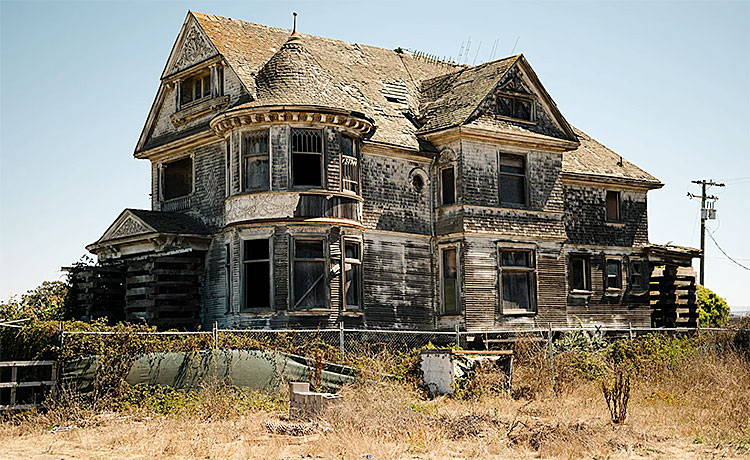
Redman-Hirahara House in 2007
The Hiraharas also housed many other Japanese-Americans who had no place to live after the war. Future generations of the Hirahara family would continue to live at the home until the Loma Prieta Earthquake in 1989. It was red-tagged due to structural damage and has been empty ever since.
In 2004, a local nonprofit, the Redman-Hirahara Foundation, managed to purchase the home on borrowed money for $1.9 million and tried to raise funds to save and restore it.
The plan was to turn the home into an educational and cultural center where the home’s story would be told. The nonprofit invited Professor Rob Edwards of Cabrillo College to conduct an archaeological dig at the site in 2005, unearthing 4,000 artifacts.
One of Edwards’ students, Jacob Stone, went on to study at UC Santa Cruz and wrote his doctoral thesis on the house in 2024.
“Once excavations were underway, it was clear that the farmstead was not only a valuable source of cultural information regarding California history, but also a story of persistence and hidden agency …” Stone wrote.
Unfortunately, the effort to save the home failed amid the 2008 financial crisis. The fact that the home’s value was not anywhere near the purchase price was a likely factor. It was appraised as if it were a commercial property when the foundation bought it. It was foreclosed in 2009 by GreenFarm LP, which then sold it to Elite Developments for $1.2 million in 2018. Since then, it has rested on its cribbing as properties around it have been improved.
Larry Hirahara, no relation to the family that once owned the home, went to the Santa Cruz County Board of Supervisors on Aug. 5 to speak against delisting the home. He is the president of Asian Cultural Experience in Salinas, which focuses on preserving the Asian heritage of Salinas. He said the home has a lot of history in it.
“The architect, William Weeks, and those witch’s hats on the roof, that’s his signature style. Then there’s the Redman part and how he made his fortune in sugar beets. And then there is its association with the history of the incarceration of Japanese-Americans and how they were able to preserve that house,” he said. “It was sort of a hostel after the war.”
Hirahara is working to restore the historic Salinas Chinatown eatery, the Republic Cafe, and turn it into a museum. He said it takes money and commitment to make such projects happen.
“When you try to preserve these sorts of things, it takes a lot of will, and for the city to recognize it, that’s the important part,” he said.
In his case, Salinas partnered with the nonprofit, even purchasing the building.
“The preservation of this is very expensive, but it’s a better alternative than demolition,” Hirahara said. “There has to be a consideration of the historic value.”
History to End in Demolition?
The county decision on Aug. 5 determined that the home could not be restored and that its historic nature had been lost or destroyed. Former Redman-Hirahara board members feel differently. Former board member Dean Coley, who owns Architectural Millwork and Design in Watsonville, believes the home could still be restored.
“The bare bones are there. It’s not in much worse shape than it was when we bought it, to tell the truth,” Coley said. “It’s still standing strong, as far as I’m concerned.”
Many of the doors, banisters, and interior woodwork had been removed or pilfered over time. But Coley said enough remains to recreate the interior, and he still has some of the doors and enough of the pieces in his shop to do it. Former Redman-Hirahara Foundation President Geoff Scurfield, a retired contractor, also believes it could be saved.
“It could still be salvaged because it’s old growth redwood, hard as a rock. I still feel it’s a doable project,” he said.
Steinbruner said she believes Watsonville and the county have long had plans for the city to annex the property and develop it. Those plans are now spelled out in the city’s proposed 2050 General Plan, which calls for annexation of the Redman-Hirahara House property and surrounding area, referred to as the Highway 1 Gateway, and the creation of more than 2 million square feet of retail and visitor-serving uses.
This idea, that the city always had a plan to replace the home with new development has long been held by some members of the Redman-Hirahara Foundation. The possibility was even a topic at board meetings back in 2005.
“The city was never helpful to us,” said Scurfield. “They were not interested in saving that house. Not at all.”
Steinbruner said she has met with other public officials and none seem interested. She said Monterey County Supervisor Luis Alejo, a former mayor of Watsonville, was rudely disinterested. Congressman Jimmy Panetta showed interest initially and told her he would write a letter, but when she saw him later and asked him about it, his tone had changed and he was dismissive. She said she thinks there are plans for development and government officials have already agreed upon it. Some may even be benefiting from it.
“I think that is what is really going on behind the scenes here,” she said.
Steinbruner hopes a new community effort will emerge to save the home. “The times are different now and I think we can get some community support for this if the owners are willing to sell,” she said. “This is such a golden story, and in these times especially, we need to keep this story alive.”
In his thesis, Stone pointed out that the Hiraharas’ situation is repeated throughout history, especially in war zones such as Gaza. It’s not just a national story of redemption and hope; it’s international.
“The Hirahara family and their journey showcase how individuals in the community can make a difference for those displaced following relocation, and how the communities established in those places can remain a beacon of hope for those longing to return home,” Stone wrote.
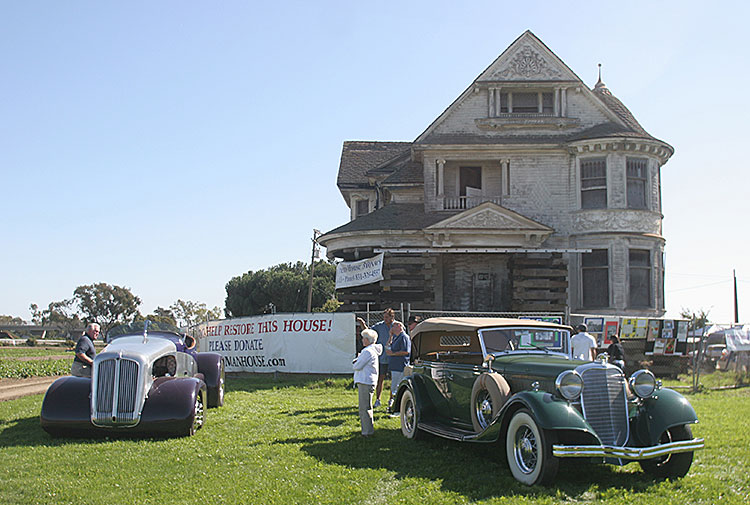
TOP PHOTO: The Redman-Hirahara House in 2013 during a car show held by the Redman-Hirahara Foundation at the site to raise money for the restoration of the house.