
By Joe Ortiz
Artists work with established prompts and exercises to flex and develop their artistic muscles. These methods start out as disciplines to achieve new habits and inspirations but eventually become “just what we do.”
In the movie The Karate Kid, Mr. Miagi taught the Kid to polish an old truck. “Wax on, wax off.” But the Kid saw no connection between rubbing polish and learning karate. Was the practice an arbitrary discipline? A blind devotion to the master?
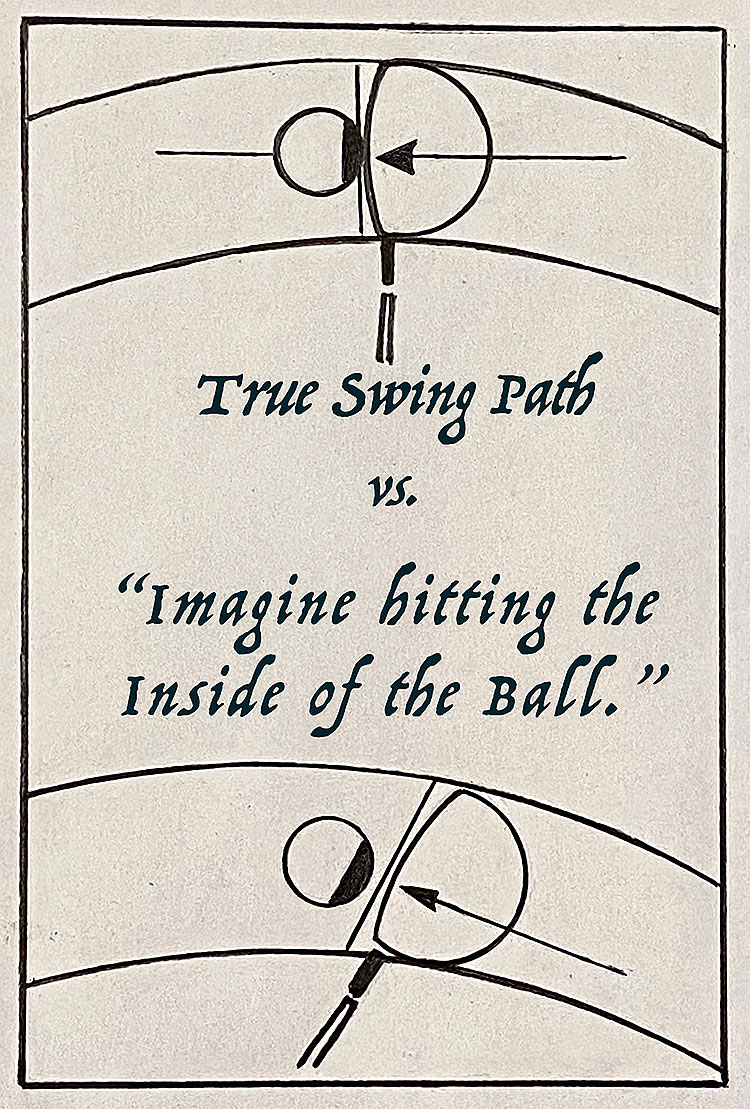
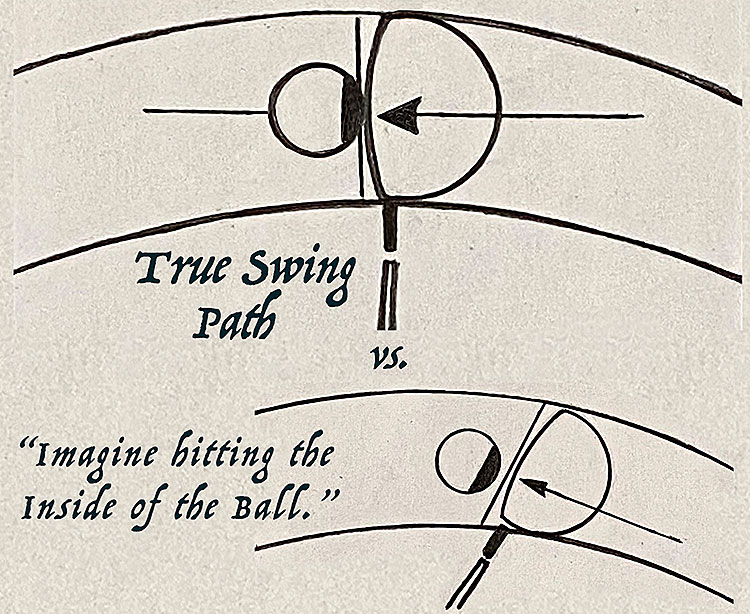
To create “lag” in the golf swing, golfers can focus on hitting the inside of the golf ball to avoid mechanical thinking.
The Kid quickly became disillusioned. But when he performed the move later — unconsciously in combat — it resulted in a highly skilled defense.
Shunryū Suzuki shares a similar story in his book, Zen Mind, Beginner’s Mind: When a Zen master approached a student sitting in meditation (Zazen), he asked him what he was doing.
The student replied, “I’m meditating in order to attain Buddhahood.” So, the teacher told the student that in Japan after a tile gets taken from the kiln, it gets polished with the hope of turning it into a jewel.
The teacher went on to explain that it’s no more possible to become a Buddha by practicing Zazen than it is to turn a tile into a jewel by polishing it. Instead, “just sitting” is the practice. Any ounce of striving for attainment in Zen disrupts the idea of “beginner’s mind.”
Likewise, Mr. Miagi didn’t tell the Kid he would become a karate master by practicing “the move.” Nor did he tell him why a circular motion would act as a defense to deflect an assailant’s attacking blow. He just told him to practice.
And for the Kid, attainment arrived without his striving for it, in having practiced rubbing polish on a truck’s fender in the same way a potter might polish a tile, without a lofty goal in mind.
What Can We Learn? Golf pros rely on drills to simulate proper swing movements. Good instructors rarely tell students how a drill is designed to achieve its goal, because they don’t want to place focus on some mental process or complex position.
The teacher often describes a simple image or movement so the student can lock into a bodily sensation and not get bogged down in “paralysis by analysis.” In order to teach his students the concept of “late release” of the club or “lagging the clubhead”—a difficult technique to explain—my golf pro tells students to “think about hitting the inside of the ball.”
What We Can Do? A few lessons can help us to practice without striving for a goal:
- `Leonardo DaVinci walked the streets of Milan memorizing faces, then returned to his studio to copy them from memory. These sketches were not intended as studies for future paintings, they were just exercises in looking, remembering and recording.
- Anton Chekhov wrote copious entries in a notebook which he never used in any of his short stories; they were just his “practice” of observation and description.
- Years ago my friend Steve McGuirk wanted to write a mystery, but couldn’t find the time. One day he said to me, “I just want to be able to write for an entire day so I can get this novel down on paper.”
“Steve,” I said. “If you can start out writing 15 minutes a day, that 15 minutes will become 20, then grow into half-an-hour. Eventually, it will become a habit of what you’ve done every day.”
My point? It’s like sitting Zazen: “Just sitting” is the practice. But writing a book will only result from the process of sitting . . . AND putting words on paper. And later, in revision, applying a little polish and elbow grease: Wax on, wax off.
It becomes “Just something we do.”