
The deaths of two Bay Area college students who were swept into the ocean from a Santa Cruz County beach bring heightened alarm to dangerous local coastal conditions as authorities report an increase in water rescues heading into the summer season.
Harshita Nair, 21, a University of California, Berkeley student, and Mahial Sran, 20, a San Jose State University student, died after being swept into the ocean June 10 near the area between Panther Beach and Yellow Bank Beach north of Santa Cruz. Both women were Fremont residents and graduates of Washington High School.
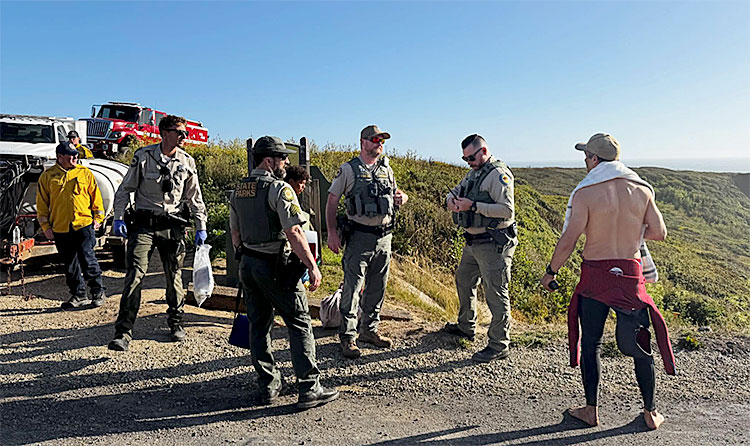
Everyone involved in the rescue gathered afterwards for the after-action review.
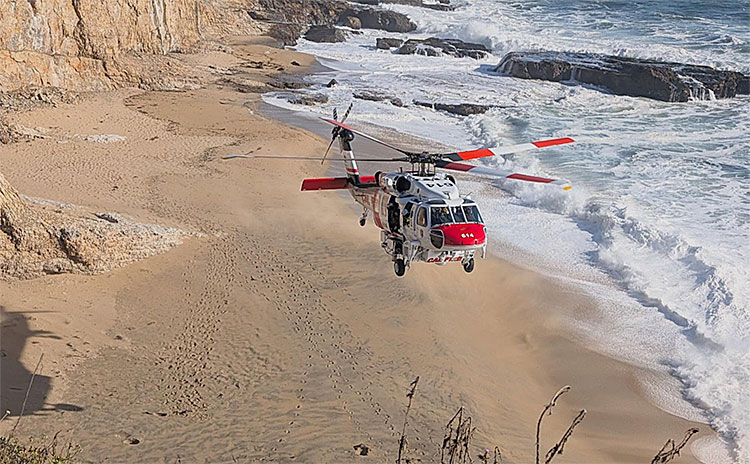
Emergency crews responded to reports of two women in the water near a rock passage known locally as the “Keyhole,” a beach access point that can become cut off by rising tides. Rescue swimmers searched the area, recovering one woman near Panther Beach and the other farther north near Yellow Bank Beach. Both were transported to hospitals following a large-scale rescue effort involving multiple agencies and helicopter support.
According to authorities, Nair died several days after the incident and Sran later died at a local hospital.
The tragedy comes amid a string of water rescues and hazardous ocean conditions along the Santa Cruz County coastline. Fire officials say the stretch of coast between Bonny Doon Beach and Yellow Bank Beach has become a recurring trouble spot where visitors can become trapped or swept into the ocean when tides and surf conditions change unexpectedly.
Over the past several weeks, local law enforcement, lifeguards and fire crews have responded to an increased number of ocean emergencies. Officials have warned that elevated temperatures, strong surf and long-period swells can create dangerous conditions even for experienced beachgoers.
One recent rescue underscores how quickly conditions can become life-threatening.
On June 12, emergency responders were called to Pescadero State Beach after two young people entered the water and one became caught in a rip current that carried the swimmer approximately 200 yards offshore. One swimmer was able to return to shore and call 911 while the other struggled in the water.
California State Parks Lifeguard Officer Moore said the 19-year-old survived in part because he avoided exhausting himself by fighting the current.
“Instead of fighting it until he was completely exhausted, he stayed on his back,” Moore said. “The current, over time, brought him back in.”
Moore said swimmers caught in a rip current should remain calm, float if possible and avoid swimming directly against the current.
“Honestly, in most circumstances, it usually ends in a drowning,” he said.
Authorities are urging residents and visitors to use extra caution as warm weather draws larger crowds to local beaches. Authorities recommend never turning your back on the ocean, watching for sneaker waves and changing surf conditions, keeping children within arm’s reach near the water, and swimming near staffed lifeguard towers whenever possible.
Officials also advise visitors to stay off rocks, jetties and driftwood near the surf zone, where unexpected waves can knock people into the water.afterwards for the after-action review.
TOP PHOTO: CAL FIRE SCU Alma Helitack Copter 614 brought one patient from the beach to the bluffs during the rescue attempt on June 10.