
By Deborah Osterberg
Campo Del Mar was a porcelain manufacturing business founded in Capitola in August 1945 by Waldemar F. Dietrich. Originally from Oregon, Dietrich was a mining engineer and metallurgist who once taught at Stanford University. He’d worked as a caster and mold maker since the age of nine, continuing in the tradition of his father and grandfather.
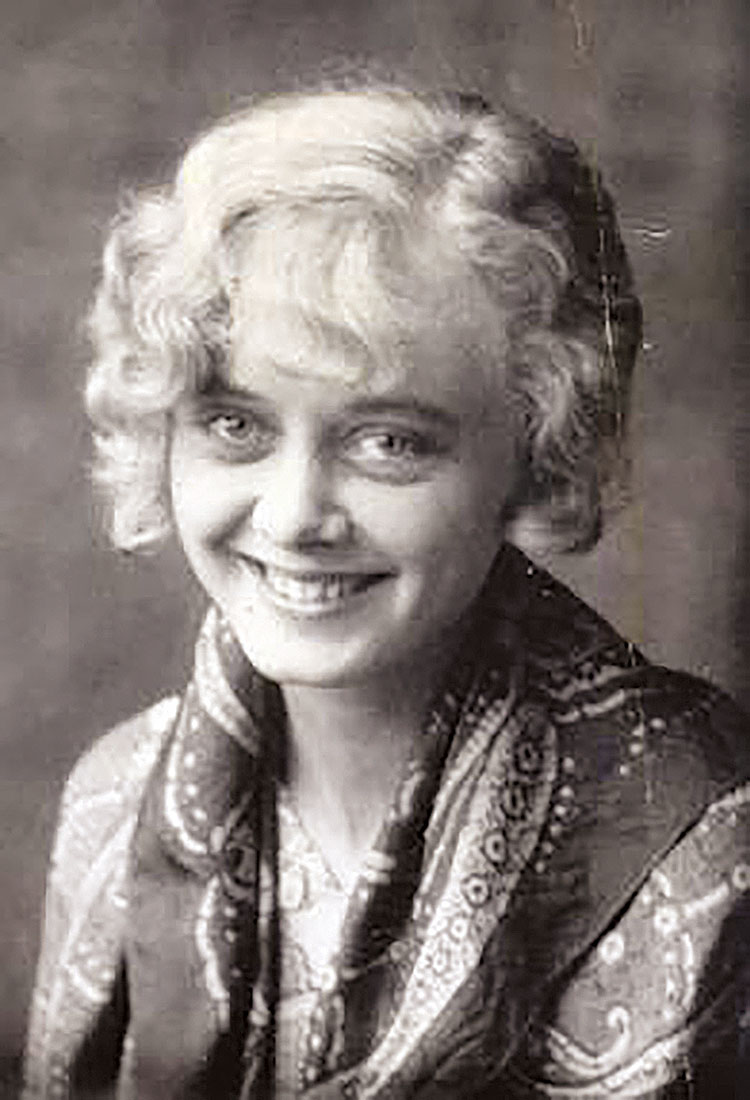
Evora Shaver, Campo del Mar supervisor of glazing. This photo courtesy of Susan Rossi, who recently donated nearly 30 pieces of her grandmother’s Campo del Mar porcelain to the museum.
The Campo Del Mar factory on Capitola Avenue was one of the few firms in the U.S. devoted to making high-grade porcelains glazed in color. Dietrich was assisted at his small factory by J.R. McKinnie who served as his production manager. It was Dietrich’s wife Grace who coined the company name. Grace said that Campo del Mar meant “site by the sea” and she came up with it after perusing a Spanish dictionary at the Santa Cruz Public Library.
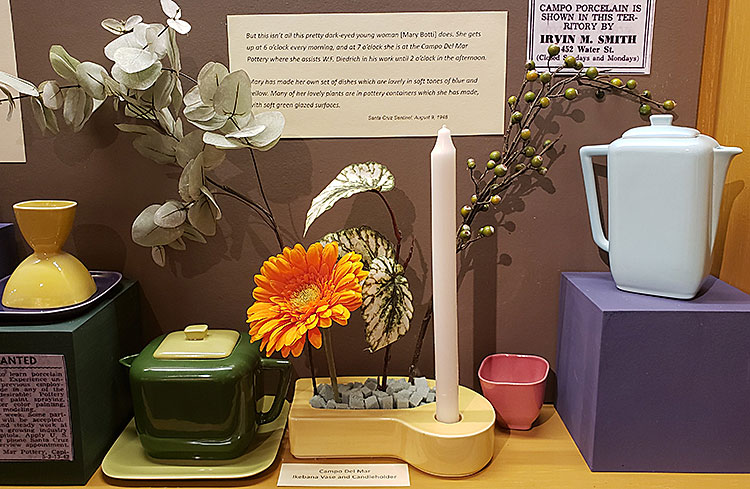
Campo del Mar produced quite fine, vividly colored porcelain. Most other pottery firms turned out white or ivory porcelain, which was a much easier process. After Dietrich molded an item into shape, it was fired to vitrification, which developed it to a white translucent body. Then he finished with various colors and re-fired. He used a gas heated kiln at a temperature of about 1200 degrees for vitrification and about 1950 degrees for the gloss fire.
Though Dietrich originally experimented with about 30 colors, he eventually decided to limit production to a select twelve shades. Dietrich noted that one of his most popular products was the ”… after-dinner demi tasse assembly sets in three color combinations. The assembly … consists of a cup, saucer, serving plate, cordial glass, individual ash tray, one-package cigarette box, match holder, and snack dish. This assembly is made in chartreuse, green, black and grey, mauve and dusty pink.”
The factory on Capitola Avenue produced porcelain after-dinner coffee sets, vases, flower arrangement bowls, ash trays, etc. The clay was imported from the eastern U.S. (Georgia, Kentucky, and Florida) and Ontario, Canada. In a 1946 Santa Cruz Sentinel interview, Dietrich stressed that his high-grade, translucent porcelain ”… products are not for mass production, and practically every piece of work is turned out in octagonal or rectagonal shape so it cannot be duplicated by mass production by anyone else after he has spent time and money designing it.”
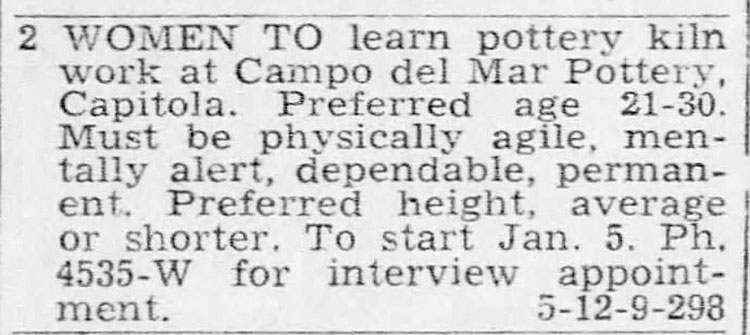
At any one time, Campo Del Mar employed about sixteen women who cast the high-grade porcelain. Mrs. Evora E. Shaver served as supervisor of glazing and Mrs.
Luise Mable Beha oversaw casting and finishing. Other employees were listed as Mrs. Frances June Howes, Mary Botti, Peggie S. McCabe, Mary Lynne Godfrey, Dama Beatrice Haskett, Dorothy Vogt, Jessie G. Rehdorf, Blanche Allison Williams, Verna Ella Lane, Mary A. Mastel, Mrs. Dora Matoush, Julie Wessenberg, and Midred Lorayne Cash.
Here are further stories of two of these women:
 Kansas native Evora Shaver, arrived in California from Wyoming in the 1940s. After her husband deserted the family, she became a single working mother. Once a schoolteacher, she went on to take government radar training at the University of Wyoming. During World War II she taught servicemen radar operation and installation in New Jersey and later at McClelland Field in Sacramento. She also contributed to the development of the Northrop P-61 Black Widow fighter plane; the first warplane designed specifically as a night fighter. After her supervisory work at the Capitola Campo del Mar factory, she worked for several years with Vetterle and Reinelt, a long-time flower nursery on Capitola Road, best known for their tuberous begonias.
Another Campo Del Mar employee was Mary Botti. Born near Capitola, as a young girl she worked for Vetterle and Reinelt. She was quite a busy lady – an award-winning member of the American Fuchsia Society and in 1948 she conducted an experimental plot for the Spreckels Sugar Company of Salinas.
•••
But this isn’t all this pretty dark-eyed young woman [Mary Botti] does. She gets up at 6 o’clock every morning, and at 7 o’clock she is at the Campo Del Mar Pottery where she assists W.F. Diedrich in his work until 2 o’clock in the afternoon.
Mary has made her own set of dishes which are lovely in soft tones of blue and yellow. Many of her lovely plants are in pottery containers which she has made, with soft green glazed surfaces.
— Santa Cruz Sentinel, August 9, 1948
•••
The Santa Cruz Sentinel reported in 1946 that there were only two retail outlets for Campo Del Mar pottery in Santa Cruz County: Irvin M. Smith in Santa Cruz and Ford’s Department Store in Watsonville.
 Despite that the fine porcelain was also available at several “swank” shops in San Francisco, Carmel, and New York, Dietrich was not anxious to increase his retail output because the demand for his product was already strong, and he felt there were “… not enough persons interested in such high-grade, non-mass-produced ware to warrant letting any more contracts in this vicinity.”
Unfortunately, the story of Campo del Mar porcelain was one that burned brightly but briefly. Mr. & Mrs. Dietrich sold the business in 1952 after he was appointed to a position with the U.S. Bureau of Mines in Washington D.C.
We at the Capitola Historical Museum are proud to have a sizeable collection of this colorful period of Capitola history. In the past we have exhibited pieces from this unique collection and plan to continue including Campo del Mar porcelain in some of our future exhibitions. Last year former Museum Board President Emmy Mitchell-Lynn and Youth Museum Board Representative Juliette Thompson volunteered with the Museum Curator in a project to rehouse the collection pieces using museum quality storage products to ensure their long-term preservation.
The admission free Capitola Historical Museum, located at 410 Capitola Avenue, is open every Friday through Sunday from noon until 4:00 p.m. through the end of December. If you have any questions, you may call the museum at 831-464-0322. n
•••
 You may view a 360-degree view of Campo del Mar porcelain on the Capitola Historical Museum website at this QR link: