
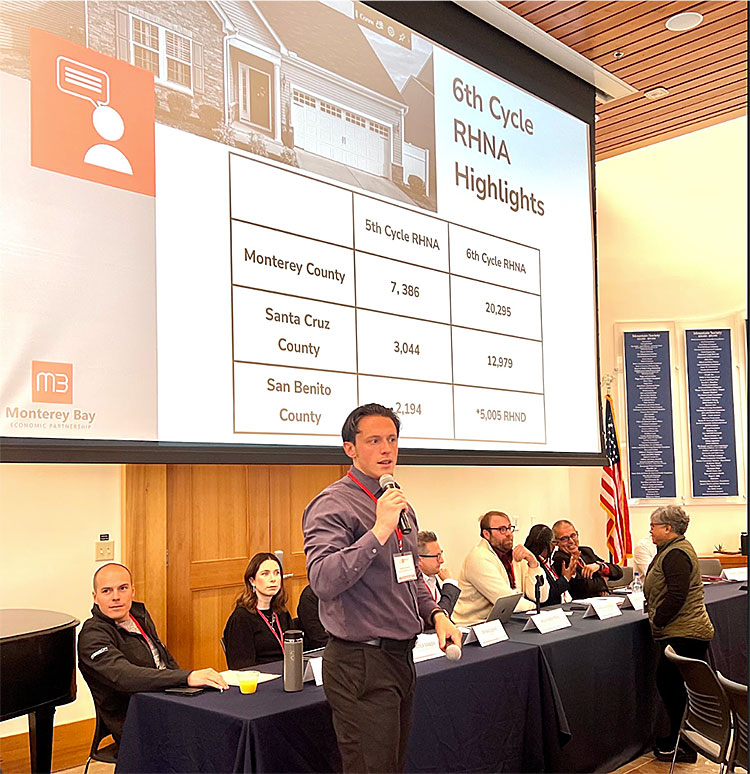
On June 27, the nonprofit Monterey Bay Economic Partnership unveiled a new white paper, “Practical Housing Policy: Increasing Supply and Affordability,” to a sold-out audience of nearly 100 people at a Housing Summit hosted by CSU Monterey Bay.
 Increasing supply and affordability of housing in the tri-county area has been a priority of the Monterey Bay Economic Partnership since 2016.
The nonprofit launched the Monterey Bay Housing Trust to fund 500 new affordable homes, implemented a farmworker housing action plan resulting in 2,200 new beds; launched the action center resulting in 2,029 new homes and produced a “blue paper” on water policies that are increasing housing production.
The nonprofit has endorsed the Water St. Apartments, 41 rentals, 831 Water St., 140 rentals, Cedar St. Apartments, 65 rentals, 111 Errett Circle, 36 homes with accessory dwellings, Pacific Front, 205 homes on Pacific Avenue, all in Santa Cruz, and Sunshine Vista, 150 homes in Watsonville.
State Housing and Community Development Department officials calculate how many new units are needed based on household projections, and here the Association of Monterey Bay Area Governments then allocates those numbers among the city and county jurisdictions.
The demands for new housing through this process have jumped statewide to the point that some local residents are resisting.
In 2022, Mill Valley resident Susan Kirsch created Catalysts for Local Control, activists who contend the state quotas as unrealistic.
Another group, OurNeighborhoodVoices.com, is organizing a campaign for a 2024 statewide ballot measure to restore the authority of local representatives to decide what gets built in your community, on your street and right next door to where you live.
The group says this initiative is supported by a statewide grassroots coalition of Californians that includes Democrats, Republicans, and independents.
The group objects to recent state laws that allow developers to build multi-unit, multi-story buildings without environmental review, or onsite parking.
Monterey Bay Economic Partnership takes another tack, coming up with ways policies could be amended to be housing-friendly.
The five policy recommendations in the latest white paper are:
- Streamline permitting and reduce discretionary reviews: Decrease risk and pre-development costs for nonprofit and for-profit developers with objective design guidelines and ministerial approval for specific, needed housing development.
- Increase allowable densities: Enable more efficient use of vacant or non-vacant land — especially in urbanized areas —through updates to zoning regulations and by optimizing height limits and density calculations.
- Reform & defer impact fees: Scale fees by square footage rather than per housing unit to incentivize more units per development. Collect impact fees as a requirement for issuing the certificate of occupancy, rather than earlier in a project’s timeline, to reduce risk and financing costs to the developer.
- Increase funding sources for affordable housing: Thoroughly explore funding resources – from the local to state and federal levels – and partnerships to increase financing options and affordable production. Partner with local agencies to identify potential sites.
- Optimize Inclusionary Housing Ordinances: Maximize incentives by offering additional density bonuses, impact fee deferral or reductions, or other concessions to increase developments with inclusionary components. If the required percentage of affordable housing is too high, it can be a disincentive to developers.
•••
To read the white paper, see: https://tinyurl.com/MBEP-practical-housing.
Top Photo: Summit attendees saw the state demands for new homes in Santa Cruz County: 3,044 for 2015-23 vs. 12,979 for 2023-2031.