
By Jon Chown
SEASIDE — Artificial intelligence is likely to reshape the workplace gradually rather than cause the immediate collapse of white-collar employment that some have predicted, economist Erika McEntarfer told regional leaders recently during a conference on AI.
“My personal forecast is that we’re looking at normal economic disruption,” McEntarfer said during the Monterey Bay Economic Partnership’s “AI & the Future of Our Region” summit at California State University, Monterey Bay.
 McEntarfer, a research scholar and distinguished policy fellow at the Stanford Institute for Economic Policy Research, served as commissioner of the U.S. Bureau of Labor Statistics from 2024 to 2025. She has been studying recent research on AI’s effect on employment, wages and productivity.
She stressed that transitioning to AI will take time. New technology has changed how business is done many times, and it has always been a fairly slow transition, even when the discovery was monumental, such as electricity. Artificial intelligence, she said, may make transition easier, but it still will take time.
“It is very hard — and I say this as an ex-CEO — to do structural change of your organization around a radical move, especially around a radical new technology,” she said.
Organizations will have to retrain workers and change established procedures before they can use AI broadly, she said. That process may be easier for a small startup than for a large organization operating with old computer systems and deeply rooted practices. The evidence so far points more toward stability than widespread job destruction, she said.
“No matter how you have the data, if you look at unemployment, if you look at employment, if you look at specific occupations, what the data largely paint a picture of is stability rather than disruption,” McEntarfer said.
Researchers have looked closely at occupations considered particularly vulnerable to AI, including software development and customer service. McEntarfer said employment and unemployment trends in those fields do not differ greatly from the broader cooling of the labor market.
Software development is an important test case because AI adoption is relatively advanced in the technology industry and many programming tasks can be performed with AI assistance, she said. Still, employment has remained fairly stable, and job openings for software developers increased faster than openings in many other occupations during the past year.
Companies spending the most on AI also are not generally shrinking their workforces, she said.
“They are growing,” McEntarfer said.
One reason the technology has not produced wider economic effects is that business adoption remains limited and uneven. McEntarfer said about one in five businesses uses AI in some capacity, with adoption concentrated among technology and professional-service companies.
Use remains much lower in industries such as restaurants and construction, which collectively employ large numbers of workers. Even many businesses using AI have introduced it in only a few parts of their operations, she said. And thepace of adoption is moving more slowly than the capabilities of AI models. Businesses are still trying to determine how the technology can produce a return on their investment.
She also cautioned that the absence of widespread job losses today does not mean disruption will not occur.
“Just because we’re not seeing a ton of disruption yet doesn’t mean disruption isn’t coming,” McEntarfer said. “It just means that right now we don’t appear to be on the path of an immediate collapse in white-collar jobs that was forecast as little as two years ago.”
The form that disruption will take remains uncertain, she said.
A gradual transition would give workers and institutions more time to respond. Students could adjust their choice of degrees, universities could change their programs, employers could reconsider their staffing needs and workers could learn new skills.
“This is something that’s not new,” McEntarfer said. “We have had technological change for hundreds of years. This is how it works.”
A faster transition could be far more damaging, she said, particularly because programs intended to support unemployed workers may not replace enough income for people displaced from higher-paying occupations. For instance, she said a programmer making $170,000 annually would make just $17,000 on unemployment.
“If it happens very, very fast, it might be hugely disruptive in a way that would be harder to adjust,” McEntarfer said.
The summit brought together business executives, public officials, researchers and technology leaders from throughout the Monterey Bay for discussions about jobs, public policy, elections, misinformation, privacy and education. Kory Asfour, who works for Santa Cruz County’s Information Services Department, was one of many taking notes and asking questions.
“It’s a complicated discussion,” he said.
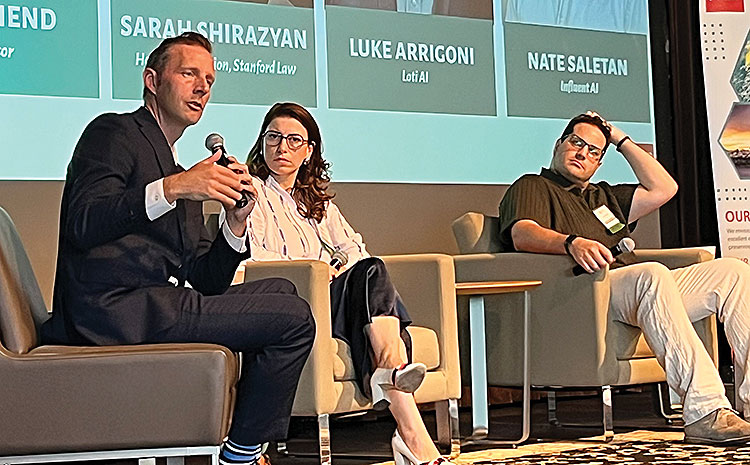
There were three panels at the conference with former Santa Cruz County Supervisor Zach Friend moderating. The first panel discussed what’s coming with AI, another discussed AI and politics, and a third looked at how it will affect jobs and the workforce.
Sarah Shirazyan, a Hoover Institution research fellow and Stanford Law lecturer, said schools face difficult choices over students’ use of AI. A ban in public schools could deepen inequality if private-school students learn to use tools that employers increasingly expect workers to understand, she said.
Donnie Fowler, OpenAI’s head of U.S. state policy and partnerships, discussed privacy and government access to personal information. The threat of mass surveillance and abuse is very real. Companies supplying AI-powered surveillance systems need controls that can detect and audit abuse as it happens, not merely rules intended to prevent it, or methods to discover abuse if it is suspected.
“At the end of the day, the opportunities for abuse in companies like this are tied to the humans that have access to them and the controls that are in place. And there›s a responsibility that platforms have to provide these technologies to have controls in place to not just prevent incidents, but also to tackle them on a healthy level,” he said. “Something that’s really doing this actively, not passively.”
TOP PHOTO: Zach Friend moderates a panel including Sarah Shirazyan and Luke Arrigoni.