
By Jondi Gumz
On March 9, Santa Cruz County Health Services Agency issued guidelines for “social distancing” effective through March 22 to prevent spread of the coronavirus COVID-19.
 One key recommendation is to cancel non-essential gatherings of 50 people or more, such as concerts, sporting events, conventions, and community events including religious services. For events not cancelled, the county recommends having hand-washing capabilities, hand sanitizers and tissues available, frequently cleaning commonly touched surface areas like counter tops and handrails and finding ways to create physical space to minimize close contact.
The Santa Cruz County Business Expo, which attracts 1,500 people each year, will go on March 11 at the Coconut Grove in Santa Cruz, according to the Santa Cruz Chamber of Commerce, the sponsoring organization, with hand sanitizer, a hand-shake ban and advice to stay an arm’s length from one another.
Moreover, families should prepare for school closures.
What follows is the recommended guidance from the county:
•••
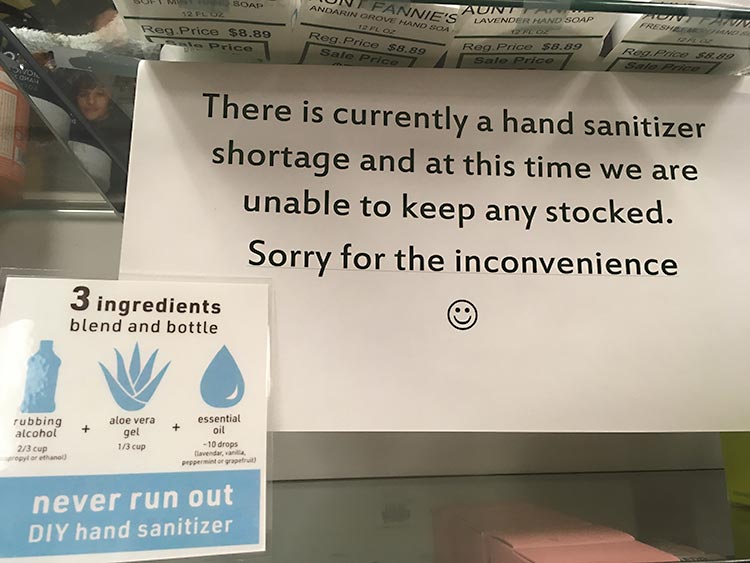
Aptos Natural Foods posted a recipe for do-it-yourself hand sanitizer since the store is out of stock. • Photo credit Jondi Gumz
COVID-19 needs people to spread. Although these measures will cause disruption to the local economy and our daily lives, they are intended to interrupt and slow the spread of the virus and protect overall community health. By limiting opportunities for transmission, we can slow its spread.
Each of us must do our part to protect our older citizens and vulnerable individuals at risk of serious outcomes should they be exposed. These recommendations have been made in consultation with the California Department of Public Health, based on the best information we have at this time. They are also in line with actions taken by other counties and states with community spread of COVID-19.
Vulnerable Populations: Limit Outings
- People who are 60 years of age and older. The risk increases significantly thereafter and escalates with age, with persons over age 80 in the highest risk category.
- People, regardless of age, with underlying health conditions including cardiovascular disease, diabetes, cancer, heart disease, or chronic lung diseases like COPD, as well as those with severely weakened immune systems.
- For vulnerable populations, don’t go to gatherings (of about 50 people or more) unless it is essential. Avoid people who are sick.
Workplace and Businesses: Minimize Exposure
- Reduce nonessential, work-related employee travel.
- Minimize the number of employees working within arm’s length of one another, including minimizing or canceling large in-person meetings and conferences of about 50 or more.
- Urge employees to stay home when they are sick and maximize flexibility in sick leave or other leave benefits.
- Do not require a doctor’s note for employees who are sick.
- Consider use of telecommuting options.
- Some people need to be at work to provide essential services of great benefit to the community. They can take steps in their workplace to minimize risk.
Large Gatherings: Cancel Non-essential Events
- Recommend cancelling or postponing large gatherings of about 50 or more, such as concerts, sporting events, conventions or large community events.
- Do not attend any events or gatherings if sick.
- For events that aren’t cancelled, we recommend having hand washing capabilities, hand sanitizers and tissues available, frequently cleaning commonly touched surface areas like counter tops and handrails, finding ways to create physical space to minimize close contact as much as possible.
- See California Department of Public Health Mass Gatherings Guidance March 7, 2020.
Schools: Safety First
- If there is a confirmed case of COVID-19 at a school, the Santa Cruz County Public Health Division will work with the school and the district to determine the best measures, including potential school dismissal.
- Do not go to school if sick.
- If you have a child with chronic health conditions, consult your doctor about school attendance.
- Equip all schools and classrooms with hand sanitizers and tissues.
- Recommend rescheduling or cancelling medium to large events that are not essential. • Recommend cancelling field trips.
- Explore remote teaching and online options to continue learning.
- Families should prepare for potential closures.
Public and Commercial Transportation: Cleaning and Protection
- Increase cleaning of vehicles paying special attention to commonly touched surface areas. • Provide hand washing supplies in stations and hand sanitizers and tissues in vehicles.
Health Care Settings: Avoid as possible, protect the vulnerable
- All health care facilities including long term care facilities, must have a COVID-19 plan in accordance with CDPH guidelines.
- All health care facilities, including long term care facilities, must screen all staff and visitors for illness and turn away those with symptoms.
- The general public should avoid going to medical settings such as hospitals, nursing homes and long-term care facilities. If you are ill, call your health care provider ahead of time, and you may be able to be served by phone or receive other instructions.
- Do not visit emergency rooms unless it is essential.
Everyone: Do your part
The best way for all community members to reduce the risk of getting sick, from many illnesses including colds, flu and COVID-19 are:
- Wash hands frequently with soap and water for at least 20 seconds.
- Cough or sneeze into the crook of your elbow, not your hand, or use a tissue and discard.
- Stay home if you are sick.
- Avoid touching your face.
- Avoid shaking hands.
- If you have recently returned from a country, state or region with ongoing COVID-19 infections, monitor your health and follow the instructions of public health officials.
There is no recommendation for healthy people to wear masks to prevent themselves from getting sick. You can also prepare for the possible disruption caused by an outbreak. Preparedness actions include:
- Prepare to work from home if that is possible for your job, and your employer.
- Make sure you have a supply of all essential medications for your family.
- Prepare a childcare plan if you or a caregiver are sick.
- Make arrangements about how your family will manage a prolonged school dismissal.
- Plan for how you can care for a sick family member without getting sick yourself.
- Take care of each other and check in by phone with friends, family and neighbors that are vulnerable to serious illness or death if they get COVID-19.
- Keep common spaces clean to help maintain a healthy environment for you and others. Frequently touched surfaces should be cleaned regularly with disinfecting sprays, wipes or common household cleaning products.
•••
For general information on COVID-19 call 211, or text coronavirus to 211211, or visit www.santacruzhealth.org/coronavirus for updates and links to state and federal guidance.
Here are some more information sources:
Health Professionals: www.cdc.gov/coronavirus/2019- nCoV/hcp/index.html
Schools and Communities: www.cdc.gov/coronavirus/2019- ncov/community/index.html?CDC_AA_refVal=https%3A%2F%2Fwww.cdc.go v%2Fcoronavirus%2F2019-ncov%2Fpreparing-individuals-communities.html
Higher Risk: www.cdc.gov/coronavirus/2019-ncov/specific-groups/index.html
California Department of Public Health: www.cdph.ca.gov