
By Jon Chown
Santa Cruz County is drafting an ordinance on battery energy storage systems that creates a timeline in which a new facility proposed for Minto Road near Watsonville could be approved by the end of 2026.
Battery energy storage systems allow solar and wind energy to be stored and used later — helping stabilize the electrical grid, lower energy costs and reduce greenhouse gas emissions. The new ordinance will guide how and where these systems can be built in unincorporated Santa Cruz County. Named the Energy Storage Combining District Ordinance, it defines eligible sites, safety and environmental requirements, application procedures, and oversight responsibilities. It includes environmental review to assess potential risks, public review and hearings for proposed projects, and mandates regular updates on safety research and technology improvements.
According to county documents, the ordinance will ensure that any energy storage facility proposed in the community meets the highest standards for safety, environmental protection and local oversight. It will help ensure public and firefighter safety, minimize environmental and neighborhood impacts, and prevent the construction of outdated systems such as the Moss Landing facility that caught fire in January. A draft of the ordinance will be presented to the board on Nov. 18. Public hearings on the ordinance are slated for the summer of 2026, with final adoption not scheduled until the fall of 2026, and a review of any proposed project before the end of 2026.
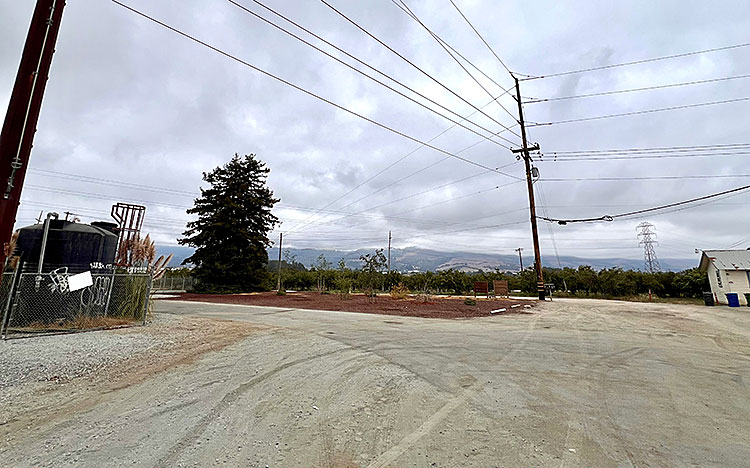
Meanwhile, New Leaf Energy is proposing to develop a 200-megawatt BESS project on 14 acres that would connect to the PG&E substation on Minto Road. About 300 containers, each with 40 batteries inside, would be placed several feet apart. Each would have its own fire-suppression system. A rubber bladder would be placed underneath the entire site to prevent any liquids from leaking into College Lake. Once the permits are in place, the project would likely be sold to PG&E or another entity to build and operate, said New Leaf Energy Project Lead Max Christian.
“It’s a great opportunity for the county to get improved grid benefits,” Christian said. “Your county will be able to meet its climate goals, there’s revenue that would go to schools … a lot of benefits.”
Fire Resets Conversation
The county originally started a draft BESS ordinance in October 2024, with approval expected by the summer of 2025, but on Jan. 16 a fire engulfed the Vistra BESS plant in Moss Landing.
Hundreds of lithium batteries, sitting adjacent to each other in an old warehouse, caught fire, resulting in evacuations in Moss Landing and neighborhoods nearby. A hazardous plume of smoke drifted north into Santa Cruz County.
Monterey County, with the assistance of the Environmental Protection Agency and other federal, state and regional agencies, continues to collect environmental data on the fire. Soil and water testing has shown some increased levels of heavy metals as far north as Watsonville, but mostly not at high enough levels to be deemed a health risk. Just three of 108 soil samples showed unsafe levels for battery-related metals, including aluminum, cobalt, copper, lithium, manganese or nickel.
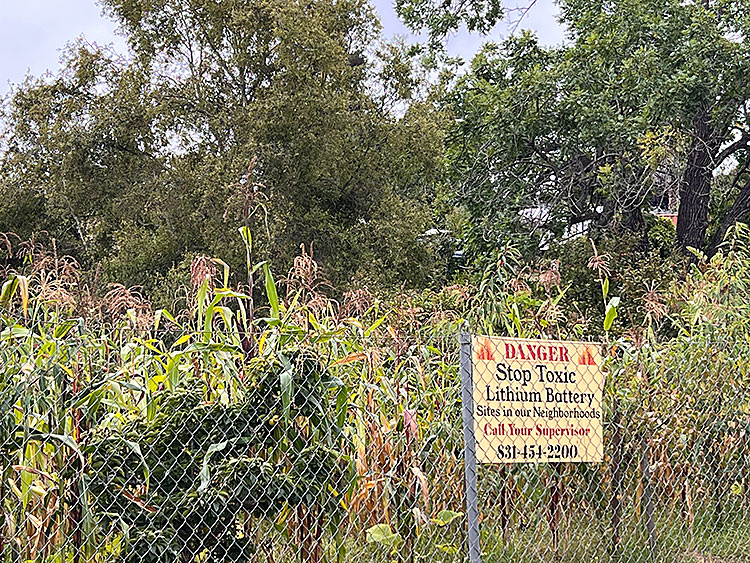
Signs have gone up all around Watsonville opposing the BESS facility.
Traces of lithium were found in the drinking water, but not at levels deemed unsafe by the EPA. Barium, chromium, cobalt, nickel, vanadium and zinc were found in surface water samples taken nearby, but the levels of barium and nickel were deemed safe for human recreational water activities, including ingesting water or eating aquatic organisms. There apparently aren’t established measures of safe exposure for the other metals, though they are not entirely safe. For instance, there is no universal toxic level for exposure to cobalt, but it can cause allergic reactions if it touches the skin and can cause lung disease if inhaled. Vanadium is found naturally in rocks and soil, and also in mushrooms and grains. However, too much of it, which varies by the individual, is toxic.
Monterey County supervisors have since put a temporary moratorium on any new BESS facilities in the county. On Oct. 28, Supervisor Glenn Church, whose district includes Moss Landing, introduced the proposed halt while safety and regulatory issues are studied further.
A Bump on the Road to Minto
Santa Cruz County’s draft ordinance would not allow a facility similar to the Vistra plant in Moss Landing. Among its requirements are 1,000-foot setbacks from sensitive sites such as schools or residential care facilities and that batteries be stored in single-use buildings or containers, or be located outdoors. It also restricts the use of nickel manganese cobalt chemistry, requires continuous monitoring, and consultation with the local fire district before it is built.
A BESS site requires at least 10 acres of land located outside the coastal zone and must be adjacent to an existing electrical substation. There are only three sites in the county that meet these criteria: one on Houts Drive behind Dominican Hospital, another on Freedom Boulevard not far from Aptos High School, and one on Minto Road outside Watsonville. The draft ordinance leaves Minto Road as the only possible site, and nothing it requires would force any significant changes to the BESS project that New Leaf Energy is proposing. The city of Watsonville has taken notice.
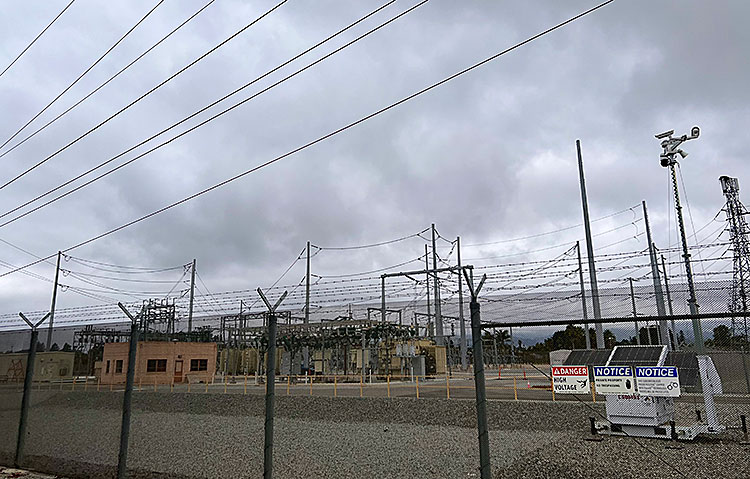
The BESS facility would connect to the PG&E substation on Minto Road.
On Oct. 14, Christian made a presentation on the proposed Minto Road project to the Watsonville City Council. The reaction was probably not what he hoped for. At the next City Council meeting, Council Member Ari Parker suggested the city draft a letter to the county about the project, and the rest of the council agreed. That letter, expressing the community’s concern and requesting input from the city before any approval of a project on Minto Road, was drafted and approved on Oct. 28.
“People are really upset about it here in South County,” Parker said in a phone interview nearly two weeks after the letter was sent.
Parker said the final ordinance should have requirements for the operator of any BESS project to fund HAZMAT and fire operations nearby. Perhaps a fire department substation could even be required. Regular funding for such things, not just a one-time payment, should be required.
“But if they don’t put things in there that would require that, it could be a problem,” Parker said. “If the local ordinance doesn’t say you need to fund the local fire municipalities, I fear it won’t happen. Watsonville should have regular funding as long as it has this installation. I mean, $2 million is nothing to PG&E.”
PG&E’s budget for 2026 is just under $15 billion.
Another factor in the timeline is that the disaster prompted state legislation — AB 205. Sponsored by Sen. John Laird, the law adds regulations for BESS projects but also allows the California Energy Commission to override local rules with findings of public convenience and necessity. If local regulations are not in place, developers can apply directly to the state. Christian has said that a lengthy delay would add burdensome costs to the project that could sink it. Huge sums of money are required to keep the project’s spot in line to get on the state’s electrical grid, which has to be guaranteed beforehand in order for the project to move forward.
“The county delaying the ordinance, that puts us in a bind,” Christian said in September. He said at that time that if an ordinance was not in place by August, his company might have to move forward without local input.
Meanwhile, the county’s draft ordinance asks the Board of Supervisors for approval to move forward with environmental review of the proposal at 90 Minto Road, and once the supplemental EIR is completed, hearings at the Planning Commission. According to the draft ordinance, county staff anticipates a year’s worth of work to complete this process, with the supplemental EIR process in the first half of 2026 and adoption public hearings in the second half of 2026.
The proposal at 90 Minto Road would not move forward to public hearings for approval until after the supplemental EIR is completed and the ordinance is adopted in late 2026.
Parker said she fears a disaster will eventually follow any completed project at Minto Road.
“Don’t tell me ‘if it’s going to happen,’ it’s ‘when it’s going to happen,’” she said. “This is about our homes, our land, our air. I think this draft ordinance is not as tough as it needs to be.”
TOP PHOTO: A BESS facility proposed for Minto Road near Watsonville could replace the apple orchard near the end of the street.