

By Colin Lecher and Miles Hilton © Calmatters.org
The California Privacy Protection Agency kicked off 2026 by launching a tool that state residents can use to make data brokers delete and stop selling their personal information.
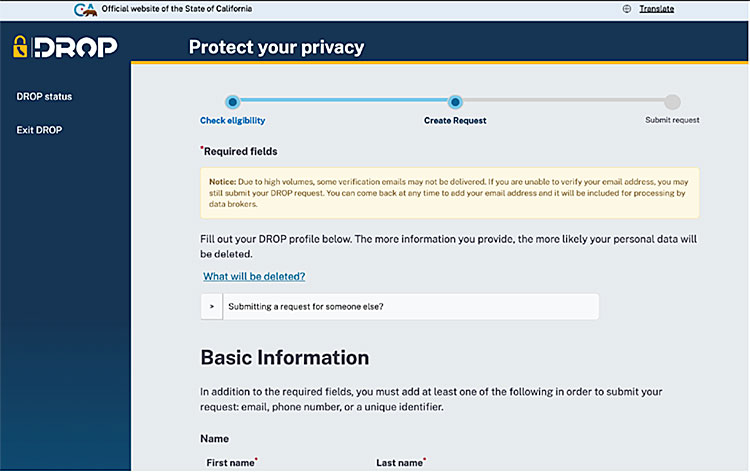 The system, known as the Delete Request and Opt-out Platform, or DROP, has been in the works for years, mandated by a 2023 law known as the Delete Act. Under it and previous laws, data brokers must register with the state and enable consumers to tell brokers to stop tracking them and selling their information.
Until now, those instructions had to be delivered to each data broker individually — not an easy feat, given that more than 500 brokers were registered in the state as of the end of last year. Making things even more difficult, some brokers obscured their opt-out forms from search results.
The new system delivers privacy instructions to every registered broker at once. Launched on Jan. 1, it is open to all California residents. By law, the hundreds of data brokers registered with the state must begin processing those requests in August.
Here’s how to take advantage of it:
Finding Your Advertising IDs
DROP asks you to provide some basic information — your name, email address, phone number, and zip code — so data brokers can find you in their systems.
You can submit the form with just this information, but if you’d like a more thorough deletion, you can also provide your mobile advertising IDs from your phones, smart TVs, and vehicles.
Including these IDs can help brokers match more of your data, but you have to take the time to collect them.
Verify Your Identity
Go to the DROP website. You’ll be asked to accept the terms of use and be directed to a page that asks you to prove you’re a California resident. There are two ways to do so, and you can’t change methods once you’ve selected one of them.
ONE: The system allows you to verify your identity using personal information through a system called the California Identity Gateway.
If you select this option, you’ll be asked to provide some basic personal information, like a phone number, email address, California address, or your social security number. The gateway will use this information to attempt to verify your residency directly with the state.
This option should be quick if you have an email address and phone number.
TWO: Alternatively, you can verify your identity to DROP using login.gov, a system that some federal and state agencies in the United States have adopted to allow residents to interact with government services.
To sign up for a login.gov account, you’ll be asked to provide an email address, create a password, and provide photos of government-issued identification.
After signing up and verifying your identity, you should be able to move on to the next step.
This option might take a little more effort than the first option, since ID is required, but might be faster if you’ve already signed up for an account for other purposes.
Fill Out and Submit the DROP Form
After verifying your identity, you’ll get to a form where you can submit multiple versions of your name, up to three zip codes, up to three email addresses, up to three phone numbers, advertising IDs from your mobile devices and smart TVs, and VINs for your vehicles.
You’ll be asked to verify your email addresses and phone numbers with single-use codes before submitting. (The agency notes there may be delays with some verification codes due to high volume.)
Once you submit the form, you’ll get a unique DROP ID to check the status of your request.
What Happens Now?
Sit back and wait. While the window for making DROP requests has opened, data brokers registered with the state aren’t required to handle them just yet.
On August 1, brokers will begin processing the requests.
Starting then, companies have 45 days to process requests and 90 days to report back on how they handled requests. If they fail to do so, the companies can face financial penalties.
In the meantime, you can monitor the status of your request with your DROP ID.
At some point later in the year, when you log in the system should tell you whether your data was successfully deleted, whether records on you weren’t found, or whether companies believed the data was exempt from deletion under the law, which provides some limited ways for brokers to hold on to data.
If you find more information while you’re waiting for your request to be processed, like a new mobile advertising ID, you can update your request with that information, increasing the odds you’ll successfully get your data deleted.
•••
DROP Website: https://consumer.drop.privacy.ca.gov