
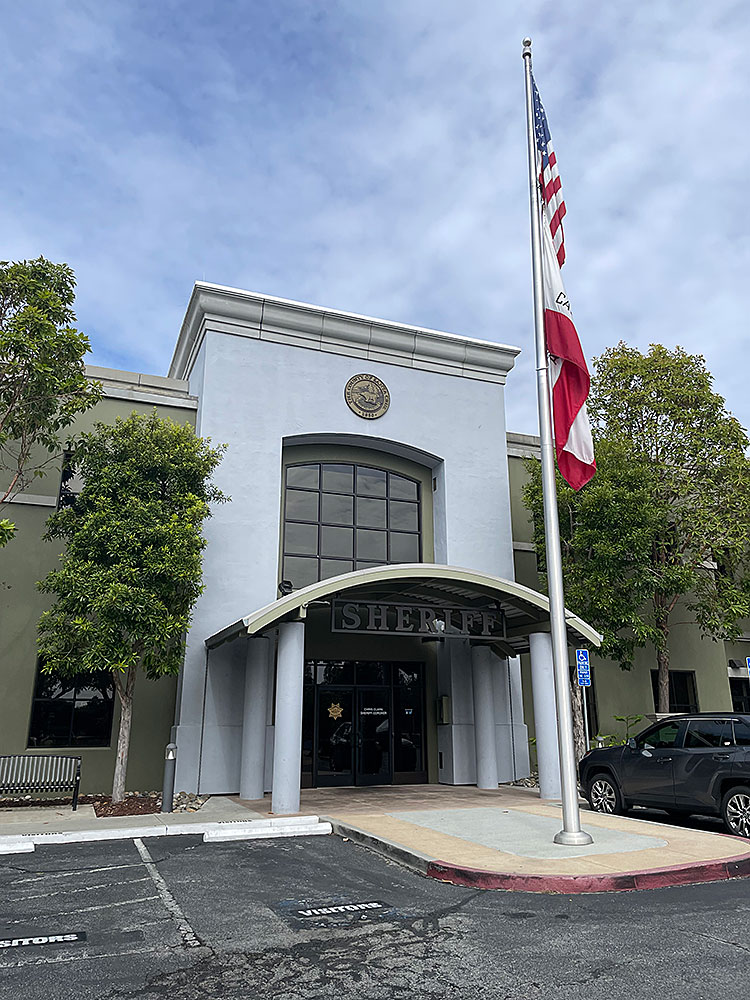
By Tad Stearn
The Santa Cruz County Sheriff’s Office deployed its inventory of military equipment more than 100 times in 2025 while responding to a wide range of incident calls.
Situations that warranted the use of this equipment included missing persons and felony suspect searches, bomb threats, and confronting armed suspects, as well as more mundane uses such as accident scene investigations and event security.
The department also invested over $124,000 in staff training associated with the specialized equipment. Only one item, an Unmanned Aircraft System/Unmanned Aerial Vehicle (UAS/UAV system), is scheduled to be added to the inventory in 2026.
Those are some of the takeaways from the 2025 AB 481 Annual Report on Military Equipment Acquisition and Use recently released by the Sheriff’s Office. The report’s findings were also presented by Lieutenant Dee Baldwin and Chief Deputy Daniel Freitas at a required public meeting on the evening of April 22 in the Sheriff’s Office Community Room.
Reporting due to AB 481
California Assembly Bill 481 (AB 481), effective as of Jan. 1, 2022, requires local law enforcement agencies to obtain approval from their governing body prior to the funding, acquisition or use of “designated military equipment.” The Santa Cruz County Board of Supervisors approved a local ordinance and Military Equipment Use Policy in April 2022 consistent with this statute.
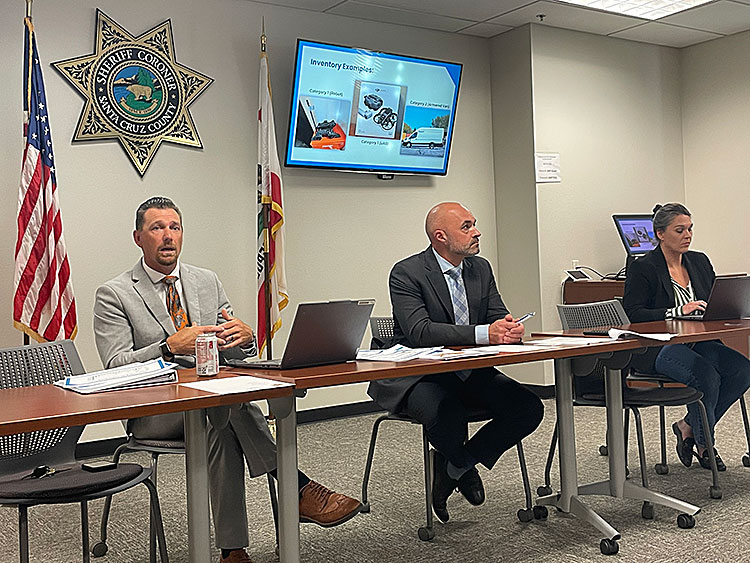 AB 481 also requires the Sheriff’s Office to submit an annual report summarizing the quantity, use and deployment, costs, training commitments and other information related to each piece of military equipment, as well as the quantity and type of equipment the agency intends to acquire in the coming year.
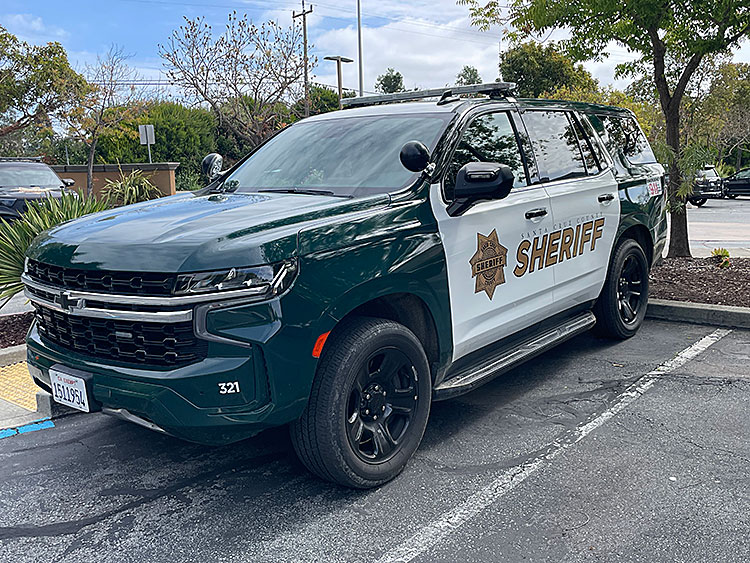
Under AB 481, “military equipment” refers to 15 specific categories of high-tech, high-caliber, or tactical gear. In Santa Cruz County, the Sheriff’s Office has acquired an array of equipment in recent years meeting that definition including robots, UAS/UAVs (specialized drone systems), armored vehicles, command and control vehicles, specialized firearms and ammunition, flash bang devices, tear gas, pepper ball launchers, and “less lethal” weapon platforms such as bean bag guns.
In addition to the direct costs of aquisition, the Sheriff’s Office also incurs the cost of maintenance and ongoing staff training on each class of equipment. In 2025, the two types of equipment requiring the most training were the inventory of 92 Patrol AR-15 rifles (requiring 861 staff hours at a cost of $53,000) and UAS/UAVs (resulting in 369 hours of training at a cost of just over $22,000).
The AR-15s were only recently added to the Sheriff’s military equipment list, in direct response to public concerns voiced during last year’s reporting process.
Military Equipment and Public Concerns
Military-style equipment in law enforcement agencies has become more commonplace in recent years, primarily through federal programs like the “1033 Program” which distributes surplus Department of Defense inventory. This equipment is intended to assist with anti-drug, counterterrorism, and gang enforcement efforts at the local level. Post-9/11 security policies and the perceived need for more firepower in high-risk situations (such as narcotics raids and active shooters) have also accelerated this trend nationwide in agencies large and small.
 While this equipment can provide law enforcement with additional response options and can potentially save lives, this proliferation can also be met with pushback at the community level. Concerns voiced locally at the April 22 public meeting included the tracking and control of weapons and their use, the fear of potential use of equipment against citizens and protesters, the potential for increased public surveillance and the general perception of increased law enforcement militarization.
When asked specifically about the increased use of drones and drone technology, Chief Freitas and Lt. Baldwin explained that the Sheriff’s drone systems are not used for patrols or public surveillance, and that newer vehicles “have been found to be incredibly valuable in searching for missing people, hiding suspects and investigating major collisions. We will continue to improve that program.” Baldwin explained that the new drone system currently in the purchasing process, made by San Mateo-based Skydio, will be more compliant with FAA regulations because it is made in the United States.
One of the attendees of the April 22 meeting was Lee Brokaw, a Vietnam-era veteran, member of the Police Accountability Committee of the local chapter of the American Civil Liberties Union, and no stranger to the Sheriff’s Office and the AB 481 reporting process. “Because of 481 we know things we’ve never known before. We had to fight to get the Sheriff to list the assault rifles. We’ve been trying to get them to do better,” he said.
As a law enforcement watchdog, his concerns revolve around transparency and the oversight of military weapons at the local level. “I don’t care about the cars or command vehicles” said Brokaw. “I’m concerned about how they use their weapons. Weapons scare the (expletive) out of people.”
In response to the issue of tracking the County’s military equipment, including the AR-15 rifles, Lt. Baldwin explained how they are now using technology for that task. “We’re documenting every use of those rifles throughout the year. Early in January of 2025 we created a scannable barcode system with a sticker that goes on every piece of 481 equipment we have, to track the use, deployment and training associated with that equipment”.
Despite some of these specific concerns, several members of the public, including Brokaw, were also generally appreciative of efforts made by the Sheriff’s Office.
“Your reporting is voluminous. But the fact that it’s there puts you in a unique category (compared to other law enforcement agencies). So thank you very much for that,” Brokaw said.
•••
The 2025 AB 481 Annual Report can be found on the Sheriff’s Office website at: 2025 AB481 Annual Report.pdf