
By Joe Ortiz
Artists are notorious for creating games, exercises, physical challenges (self-imposed or accidental) for themselves, all of which can spur creativity.
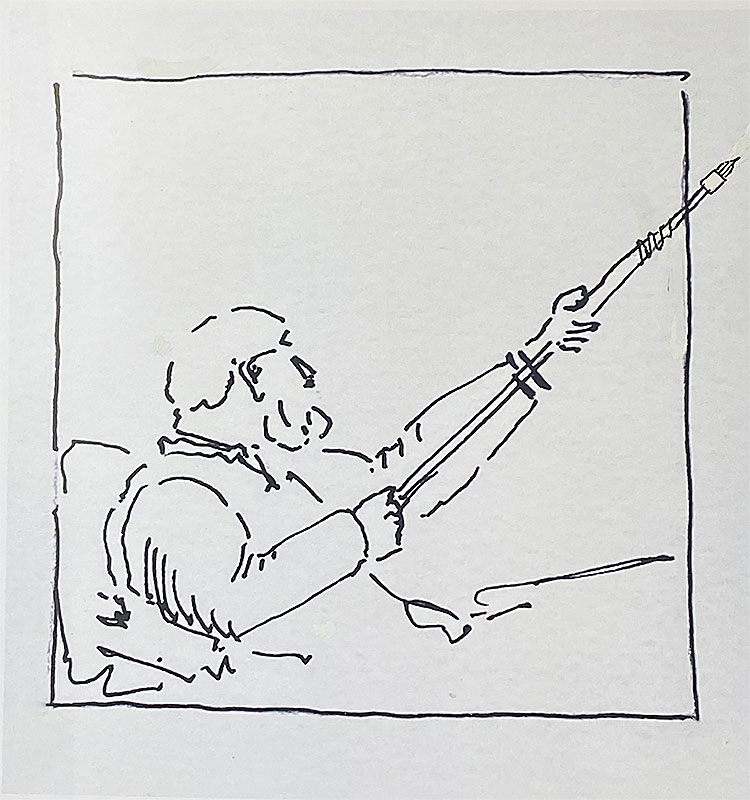
Betty Edwards mentions many of the methods in her book, Drawing on the Right Side of the Brain: Monet’s long stick attached to a brush, for example. Or drawing without lifting the pencil from paper. Or drawing a likeness from a photograph that’s been turned upside down. Many of these exercises help to foster a loss (or limitation) of the artist’s control.
 There’s a reason artists brushes have long handles. If one holds a brush down toward the bristles like a pencil, control can become stilted. But if the artist holds the brush from the long end, control is de-emphasized. The wrist becomes engaged and physical gesture is enhanced.
This helps allow for the individualism of an artist’s “personal thumbprint.” Such accidents that can happen help promote fluid expression.
They lead us to the modern concept we see in all art forms, those impromptu gestures which help show the artist’s vulnerability, adding an emotional quality to the finished work, whether it’s in a singer’s interpretation of a song or a painter’s unique (yet less-than-perfect) style.
For example, long handled brushes allow a painter to stand back from the work, an aid in fostering simplicity. Control becomes less precise.
The texture and give of the canvas are also aids to composition, technique, expressiveness. The play of canvas promotes spontaneity, synthesis (combining of elements rather than an emphasis on detail) and helps the artist avoid a too-precise attention to minutiae. It fosters the happy accident, the uneven yet expressive line.
WHAT WE CAN LEARN: Loss of control can be a good thing. Art techniques can be a dichotomy. We place ourselves in positions of some mechanical (or mental) system in order to escape into a spontaneous moment.
Edwards hints at why this happens.
Our left brain wants to control and create a safe zone for something predictable, but this very restriction forces the Right Brain to step in (perhaps the left brain becomes bored or too restricted) and solve the Creative Problem.
It’s easy to say, “don’t fight it,” but hard to accomplish. Facing the structures—and perhaps even fighting their limitations—can offer the right brain opportunities to perform its unrestrained magic.
•••
Reader response: I’d love to hear your comments and questions. Email me at [email protected]